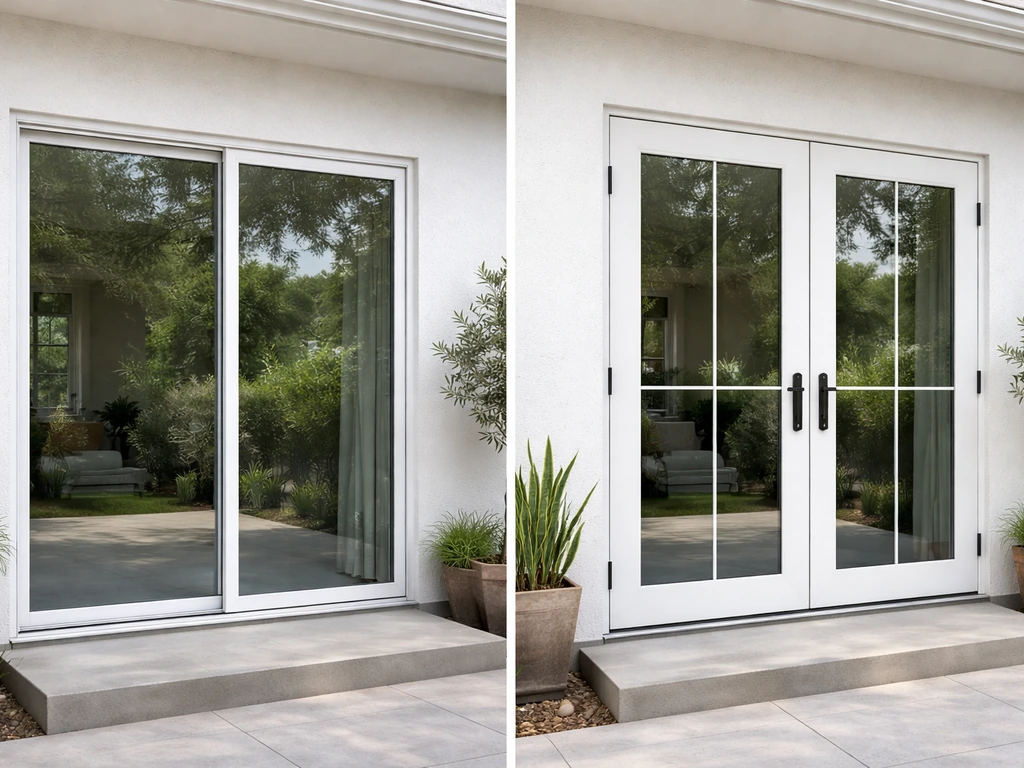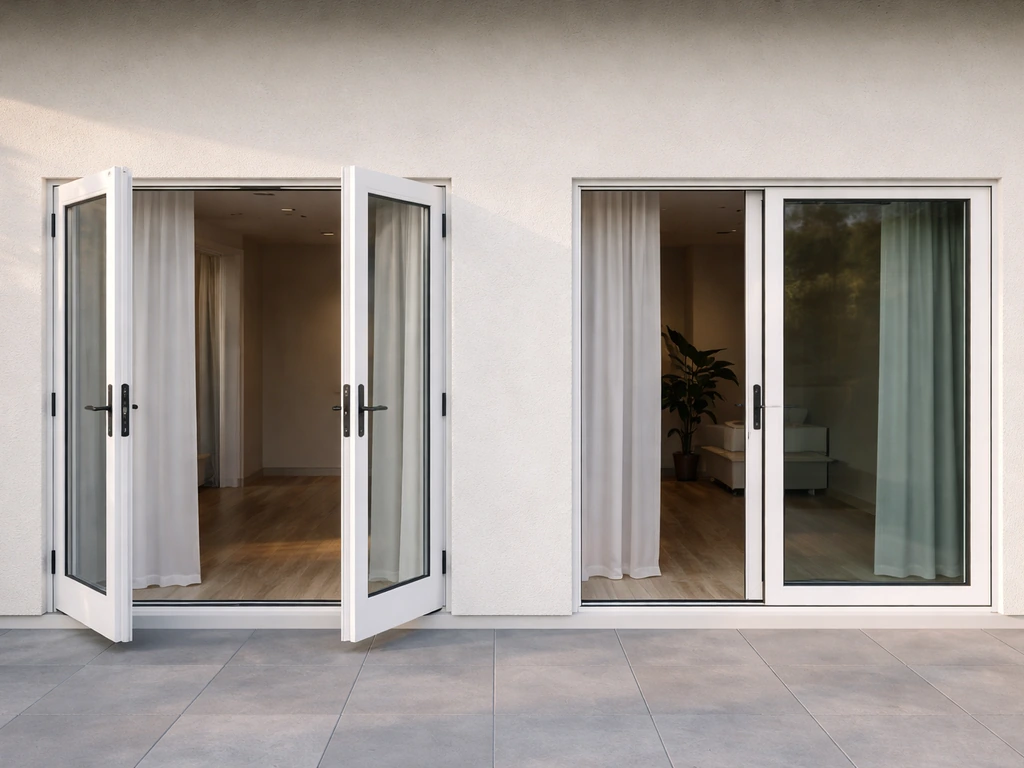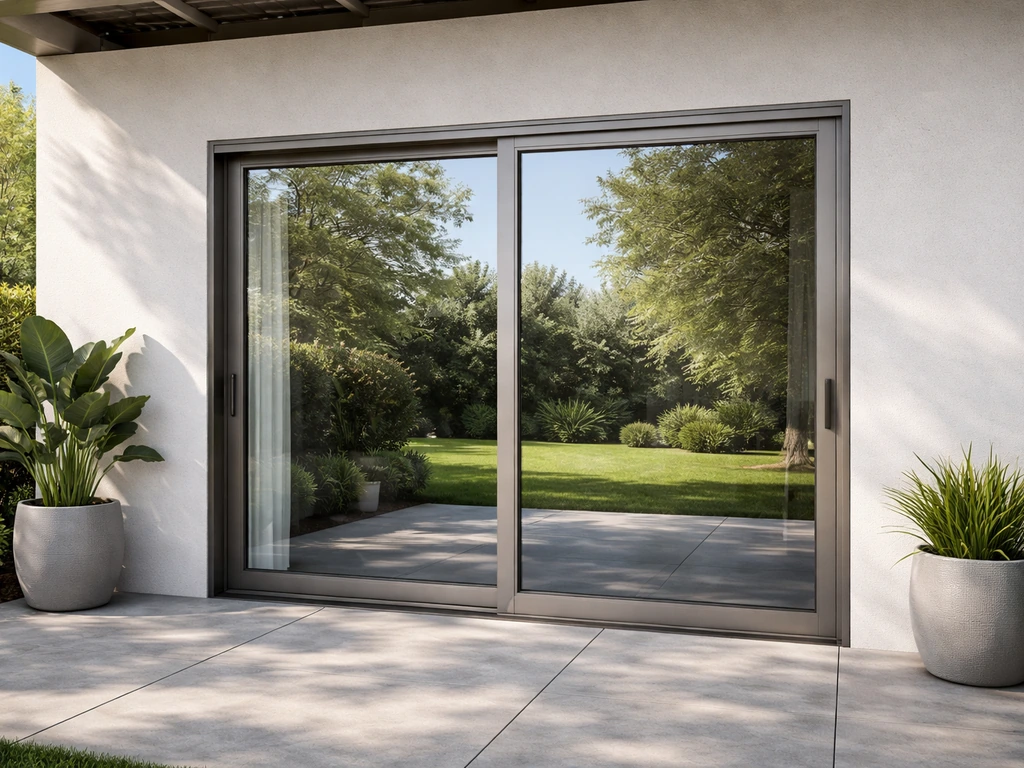
For most patio doors, vertical blinds or a panel track system are the best starting point because they slide out of the way cleanly without bunching up. But the actual best patio door blinds for your situation depend on your door type, how much privacy and light control you need, and whether you want something mounted inside the frame, outside it, or built right into the glass. This guide walks you through every real option, how to measure correctly so nothing wobbles or gaps, and which system wins for each goal.
Best Patio Door Blinds: Buyer Guide by Door Type

Owen Delaney
3 May 2026
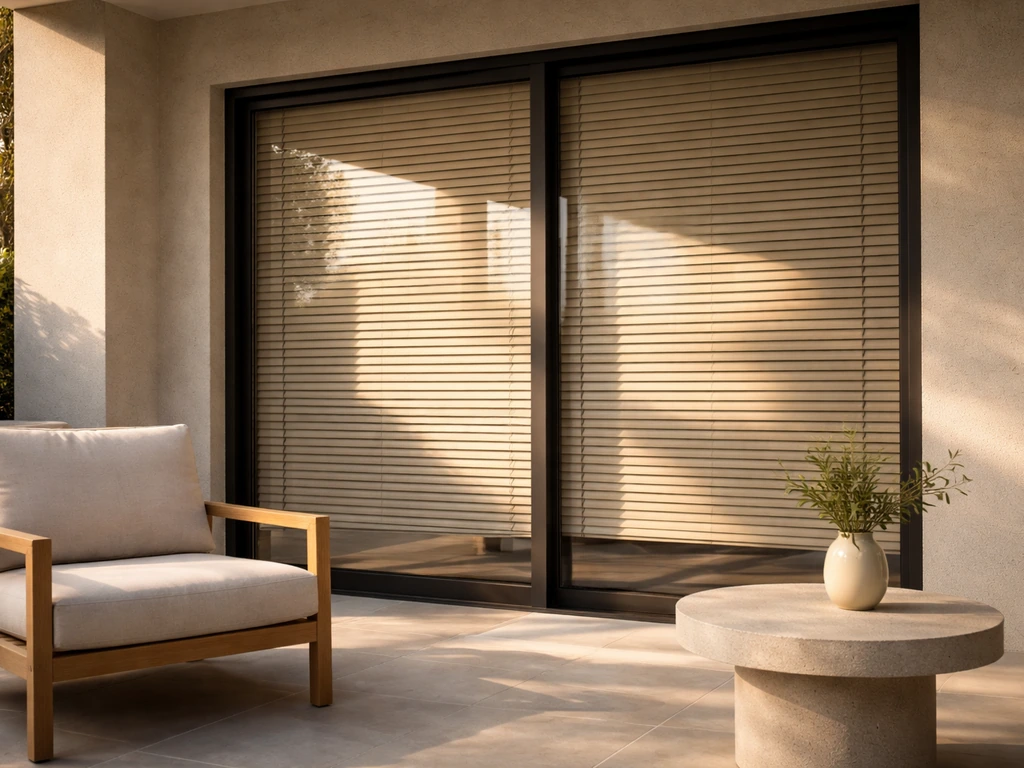
What makes patio door blinds different from regular window blinds
Patio doors are tall, wide, and they move. That combination rules out a lot of standard window blind products right away. A typical sliding patio door runs 6 to 8 feet tall and 5 to 6 feet wide, and the panels or doors swing or slide through the same space your blinds need to occupy. If you hang a wide horizontal blind across a sliding door, it either blocks the door from opening or gets destroyed every time someone walks through. The best patio door blinds account for the door's operation from day one.
The other thing that separates patio doors is the light and heat load. Most patio doors face south or west, which means direct sun for hours every day. That UV exposure fades fabrics, warps plastic slats, and degrades cheap cord mechanisms faster than you'd expect. Durability and UV resistance matter a lot more here than on a north-facing bedroom window.
What 'best' actually means: light control, privacy, insulation, and durability
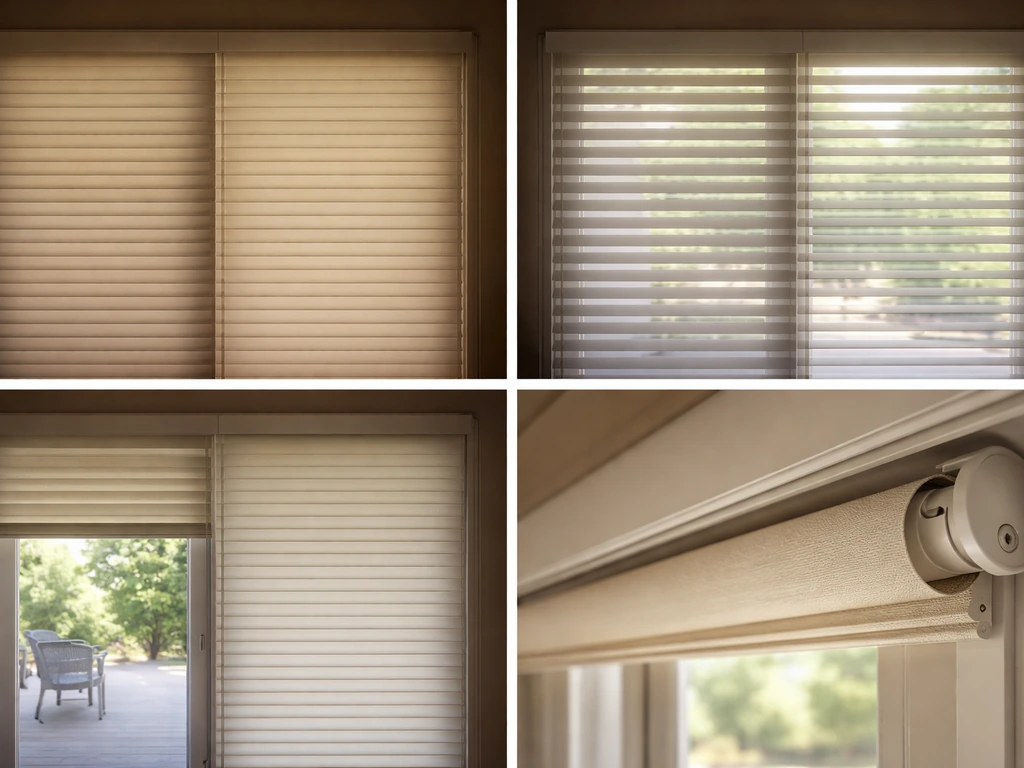
Before picking a product, it helps to rank what you actually care about. Most people want some combination of four things, and the right blind system usually does two or three of them well rather than all four equally.
- Light control: How much sun do you want to block? Solar shades in a 3% to 5% openness factor let in a soft glow while cutting glare. Room-darkening roller shades or blackout verticals block nearly everything. For a living room that gets afternoon sun, a 5% solar shade is usually the sweet spot.
- Privacy: During the day, solar shades let you see out but make it hard to see in. At night, the dynamic reverses and you need a denser fabric or a layered approach to maintain privacy. Vertical blinds with overlapping slats and tight S-curves give good nighttime privacy without going fully blackout.
- Insulation: Cellular shades (honeycomb construction) trap air and add measurable R-value. On a drafty older patio door, a double-cell cellular shade can noticeably reduce cold-air intrusion. Between-the-glass blinds don't add much insulation on their own, but they come inside an insulated glass unit that already performs well.
- Durability: Look for UV-stabilized fabrics or vinyl, corrosion-resistant hardware, and mechanisms rated for daily operation. If you have kids or pets, cordless or motorized systems eliminate cord hazards and broken wands.
Choosing the right blind type for your door (sliding vs French vs bifold)
Your door type is the single biggest filter when choosing blinds. Not every product works on every door, and the wrong match creates real operational headaches.
Sliding patio doors
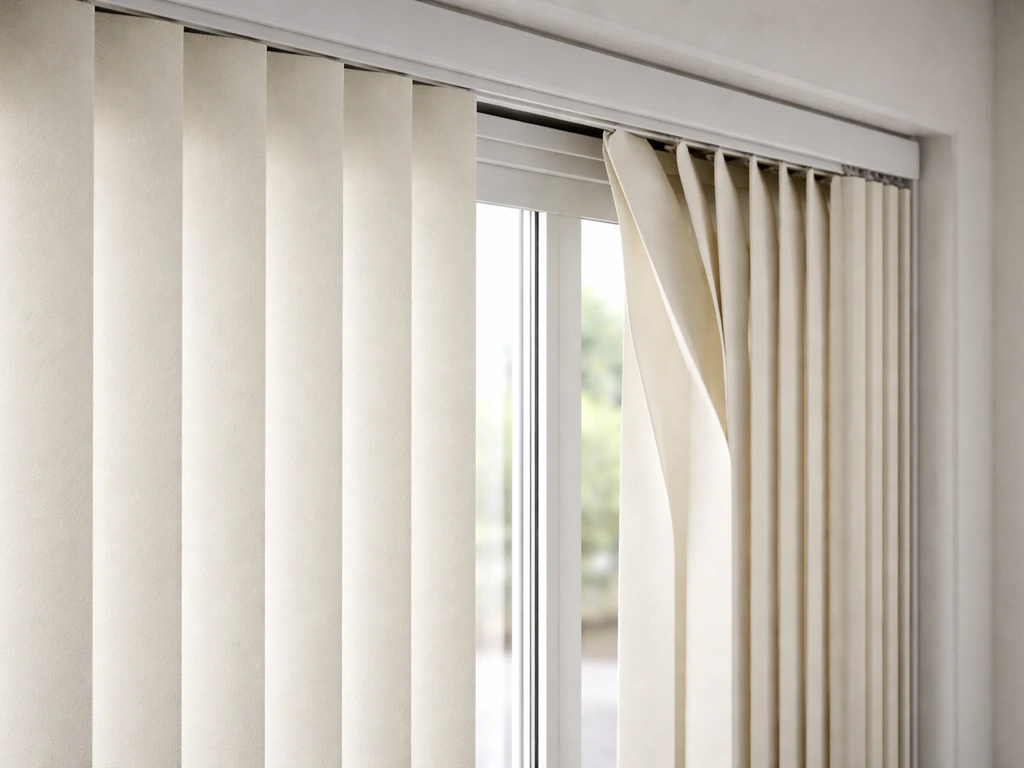
Vertical blinds and panel track systems were essentially designed for sliding doors. Vertical blinds hang from a top track and stack to one side when you slide the door open, so they never block the opening. Panel tracks work the same way but use wide fabric panels instead of individual slats, giving you a cleaner, more modern look. Both options let you draw just the panel over the moving portion of the door for privacy while leaving the fixed panel uncovered. Roller shades mounted on the moving panel of the door are another option but require the shade to travel with the door, which means it needs to be secured at the bottom or it swings freely.
French patio doors
French doors swing open, which means anything mounted to the wall or frame gets in the way when the door is open. The cleanest solution is mounting individual blinds or shades directly to each door panel. Look for door-mounted blinds that attach to the glass frame on the door itself, not the surrounding wall frame. These are usually held at the top and bottom with tension brackets or clips so they stay taut and don't swing when the door moves. Cellular shades, roller shades, and between-the-glass built-in systems all work well on French doors. Vertical blinds do not, because they need a fixed overhead track.
Bifold patio doors
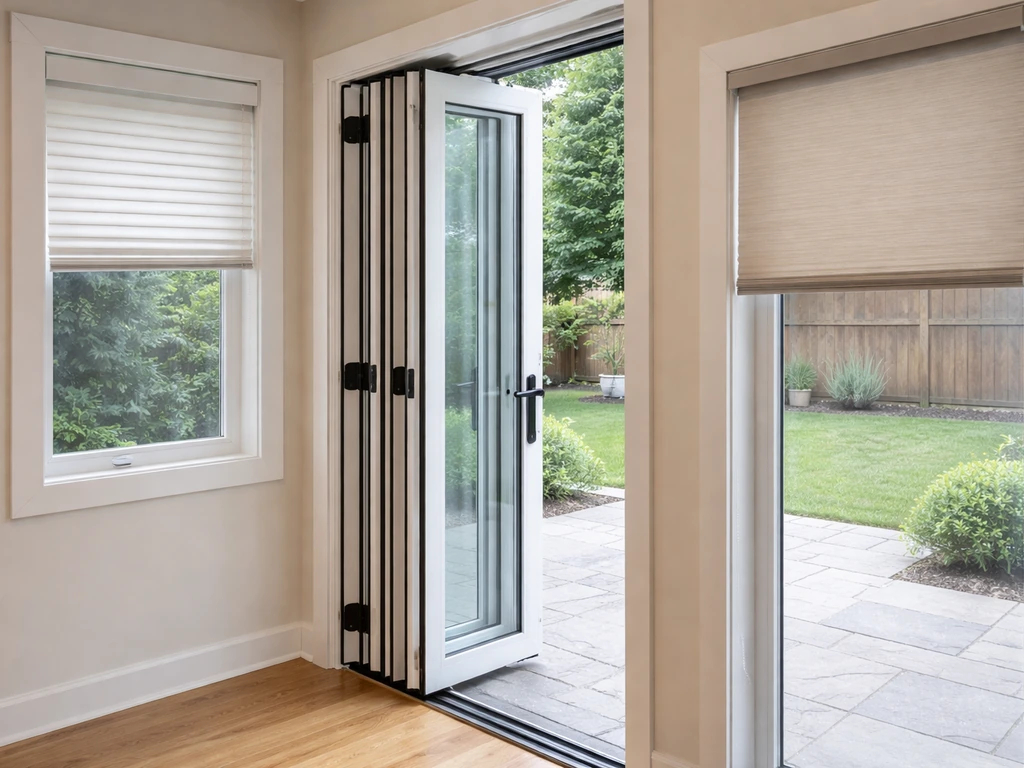
Bifold doors are the most space-efficient to open but the hardest to cover with traditional blinds. When they fold, the panels stack tightly to one side, so anything mounted inside the frame gets pinched or pushed. Most people go with an outside-mount roller shade or plantation shutter positioned above and to the outside of the door frame, which pulls up or swings open as a unit before the bifold is operated. Built-in between-the-glass options are also worth considering here because they're contained within each panel and don't interfere with the folding mechanism at all.
Built-in blinds: between-the-glass systems explained
Between-the-glass blinds are exactly what they sound like: blinds or shades sealed inside the insulated glass unit of the door itself. Because they're protected between the panes, they never collect dust, kids and pets can't bend the slats, and there are no loose cords. Operation is typically cordless, using a small handle or slider on the door frame edge that moves the blinds up and down or tilts the slats.
Pella offers between-the-glass blinds and shades on its Lifestyle Series patio doors, including both blinds and shades in that protected cavity. ODL makes an add-on enclosed blind product that can be installed on existing door glass panels, which is a more affordable retrofit path. ODL specifically includes privacy channels to block the light leaks you typically get around the edges of traditional blinds, which is a real advantage. Eclipse also makes integral blinds sealed within glazed units and claims compatibility with sliding patio doors and French doors, with some retrofit capability.
The tradeoff is that built-in systems are tied to specific door products or door glass sizes, cost more upfront, and can't be swapped out independently if something goes wrong with the mechanism. If the sealed unit fails (fogging, broken tilt mechanism), you're often replacing the entire insulated glass unit. That said, the maintenance-free operation and clean look are genuinely hard to beat for households with young kids. If you're already researching whether built-in blinds cause problems over time, the longevity of the sealed glass unit and the tilt mechanism are the two areas worth investigating before you buy.
How to measure for a perfect fit
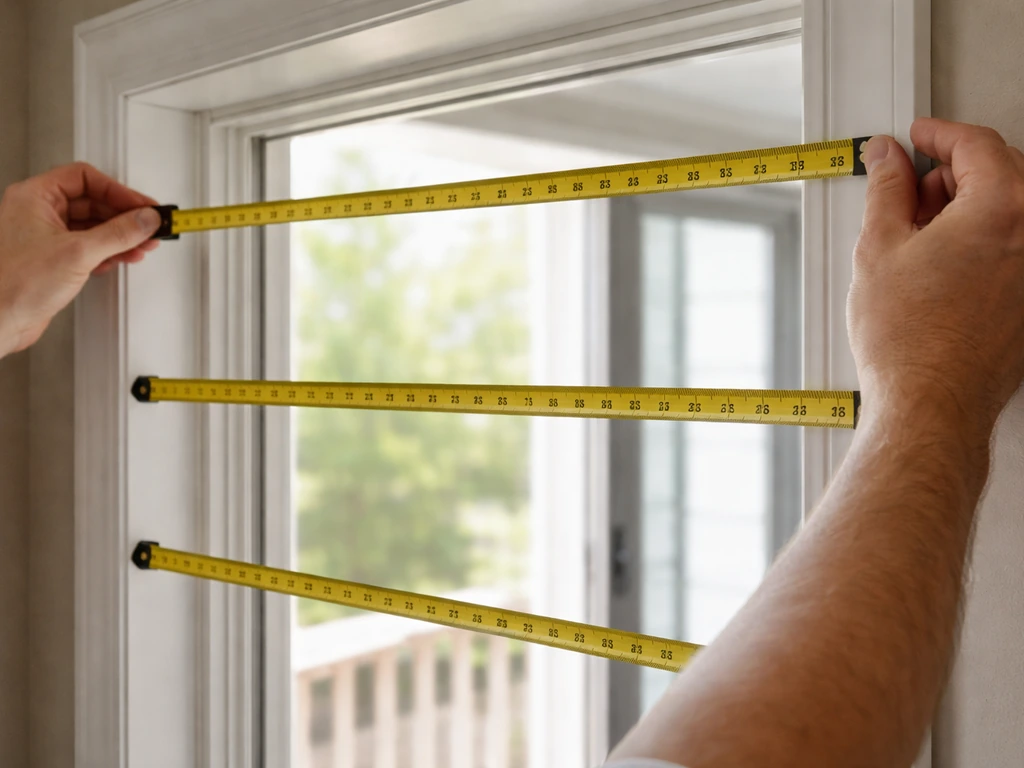
Getting the measurement right is where most DIY blind installs go sideways. The two main options are inside mount (the blind fits inside the door frame recess) and outside mount (the blind mounts to the wall or trim above and outside the opening). Each requires a different measurement approach.
Inside mount measurements
Measure the width at three points: top, middle, and bottom of the opening. Record the smallest of those three numbers. Most manufacturers apply a factory deduction of about 1/4" to 1/2" for clearance, so you provide the exact opening size and they cut accordingly. Don't pre-deduct unless the product instructions specifically tell you to. For depth, check the minimum recess requirement for your chosen product. Lowe's guides, for example, cite a 3/4" minimum depth for standard inside-mount installs, and Hunter Douglas Duette brackets may need as little as 1/2" depending on the bracket style. Measure your recess depth before ordering, because if you don't have enough depth, inside mount won't work cleanly.
Outside mount measurements
For outside mount, measure the opening itself and then add overlap on all sides to block light gaps. Home Depot's measurement guide recommends at least 2 1/4" overlap on each side for roller and solar shades (4 1/2" total added to width), and 3" past the edges for vertical blinds and panel tracks. American Blinds recommends at least 1 1/2" overlap on both sides for solar shades. For height, measure from where you want the bracket (typically 2" to 4" above the door frame) down to the floor or sill. Outside mount gives you more flexibility if your frame is shallow and makes the door look taller.
Measuring for panel tracks and vertical blinds
Panel tracks have their own quirks. The track itself must span the full width of the opening, and the panels need to stack without overlapping the active part of the door. SelectBlinds and BlindsOnLine both provide panel-track-specific measuring guidance that accounts for how the panels stack to the side when fully open. For a standard 72" wide sliding door, a panel track system typically requires 8" to 12" of clearance on the non-moving side for the stacked panels. Measure that clearance before ordering, or the system won't operate cleanly.
| Mount Type | Width Measurement | Overlap/Deduction | Depth Requirement |
|---|---|---|---|
| Inside mount | Smallest of 3 points (top/mid/bottom) | Factory deducts ~1/4" to 1/2" (don't self-deduct) | Min. 3/4" recess depth typical |
| Outside mount (solar/roller) | Opening width + at least 2 1/4" per side | Add 4 1/2" total to width minimum | No recess needed |
| Outside mount (verticals/panels) | Opening width + 3" per side | Add 6" total to width | No recess needed |
| Between-the-glass (ODL add-on) | Outside dimensions of the door glass frame | Sized to glass frame, no overlap needed | Fits within door panel thickness |
Top recommendations by goal
Best overall: vertical blinds or panel track
For a sliding patio door, a quality vertical blind or panel track system is still the most practical all-around solution. They're purpose-built for wide openings, they stack neatly when the door is in use, they're available in hundreds of fabrics and opacity levels, and replacement slats are easy to find. Look for vinyl or fabric slats with an S-curve or overlap design, which minimizes the light gaps that straight-hanging slats leave. Budget around $80 to $200 for a DIY vertical blind on a standard 6-foot door, or $200 to $400 for a panel track system with quality fabric panels.
Best for privacy: blackout roller shade or cellular shade
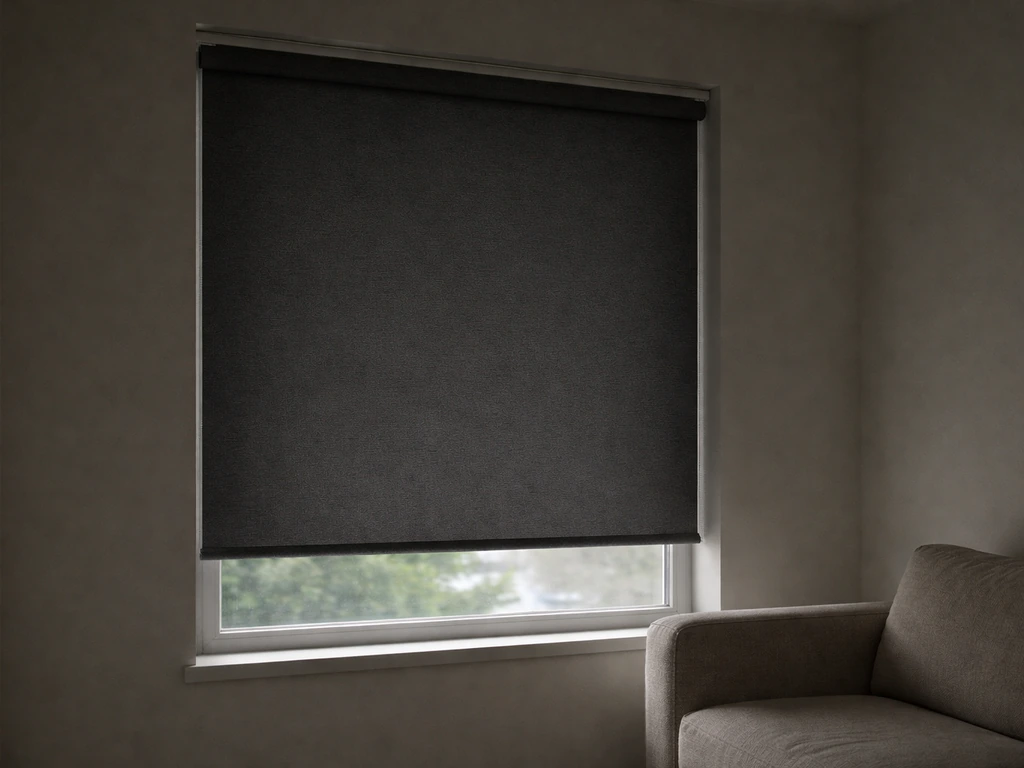
If privacy is the priority, a room-darkening or blackout roller shade mounted outside the frame with 2 1/4" overlap on each side gives you the most complete coverage. Cellular (honeycomb) shades add insulation on top of privacy, which is especially valuable on an older door with a leaky frame. For French doors, mount the shade directly to each door panel using tension brackets so it moves with the door. Top-down bottom-up cellular shades are also worth a look here because they let you open from the top for light while keeping the lower portion private. That's a legitimately useful feature on a patio door that faces a neighbor's yard.
Best for easy cleaning: between-the-glass or enclosed blinds
If you hate dusting blinds, a between-the-glass system is the obvious answer. ODL's add-on enclosed blinds retrofit onto existing door glass panels and eliminate dusting, cord tangles, and slat damage entirely. They're available in sizes matched to standard door glass dimensions and install without replacing the door. Pella's built-in between-the-glass options are the premium version if you're buying a new door or doing a full replacement. Both solutions are essentially maintenance-free on the blind itself, though you still need to keep the door glass exterior clean.
Best for tight spaces (bifold doors or shallow frames): outside-mount roller shade
When frame depth is minimal or the door folds and stacks in a way that destroys anything mounted inside, an outside-mount roller shade positioned above the door frame is the cleanest fix. Choose a solar shade in a 3% to 5% openness for daytime privacy and glare control without blacking out the space. Motorized versions are worth the upgrade here because you can raise the shade before operating the bifold door without having to reach around a folded stack of door panels. Battery-powered motors from brands like Hunter Douglas (PowerView) last about a year per charge cycle depending on use frequency.
Cost, installation, and upgrade tradeoffs
Here's how the main options stack up on cost and installation complexity:
| Option | Typical Cost Range | DIY Friendly? | Best For |
|---|---|---|---|
| Vertical blinds (standard) | $80–$200 installed DIY | Yes | Sliding doors, everyday use |
| Panel track system | $200–$500 installed DIY | Moderate | Sliding doors, modern look |
| Cellular/honeycomb shade | $150–$400 per panel | Yes (outside mount) | French doors, insulation, privacy |
| Roller/solar shade (motorized) | $300–$800+ per panel | Moderate | Bifold doors, ease of operation |
| ODL add-on between-glass blinds | $100–$250 per unit | Yes (follows install guide) | Existing doors, low maintenance |
| Pella between-glass (new door) | $500–$1,500+ as door option | No (new door install) | New door purchase, premium finish |
| Plantation shutters | $400–$1,200+ per door | No (professional typical) | French doors, high durability |
The biggest cost trap is buying a cheap set of standard horizontal blinds for a patio door because they seem like the obvious choice. They're not designed for the width, they sag in the middle over time, and they bunch up awkwardly when you need to open the door. Spending a little more on a product actually designed for patio door dimensions saves a frustrating replacement cycle within two to three years.
On warranties: Hunter Douglas offers a Lifetime Limited Warranty on many of its window treatment products, which is worth factoring in at the higher end of the price range. Between-the-glass systems from Pella and ODL come with manufacturer warranties, but coverage terms for the sealed glass unit versus the blind mechanism can differ, so read the fine print before purchasing. If a sealed unit fogs up or the tilt mechanism fails after the warranty window, the repair is typically a full glass unit replacement rather than a simple part swap.
Maintenance, operation, and troubleshooting
Most patio door blind problems come down to three things: accumulation of grime on the slats or fabric, cord or wand mechanisms that wear out with daily use, and blinds that drift or stick in their track. If you're dealing with patio doors with built in blinds problems, check whether the sealed unit, tilt mechanism, or clearance around the door edges is the real cause. Here's how to handle each.
Cleaning and routine maintenance
Vertical blind slats (fabric or vinyl) can be wiped down with a damp cloth or removed from their clips and hand-washed. Roller shades made from solar or screen fabrics can be spot-cleaned with mild soap and water. Never soak or machine-wash a roller shade. Panel track fabric panels usually have the same care requirements as roller shades. Cellular shades collect dust in their honeycomb cells over time. The easiest fix is a low-setting vacuum with a brush attachment run along the cells every few months. Between-the-glass systems require no cleaning at all on the blind itself, which is the real selling point over time.
Troubleshooting common problems
- Vertical slats that won't rotate: Usually a worn carrier stem inside the headrail. Individual carrier stems are inexpensive and easy to replace. Most vertical blind headrails use a standard 1/4" stem that's widely available.
- Panel track that drags or sticks: Check that the top track is level and that the glides in the track are clean and unobstructed. A silicone-based lubricant on the track (not WD-40, which attracts dust) usually fixes sluggish operation.
- Roller shade that won't stay up or rolls unevenly: The spring tension in the roller tube needs adjustment. Roll the shade up by hand, remove from brackets, roll it up tighter by hand, reinstall, and test. Repeat until tension feels balanced.
- Motorized shade that stops at wrong position: Most motorized systems including Somfy RTS units require a limit reset. The process involves using the UP/DOWN controls in a specific sequence to set new upper and lower end limits. Check the manufacturer's support page for the exact button sequence for your model.
- Between-the-glass mechanism stuck or unresponsive: On ODL add-on units, check that the external control slider hasn't been bumped out of its channel. On Pella built-in units, the tilt mechanism is integrated into the door frame edge and may need a service call if the linkage has broken.
Child and pet safety
Cord loops on traditional vertical blinds and roller shades are a documented hazard for young children and can also catch on pet collars. The simplest fix is going cordless on any blind within reach. Cordless vertical blinds, cordless cellular shades, and motorized roller shades all eliminate the hazard entirely. Between-the-glass systems are inherently cordless since the mechanism is enclosed. If you're replacing blinds in a home with children under six, treat cordless as a non-negotiable rather than a nice-to-have.
Your quick decision path
If you're still not sure which direction to go, use this simple decision sequence to narrow it down fast. If you're comparing patio door blind alternatives, start by matching the blind style to your door type so it opens and closes smoothly.
- Identify your door type first: sliding, French, or bifold. That eliminates incompatible products immediately.
- Decide on mount: measure your frame recess depth. If you have less than 3/4", plan on outside mount.
- Rank your priorities: light control, privacy, insulation, or easy maintenance. Pick your top two.
- If maintenance is your top priority, go straight to between-the-glass options (ODL add-on for existing doors, Pella built-in for new doors).
- If operation ease and daily use are the priority on a sliding door, start with vertical blinds or a panel track system.
- If privacy and insulation matter most on a French door, look at cellular shades or roller shades mounted directly to each door panel.
- If you have a bifold or tight-clearance situation, outside-mount roller shades (motorized if budget allows) are your clearest path.
- Take your measurements using the inside/outside mount guidelines above, order samples before committing to a fabric, and check the warranty coverage terms before finalizing your purchase.
The right patio door blind setup isn't complicated once you know your door type and what you actually need from it. Most people land on a vertical blind or panel track for sliding doors, a door-mounted cellular or roller shade for French doors, and an outside-mount roller or a between-the-glass system for everything else. Get the measurement right, pick a product built for the door's width and operation, and you'll have something that works cleanly for years rather than something that frustrates you every time you try to open the door.
FAQ
What patio door blinds work best if I need to keep the door fully usable, especially for daily traffic?
If you mount a blind on a sliding patio door where the moving panel passes, you need a system that stacks to one side (vertical blinds or a panel track) or a shade that actually travels with the door (roller/rope style with a moving attachment). A standard flat horizontal blind across the door opening will either block the door or get damaged when the door opens.
How do I avoid measurement errors that cause gaps or wobbly patio door blind installs?
For inside-mount installs, measure the width in three spots (top, middle, bottom) and use the smallest number to account for imperfect door recesses. Also confirm you have the required recess depth for the specific brand or bracket style, because some “works with 3/4 inch” rules do not apply to every mounting kit.
What overlap should I plan for on outside-mount patio door blinds if I want near-blackout coverage?
Outside-mount coverage matters more than you think. Even if the shade is the right size, you can still get light leaks if overlap is too small, and overlap needs differ by blind type (roller versus vertical/panel track). When in doubt, pick the larger overlap guidance for your product family to reduce side gaps.
Are cordless patio door blinds really necessary for homes with pets and kids?
If you have pets, avoid any design with exposed cord or wand components that can be reached or tangled. Cordless verticals and cordless cellular shades reduce risk, and between-the-glass systems are inherently enclosed, so there is no accessible cord to grab.
Can I retrofit between-the-glass patio door blinds later if I change my mind on style or opacity?
Do not plan to swap between-the-glass blinds and standard mounts later. These systems are built for specific sealed-glass or door glass configurations, and repairs can mean replacing the entire insulated glass unit if the sealed mechanism fails.
How can I use patio door blinds on French doors without them getting hit or blocked when the door opens?
Yes, if you use the right mounting method. For French doors, mount the shade or blinds to each door panel with tension brackets or clip-based hardware designed for moving operation, then verify the tension points do not interfere with the door handle or lock area.
What clearance do I need for patio door panel track blinds so the panels stack properly?
Panel track systems need clearance on the non-moving side for the stacked panels, and that clearance is separate from the door opening width. Measure how much room you have for stacking at full open, typically 8 to 12 inches for many 72-inch doors, then re-check with the manufacturer’s chart.
Which fabric opacity is best for daytime glare control versus nighttime privacy on a south or west-facing patio door?
Most patio door users use solar, screen, or room-darkening fabrics to avoid glare while keeping daytime privacy. If your main issue is privacy at night, prioritize higher opacity and adequate overlap over “light-filtering only,” because sheer-only setups can still reveal silhouettes.
Why do patio door blinds keep sticking or drifting, and what’s the fastest fix?
If you see blinds that drift, stick, or don’t travel smoothly, the most common causes are misalignment during install, insufficient clearance around the moving door section, or grime buildup in tracks. Start by checking that the door operates freely without contacting the blind assembly, then clean the track areas before adjusting tension or bracket placement.
How does cleaning and maintenance differ between vertical blinds, roller shades, panel tracks, and between-the-glass patio door blinds?
Yes, but maintenance expectations change by system. Between-the-glass systems are effectively maintenance-free for the blind itself, while cellular honeycomb and panel track fabrics need periodic vacuuming or spot-cleaning. Plan cleaning frequency based on where your door sits in sun exposure and how much dust your patio area generates.