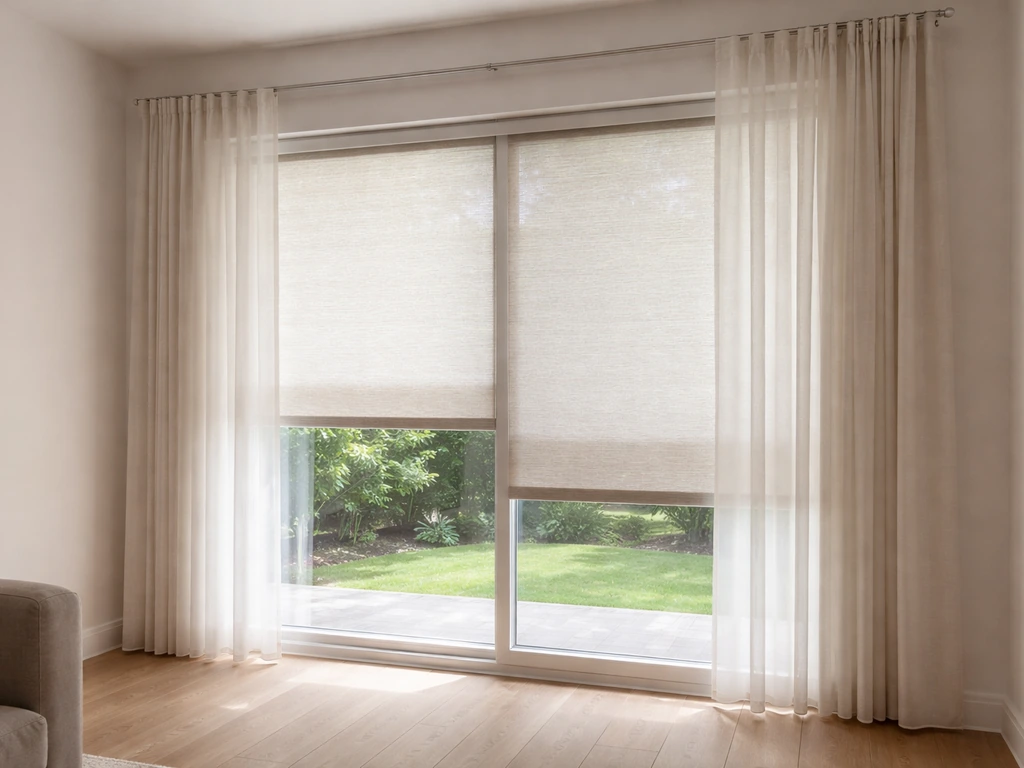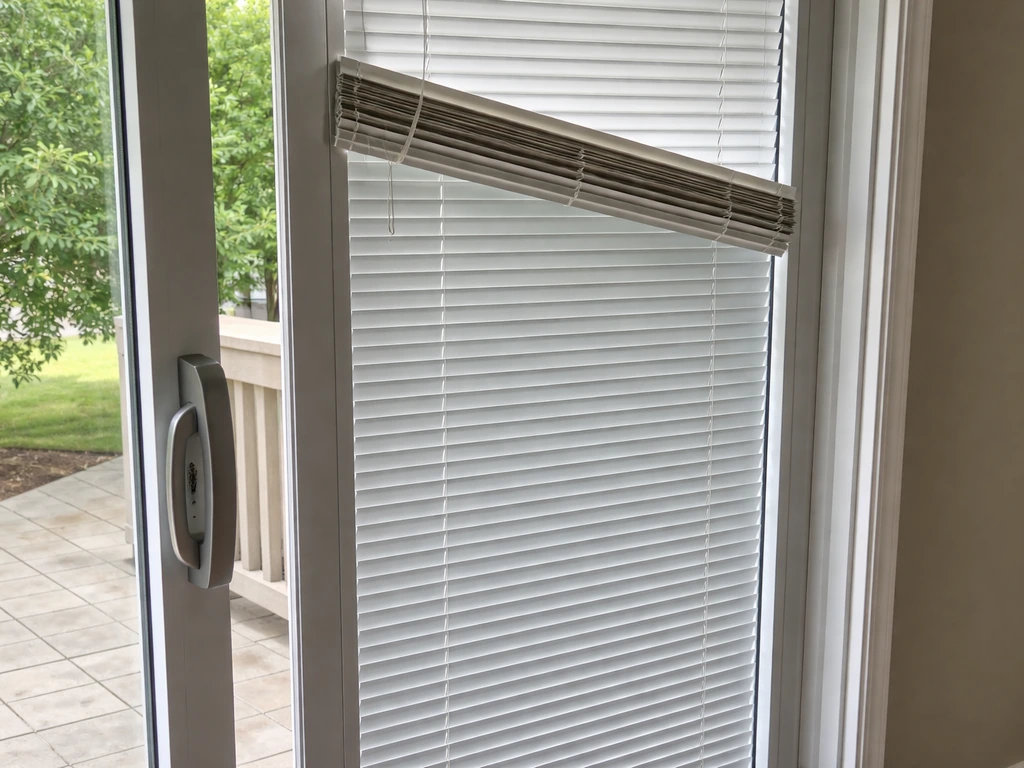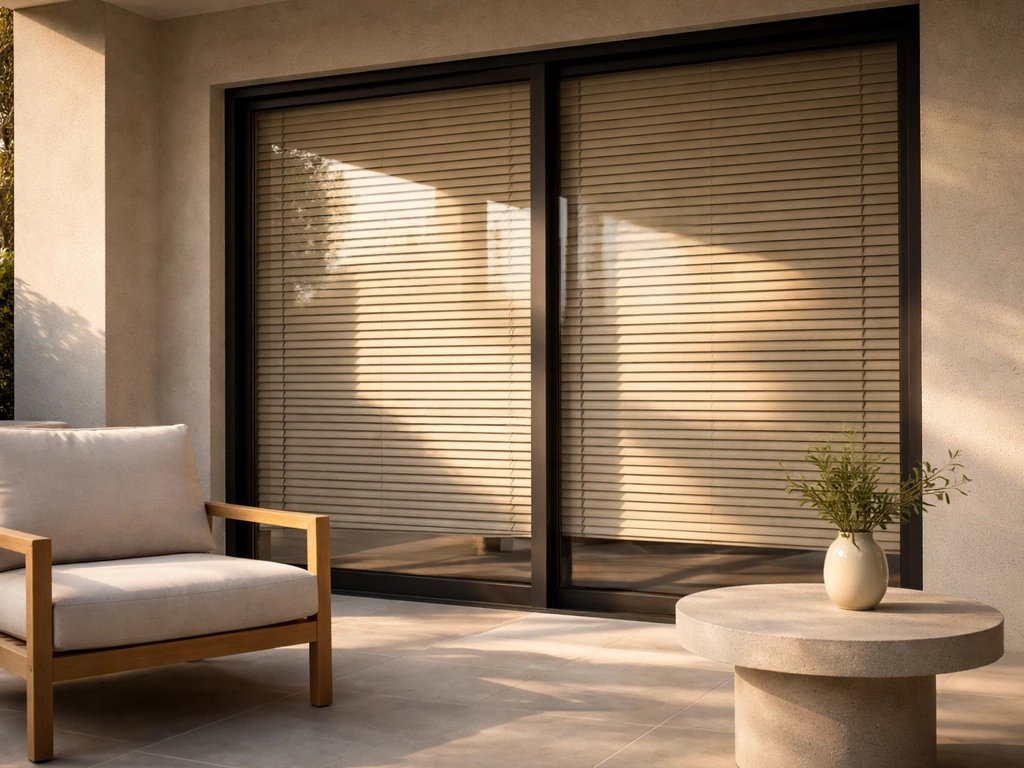
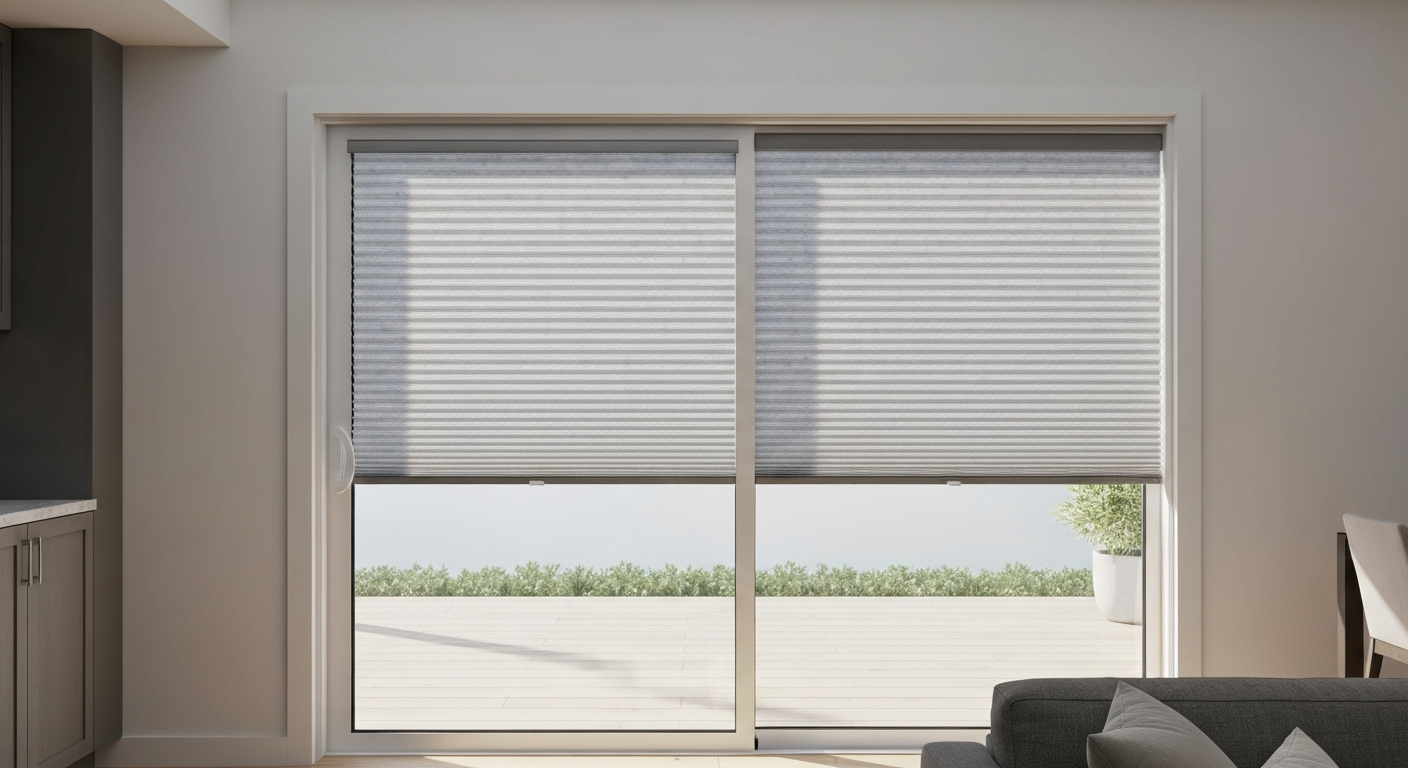
Top-down/bottom-up (TDBU) blinds work on patio doors, and they solve a real problem: you want privacy at eye level when you're sitting on the couch, but you also want daylight coming in from the top. You pull the lower rail up to block the sightline from the street, and the upper portion stays open to let in natural light. That single feature makes TDBU blinds one of the most practical covering options for a patio door, whether you have a sliding glass door, a pair of French doors, or a bifold system. This guide walks you through everything you need to pick, measure, buy, and install the right TDBU blind for your specific door setup, including exact sizing rules, realistic cost ranges, and the honest truth about built-in versus surface-mounted options.
Top Down Bottom Up Blinds for Patio Doors: Complete Guide

Who this guide is for
If you're staring at a patio door and wondering why a standard off-the-shelf blind doesn't quite fit, or you've been burned by a built-in between-glass blind that fogged up after a few years, this is for you. I've helped homeowners navigate patio door coverings across sliding, French, and bifold configurations, and the same questions come up every time: What's the right measurement? Will a TDBU blind clear the door handle? Do I need a professional, or can I do this myself in an afternoon? This guide answers all of that with real numbers, not vague ranges.
How TDBU blinds actually work, and why patio doors need them
A standard blind or shade moves in one direction only: up. A top-down/bottom-up blind has two independent rails. The top rail can be lowered from above while the bottom rail stays in place, and the bottom rail can be raised from below while the top stays put. You can position both rails independently to create a band of coverage anywhere in the window. For a patio door, this is genuinely useful in ways a regular blind is not.
Privacy is the obvious one. A patio door typically faces a yard, a deck, or a neighbor's property. At seated height, a 36-to-42-inch coverage band in the middle of the door blocks sightlines without cutting off your view of the sky or the tree line above. Light control pairs with this: you can pull the bottom rail up 24 inches and let the top 12 to 18 inches of glazing stay fully open, giving you a room that's bright but not exposed.
Child and pet safety is a harder requirement. The U.S. Consumer Product Safety Commission (CPSC) explicitly states that cordless window coverings are the safest option in homes with young children. Corded TDBU systems have two operating cords, which doubles the strangulation risk compared to a standard corded shade. If you have kids or pets, you should be ordering cordless or motorized TDBU blinds, full stop. Many retailers and custom shops now offer cordless TDBU as a standard option across their cellular and pleated lines.
Energy performance is a legitimate reason to choose cellular TDBU in particular. A double-cell or triple-cell honeycomb shade creates insulating air pockets across the glass. On a large patio door (say, a 72-inch-wide sliding door with 78 inches of glass height), the glass area is massive compared to a standard window, so the heat gain and loss are proportionally larger. Covering that expanse with a cellular TDBU shade makes a measurable difference in comfort and heating/cooling costs.
Patio door styles and what they mean for your blind choice
Not all patio doors accept every blind configuration, and getting this wrong is the most common and most expensive mistake I see homeowners make. The door style determines whether an inside or outside mount is even possible, how much clearance you have for the blind's hardware, and whether a single wide blind or multiple narrower blinds is the right approach.
Sliding patio doors
A standard two-panel sliding door has one fixed panel and one operating panel. The operating panel has a handle, typically a recessed pull or a projecting bar handle, mounted anywhere from 30 to 42 inches from the floor on the interior face of the door. If you're doing an inside-mount TDBU blind, that handle dictates where your bottom rail can travel. A blind that stacks against the handle when raised will either jam or scratch the hardware. For inside-mount work on sliding doors, measure the distance from the top of the frame to the top of the handle, and confirm your blind's raised stacking height clears that point. Most standard cellular shades stack between 5 and 10 percent of their total drop height, so a 78-inch blind might stack 4 to 8 inches at the top rail's raised position.
French doors
French patio doors (two hinged panels that swing open) present a different problem. The door moves, so any blind mounted on or adjacent to the door frame needs to either travel with the door or clear it completely when open. Most homeowners treat each French door panel as a separate mounting surface and order a narrow TDBU blind per panel, mounted directly to the door itself using door-mounted brackets (also called door-frame or sash-mounted brackets). The blind then swings with the door. You need to account for the door hardware (handle, lock, and often a flush bolt at the top and bottom) when deciding blind width and bottom-rail clearance.
Bifold patio doors
Bifold or multi-fold doors fold and stack to one or both sides. When open, they can consume 20 to 40 percent of the door opening width in stacked panels. A blind or shade mounted in the frame above the bifold opening needs enough operating width to cover the glass when closed, plus a stacking solution that doesn't interfere with the door's folding hardware. Vertical blinds or vertical panel tracks are sometimes used here because they stack horizontally to match the door's stacking direction. TDBU functionality in a vertical orientation exists but is less common and mostly found in custom pleated vertical or panel systems. For most bifold door owners, a wide TDBU roller shade or cellular shade mounted outside the frame (above the door on the wall) is the most practical solution.
TDBU blind types and materials that actually fit patio doors
TDBU is a lift mechanism, not a product type. It can be built into several shade and blind families. Here's what works on patio doors and what the tradeoffs are.
| Blind/Shade Type | TDBU Available? | Best for Patio Door Style | Key Trade-off |
|---|---|---|---|
| Cellular (honeycomb) shade | Yes, standard option | Sliding, French (per panel) | Best insulation; stacking height can be significant on tall doors |
| Pleated shade | Yes, standard option | Sliding, French (per panel) | Thinner profile than cellular; less insulation |
| Roman shade | Yes, from select brands | French doors (lighter panels) | Fabric bulk when raised; not ideal for very tall doors |
| Roller shade | Yes, via dual-roller systems | Sliding, bifold (outside mount) | Clean look; TDBU mechanism adds complexity and cost |
| Faux wood / aluminum mini blind | Rare; limited to some custom lines | Sliding doors only (inside mount) | Heavier slats make TDBU awkward on tall spans |
| Vertical blind / panel track | Limited; some custom pleated verticals | Bifold, wide sliding doors | Stacks horizontally; TDBU less common in vertical systems |
| Between-glass (built-in) | Yes, factory-configured | Sliding, French (factory-installed only) | No cleaning needed; IGU seal failure is a real risk |
For most homeowners, a cordless cellular TDBU shade is the practical first choice for a sliding patio door: it gives you the best combination of insulation, light control, and TDBU flexibility. Pleated shades are a close second if you want a slimmer profile or lower price point. Roman shades work well on individual French door panels where the glass area is smaller and the aesthetic is more traditional. Roller shades with a dual-roller TDBU mechanism are a good modern option for bifold doors on an outside mount, where the clean roll-up profile keeps the stacked door hardware clear.
Built-in between-glass blinds vs. surface-mounted TDBU: the honest comparison
Between-glass (or between-the-glass) blinds are factory-installed inside the insulated glass unit (IGU) of the door. You operate them with a small magnetic slider or wand on the door frame, and the blind never touches the room air, so theoretically it never gets dusty. Pella and other manufacturers market these as a low-maintenance, protected option. In practice, the system works well until it doesn't.
The failure mode is IGU seal failure. Every insulated glass unit has a perimeter seal that keeps argon (or krypton) gas in and moisture out. When that seal fails, which it will eventually in most climates, moisture enters the unit, fogging the glass and potentially corroding or jamming the blind mechanism inside. At that point, you cannot clean the fog or repair the blind without replacing the entire IGU, which is an expensive repair often running $200 to $500 or more per panel, depending on door size and manufacturer. Pella's own documentation and customer Q&A show this is a real-world issue, not a hypothetical. This is worth reading about alongside the broader topic of patio doors with built-in blind problems before you commit to a factory-integrated system.
Surface-mounted TDBU blinds are installed on the door frame or wall by you or a contractor. They're replaceable, upgradeable, and not tied to the IGU's lifespan. They collect dust, yes, but cellular shades are relatively easy to clean with a vacuum brush attachment. The hardware is exposed, but it's also serviceable without replacing the door panel.
| Factor | Between-Glass (Built-in) | Surface-Mounted TDBU |
|---|---|---|
| Dust/cleaning | None (sealed unit) | Requires periodic vacuuming |
| Installation | Factory only; not retrofittable | DIY or pro; retrofittable to existing door |
| Replacement cost | $200–$500+ per IGU panel if seal fails | $35–$800 depending on product and labor |
| TDBU flexibility | Limited by factory tilt/lift mechanism | Full range of TDBU positions |
| Warranty interaction | Factory warranty; check door maker's terms | Does not affect door warranty if outside mount |
| Long-term risk | IGU seal failure traps moisture and blind | Blind fails independently; door is unaffected |
| Aesthetic | Cleanest look; no visible hardware | Visible brackets and headrail |
One important note on warranties: some door manufacturers condition their warranty on using factory-approved accessories or on not modifying the frame. Before you drill into a new door's frame for an inside-mount bracket, check the manufacturer's warranty documentation. An outside-mount bracket attached to the wall or door casing above the frame avoids this issue entirely.
Motorized vs. manual TDBU: what the options actually cost
Manual cordless TDBU is the baseline. You push the bottom rail up or pull it down by hand, and the top rail is lowered by hand from above. It's simple, reliable, and the least expensive option. The drawback on a tall patio door is reach: if your door is 80 or 96 inches tall, reaching the top rail to lower it from the ceiling takes effort. That's where motorization starts to make practical sense.
Battery-powered motors
Battery tube motors (using AA or lithium cells) are the most accessible motorized option. Somfy and Hunter Douglas PowerView both offer battery-powered tube motors that integrate into the headrail of a cellular or roller shade. No wiring is required, so installation is DIY-friendly. Battery life typically ranges from 6 months to 2 years depending on use frequency and motor type. A rechargeable battery wand (a small pack that plugs in via USB or a wall adapter) is a cleaner solution if you don't want to replace batteries. Battery motor add-on cost: roughly $115 to $200 per shade over a manual cordless version.
Hardwired low-voltage and line-voltage motors
Hardwired motors require an electrician to run power to the headrail location, which adds $150 to $350 or more in electrical labor on top of the motor cost. The advantage is that you never deal with battery replacement, and hardwired systems integrate cleanly with smart home platforms (via Somfy TaHoma, Hunter Douglas PowerView hub, or direct Z-Wave/Zigbee integration). For a large bifold wall of glass or a wide three-panel sliding door where you're motorizing multiple shades simultaneously, hardwired makes sense. For a single 72-inch sliding door, battery is almost always the more practical choice.
Controls for motorized TDBU include handheld remotes, wall-mounted switches, smartphone apps, and voice assistant integration (Alexa, Google Home, HomeKit depending on the brand ecosystem). Hunter Douglas PowerView uses a proprietary hub; Somfy systems use the TaHoma hub or direct RTS/Zigbee integration. Budget for the hub if you want app or voice control: $50 to $150 for the hub itself, separate from the motors.
Safety note on motorized TDBU
Motorized cordless shades are the single safest option for homes with children, eliminating all cord strangulation risk. The CPSC consistently recommends cordless or motorized products as the replacement for older corded shades. If you're upgrading an existing installation that has corded TDBU shades, this is the moment to switch. The cost premium over corded is real but so is the safety benefit.
Measuring your patio door for a TDBU blind
Measuring a patio door for a blind is not the same as measuring a regular window. The glass area is larger, the frame geometry is different, and you have track, threshold, and handle hardware to work around. Here are the exact steps I use every time.
Inside mount measurement
For an inside mount, the blind fits inside the door frame opening. Measure the inside width of the frame at three points: top, middle, and bottom. Use the narrowest measurement. Measure the height from the top of the frame to the bottom track or threshold at two points: left and right. Use the shortest height. Order the blind at exactly those dimensions; the manufacturer will deduct 1/8 to 3/8 inch from the width to provide operating clearance. For inside mounts, you need a minimum frame depth (recess) for the mounting brackets. Levolor cellular installation specs call for at least 1/2 inch of recess for cordless models and 5/8 inch for corded. Check your specific blind's spec sheet for this number; some TDBU headrails are deeper than a standard single-direction shade.
Outside mount measurement
For an outside mount, the blind covers the frame and some of the wall or casing around it. Add at least 1.5 to 3 inches to each side of the frame for light blockage and bracket clearance. Add 2 to 4 inches above the frame to allow for the headrail mount (which should sit on the wall or casing, not on the door frame itself). For the drop, measure from where the top of the blind will mount to the floor, sill, or threshold, and add 2 to 4 inches below the frame. The Home Depot's measurement guide for patio door treatments specifies at minimum 1.5 inches of overlap per side for light control on vertical and panel systems; I use 2.5 to 3 inches on each side for patio doors because the glass runs close to the frame edge.
Handle and hardware clearance
Measure the distance from the face of the door to the outermost projection of the handle hardware. A typical sliding door pull handle projects 1 to 2.5 inches from the door face. If you're inside-mounting a blind that drops in front of the handle, the headrail and stacked blind material must clear that projection. If they don't, use an outside mount with brackets that hold the headrail out far enough to clear the handle projection plus a small buffer (at least 1/4 inch). Mounting depth requirements vary by shade type: a standard cellular headrail needs about 2.5 to 3.5 inches of projection; a motorized headrail may need 3 to 4 inches.
Stacking clearance for panel doors
On a sliding door where one panel slides behind the other, the blind must not interfere with the sliding panel's travel path. If you're mounting a single wide blind across both panels on an outside mount, the blind stays stationary and the door slides behind or in front of it. If you're inside-mounting individual blinds on each panel, each blind must be narrower than its panel's frame opening and must clear the panel's travel hardware. For bifold doors, account for the panel stack: if a 96-inch-wide bifold stacks to 24 inches on one side when open, your blind must either retract above the door or be mounted on the wall outside the door's swing/fold zone.
Step-by-step measurement checklist
- Decide inside or outside mount based on frame recess depth and handle projection.
- Measure frame width at top, middle, and bottom; record the narrowest dimension.
- Measure frame height on left and right; record the shortest dimension.
- Measure handle projection from door face and confirm headrail mounting depth clears it.
- Measure available headroom above frame for outside-mount bracket placement.
- Note the door style (sliding, French, bifold) and whether the blind travels with the door or stays fixed.
- For bifold/sliding: measure the stack zone width and confirm the blind's retracted position clears it.
- Record all dimensions to the nearest 1/8 inch before ordering.
Sizing TDBU blinds to standard patio door dimensions
Patio doors come in a fairly consistent set of widths and heights, and knowing the standard dimensions helps you understand whether a stock or custom blind is the right path. Pella's Reserve series two-panel sliding doors, for example, range from roughly 59.25 inches to 237.25 inches wide and 74 to 119.5 inches tall across their size matrix. Andersen and other major manufacturers publish similar tables. Here's how standard door configurations translate to blind sizing.
| Door Configuration | Typical Width Range | Typical Height Range | Recommended Blind Approach | Notes |
|---|---|---|---|---|
| Single sliding panel (one fixed, one sliding) | 60"–72" wide | 78"–80" tall | One outside-mount TDBU cellular shade spanning full width, or inside-mount per panel | Most common residential size; stock 72" blinds sometimes fit with outside mount |
| Two-panel sliding (wider) | 96"–120" wide | 80"–96" tall | Two TDBU shades split at center, or one wide custom shade (outside mount) | Widths over 96" usually need custom; two shades easier to operate |
| Three-panel sliding/multi-slide | 120"–237" wide | 80"–120" tall | Multiple TDBU shades (one per panel zone) or motorized system | Consider motorization for reach on tall/wide spans |
| French door pair (hinged) | 60"–72" combined width (two ~30"–36" panels) | 78"–80" tall | One narrow TDBU blind per door panel, door-mounted | Each blind mounts to door sash; must clear handle and flush bolts |
| Bifold/multi-fold | 96"–180" wide | 80"–96" tall | Outside-mount wide TDBU shade(s) above fold zone, or vertical panel track | Blind must not interfere with folding panel stack zone |
For a standard 72-inch-wide by 80-inch-tall sliding door, a single outside-mount TDBU cellular shade ordered at 77 to 78 inches wide (frame width plus 2.5 inches each side) and 86 to 88 inches tall (frame height plus 4 inches above for the headrail mount and 2 to 4 inches below) will cover the opening fully and leave room for the headrail to mount to the wall above the frame. If you go inside mount on the same door, order at the measured inside frame width minus the manufacturer's deduction (usually 1/4 inch per side), and confirm the recess depth accommodates the TDBU headrail.
For French door pairs, each panel is typically 30 to 36 inches wide, so each blind runs 28 to 34 inches wide (inside mount, deducting for clearance from the panel frame). The height is the full glass height of the panel, measured from the top of the sash opening to the bottom, typically 70 to 75 inches of glass height. Door-mounted brackets attach directly to the door's wood or metal face, and the blind swings with the door when it opens.
Cost ranges and what drives the price
TDBU blinds for patio doors span a wide price range depending on material, size, motorization, and whether you're buying stock or custom. Here's an honest breakdown based on current 2026 pricing data.
| Tier | Product Type | Price Per Opening | Installation | Best For |
|---|---|---|---|---|
| Budget | Stock cordless cellular (no TDBU) | $35–$150 | DIY (15–45 min) | Temporary or rental; limited sizing options |
| Mid-range | Custom cordless TDBU cellular or pleated | $150–$350 | DIY or pro ($200–$400 labor per opening) | Most homeowners; best value for patio doors |
| Upper mid-range | Custom motorized TDBU (battery) | $350–$600 | DIY if battery; pro recommended for optimal setup | Homes with children; tall doors over 84" |
| Premium | Motorized TDBU with hardwired motor and smart-home integration | $500–$800+ | Pro required; electrician for wiring ($150–$350 additional) | New construction, high-end renovation, whole-home automation |
| Built-in between-glass | Factory IGU-integrated (TDBU tilt/lift) | $200–$500 factory upcharge; $200–$500+ to repair if IGU fails | Factory only (not retrofittable) | Low-dust priority; acceptable long-term IGU risk |
Professional blind installation averages $200 to $1,300 per project according to HomeAdvisor and Angi data, with most single-room or single-door jobs falling in the $300 to $600 range for labor. Motorized installs run higher, particularly when electrical work is involved. HomeAdvisor notes motorized/electric installs commonly run in the mid‑hundreds per opening (installation/labor plus motor cost) and provides local quote connectivity in its How Much Do Motorized or Electric Blinds Cost to Install? (HomeAdvisor) guide. DIY installation from major retailers takes roughly 15 to 60 minutes per standard opening for someone who has measured carefully and read the instructions. TDBU configurations can take a bit longer on the first install because you're managing two rail positions, but it's not significantly harder than a standard shade installation.
Common problems and how to troubleshoot them
The most frequently reported TDBU problems on patio doors are bottom rail creep (the blind slowly slides down on its own), uneven rail travel (one side of the rail moves faster than the other), and built-in blind fogging (for between-glass systems). Bottom rail creep usually means the tension in the cordless mechanism needs adjustment, which is either a spring-tension correction done by pulling the rail to full extension and back several times, or a sign the blind has reached end of life. Uneven rail travel is almost always a measurement or installation error: one bracket is not level with the other, causing the rail to bind. Re-check bracket alignment with a level.
Built-in blind fogging is a separate category of problem tied to IGU seal failure. Once moisture enters the sealed unit, the glass fogs and you may also lose the blind's operability if the magnetic control mechanism corrodes. The repair path is IGU replacement, not blind repair. This is the core risk to weigh when considering factory-integrated systems. For a deeper look at what goes wrong with built-in systems, the topic of patio doors with built-in blinds problems covers the full failure spectrum and repair options.
Alternatives and complementary coverings to consider
TDBU blinds are excellent but not the only option, and for some door configurations they're not the best option. A wide bifold door opening, for example, may be better served by a vertical panel track that stacks horizontally to match the door's movement pattern. Roller shades are cleaner-looking and easier to clean than cellular, though they sacrifice the insulation benefit. Curtains or drapes on a traverse rod above the door give you maximum light blockage and a softer aesthetic, though they don't offer the precision privacy control of TDBU. See a quick list of patio door blind alternatives to compare vertical panels, roller shades, and drapes for different door types.
Security screens and retractable screen doors are complementary to, not replacements for, a TDBU blind. A security screen handles insects and adds a layer of forced-entry resistance; the TDBU blind handles privacy and light control behind it. The two work together. If you're also evaluating security and screening options alongside coverings, the broader topic of best patio door coverings and patio door blind alternatives both cover these complementary options in detail.
Installation checklist and accessories
Before you install, gather your tools and confirm you have everything you need. A missed step in prep is the most common cause of a second trip to the hardware store.
- Steel tape measure and pencil for marking bracket positions
- Level (at least 24-inch; a laser level is faster on wide doors)
- Drill with appropriate bit for your wall/frame material (drywall anchor, wood screw, or metal screw depending on mount surface)
- Screwdriver (manual or powered) matching the included hardware
- Stud finder if mounting outside mount brackets into wall above frame
- The blind manufacturer's installation instructions (download the PDF before you start)
- Safety glasses for overhead drilling
- A second person for handling the blind on a patio door (a 72-inch cellular shade is unwieldy alone)
Accessories worth adding: a fabric valance covers the headrail and gives a finished look; child-safety cord wind-ups or cleats are required if you're installing any corded version (though I'd strongly recommend going cordless instead); a remote control or smart hub is essential for any motorized TDBU system. For French door panels, door-frame mounting clips or adhesive-mount brackets (where the door material permits) avoid the need to drill into the door face.
Maintenance, cleaning, and replacement
Cellular and pleated TDBU shades on patio doors accumulate dust, pet hair, and cooking grease faster than bedroom window shades because of high foot traffic and proximity to outdoor air. Vacuum the shade with a soft brush attachment every 1 to 3 months. For spot cleaning, use a barely damp cloth with mild soap; never soak a cellular shade or put it in a washing machine. Most manufacturers recommend dry cleaning or professional blind cleaning services for deep cleaning.
Lifespan for a mid-range custom cellular TDBU shade with normal use is 7 to 12 years. Signs it's time to replace: the cordless mechanism no longer holds position (bottom rail creeps), the fabric is visibly yellowed or damaged, or the cells are collapsing or permanently crushed. Budget replacements for a standard 72-inch patio door blind run $150 to $350 for a quality mid-tier custom replacement; a full professional re-measure and re-install adds $200 to $400.
How to pick the right TDBU blind for your door: a quick decision path
Here's the quick decision flow I use with homeowners. Start with door style: if you have a French door, you're ordering door-mounted TDBU blinds per panel. If you have a sliding or bifold door, decide inside versus outside mount based on your frame recess depth and handle clearance. If your recess is under 1/2 inch, go outside mount. Next, decide cordless vs. motorized: if you have children or pets, go cordless or motorized, no exceptions. If your door height is over 84 inches, seriously consider battery motorization for top-rail operation. Then pick material: cellular for insulation priority, pleated for slim profile and lower cost, roller for the cleanest modern look. Finally, set your budget and choose custom vs. stock: patio doors are almost always outside standard window sizes, so custom is usually the right call. Stock blinds from big-box retailers rarely fit a 72-inch or wider sliding door in an inside mount with TDBU functionality.
For homeowners comparing all their covering options side by side, the best patio door blinds guide covers the full competitive landscape including non-TDBU options, brand-to-brand comparisons, and warranty breakdowns. That's the natural next read after you've confirmed TDBU is the right mechanism for your door. Whatever direction you go, measure twice, order once, and confirm your mounting depth before the blind ships.
FAQ
What primary technical and functional questions must research answer about how TDBU blinds work for patio doors?
Explain the TDBU operating modes (independent top and bottom travel, fixed center, partial openings), available control mechanisms (cordless, corded, motorized—battery, rechargeable, hardwired), and how each mode affects light control, privacy and ventilation. Consult manufacturer product pages/specs (Hunter Douglas, Levolor, Somfy), retailer buying guides (Blinds.com), and motor supplier tech FAQs (Somfy, Hunter Douglas PowerView).
What door types and configurations must be evaluated for compatibility (sliding, French/hinged, bifold/multi‑panel)?
List compatibility issues per door type: sliding doors (panel stacking, track clearance, overlap for outside mounts), French/hinged doors (handle clearance, swing path, jamb mounting), bifold/multi‑panel doors (panel widths, hinge clearances, panel‑mounted hardware). Use patio‑door manufacturer spec sheets (Pella, Andersen) and retailer measurement guides to verify typical widths/heights and frame geometry.
What exact measuring and sizing rules must be sourced and included?
Document inside‑mount vs outside‑mount steps: where to measure width/height, required tolerances, minimum recess/headroom, recommended side/top overlaps for sliding panels (typical +1½–3" per side), and handle/track clearance rules. Cite retailer measurement guides (Home Depot PDF, Blinds.com) and specific manufacturer installation manuals (Levolor/Hunter Douglas) for recess depth and bracket spacing.
Which product families and materials should be covered as TDBU candidates for patio doors?
Cover cellular/honeycomb (insulation), pleated, woven/solar, Roman/soft fabric and vertical/panel systems that support TDBU. Note material tradeoffs: insulation (cellular), UV screening (solar), light diffusion (pleated), durability (woven/vertical). Source manufacturer product lines (Hunter Douglas, Blinds.com collections) and material spec sheets.
What mounting and installation options must be compared and what sources are needed?
Compare built‑in/between‑glass vs surface/frame‑mounted (inside/outside), and panel/stacking approaches for sliding doors. Include installer constraints, door‑maker warranty impacts, and frame geometry interactions. Consult door manufacturer integration pages and warranty docs (Pella), manufacturer install manuals, and retailer how‑to guides.
What motorization categories and installation constraints must be researched?
Cover battery/wireless tubular motors, rechargeable battery packs, and hardwired motors; power supply, hub/remote/smart‑home integration, required clearances and mounting brackets, and expected battery life/maintenance. Use Somfy and Hunter Douglas PowerView spec sheets and motorization FAQs for exact electrical/clearance requirements.