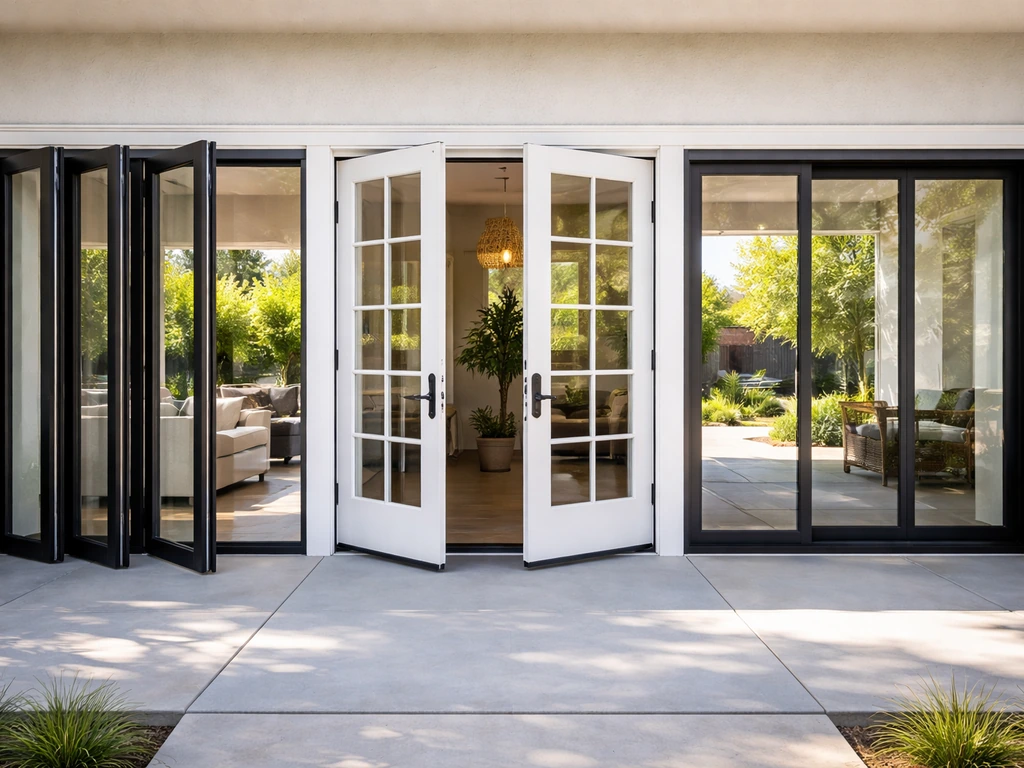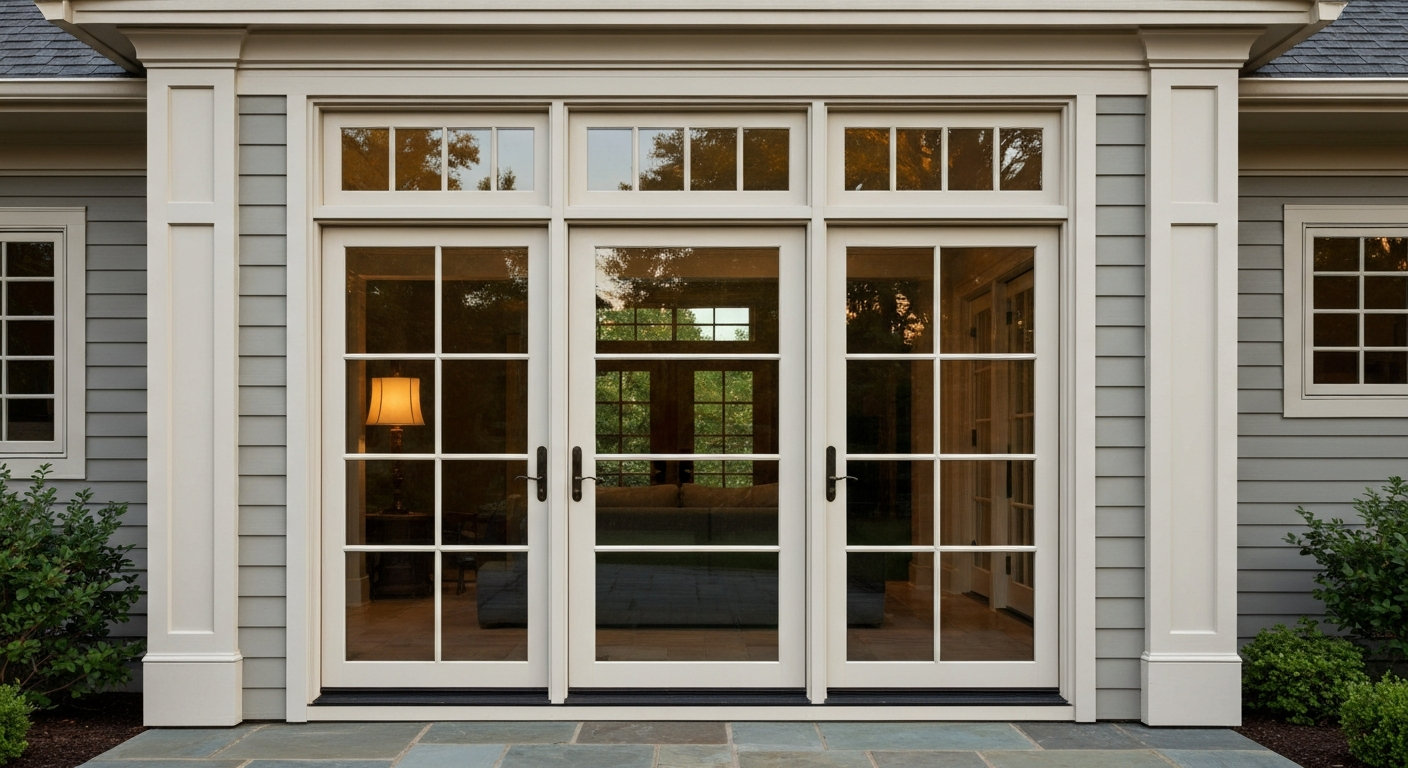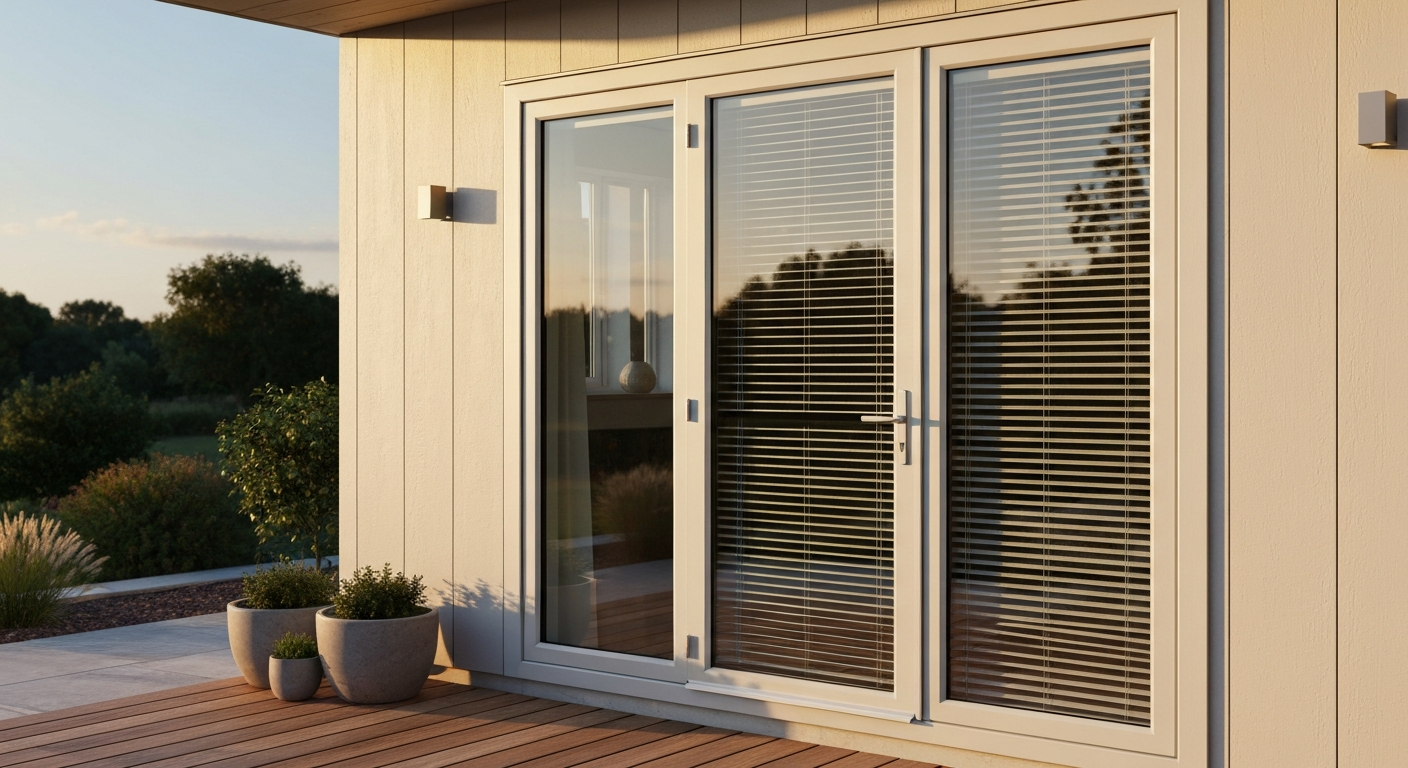
The best alternatives to vertical blinds for sliding patio doors are roller blinds, panel track blinds, and curtains on a ceiling-fixed track. For most UK homes, a made-to-measure roller blind or panel track system does everything vertical blinds do but with better light control, cleaner looks, and far less rattling in a draught. Which one suits you depends mainly on how often you use the door, how much light you need to block, and your budget.
Alternative to Vertical Blinds for Patio Doors UK Guide

Owen Delaney
14 May 2026
First, confirm your patio door type and measurements
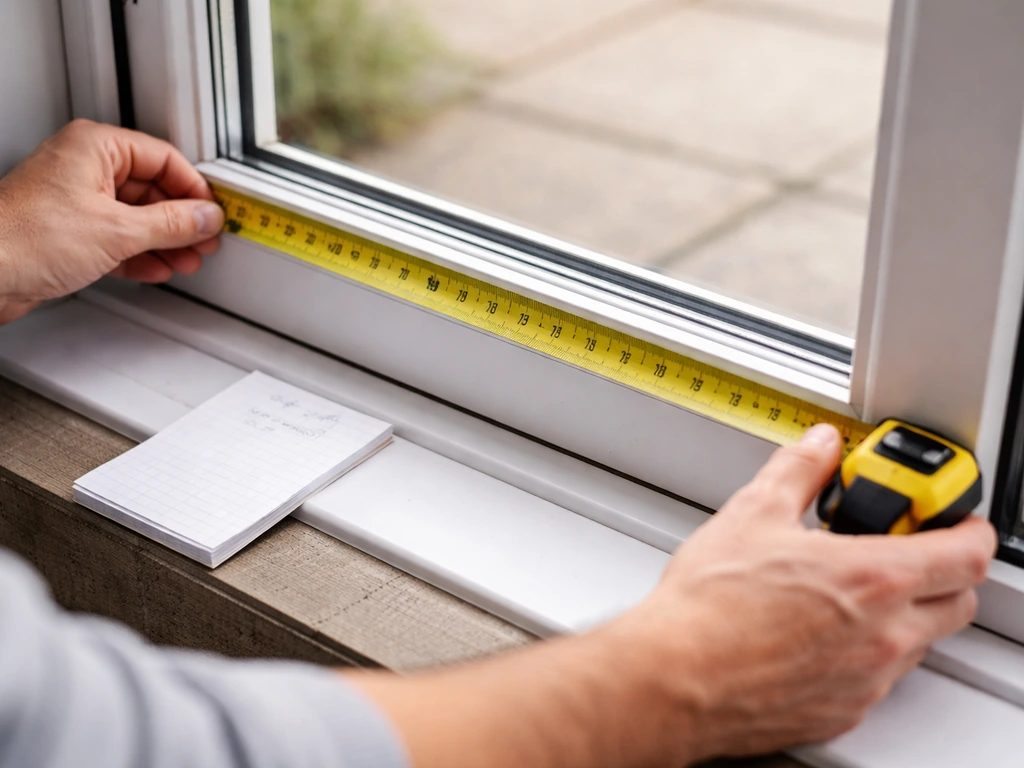
Before you look at a single product, you need to know what you are working with. First, confirm your patio door type and measurements, because the right selection depends on what to put on patio doors for your exact door setup. Most UK patio doors are sliding doors with a wide glass span, typically 1800mm to 2400mm wide and around 2100mm tall. French doors and bifold doors have different fitting requirements, so if yours are not sliding, some of what follows will apply differently. This guide is focused on sliding patio doors because that is where vertical blinds are most commonly installed and most commonly regretted.
Take three measurements before you buy anything: the exact width inside the recess (measuring at the top, middle, and bottom and using the smallest figure), the full height from top to sill, and the depth of the recess if you plan an inside fit. For an outside-recess mount, which is what most roller blind and panel track installers recommend for patio doors, you also need to know how much clear wall you have above the frame and to each side.
Dunelm's guidance suggests starting the blind at least 15cm above the recess and finishing at least 15cm below the sill, with a 5cm overlap on each side. English Blinds puts that side overlap at 10cm per edge, and for blackout specifically, most suppliers recommend a minimum of 7. 5cm to 10cm each side. Go with 10cm as your working figure and you will avoid the most common mistake, which is ordering too narrow and getting light gaps down the sides.
One more thing to check: the door mechanism itself. On a sliding door, the panel that moves needs clearance. Whatever covering you choose, it must stack or retract cleanly enough that it does not foul the door frame or slide panel when you open up. This is why vertical blinds became popular on patio doors in the first place. The alternatives below all handle this differently, so keep your door usage in mind as you read.
The main alternatives and how they actually work
Roller blinds
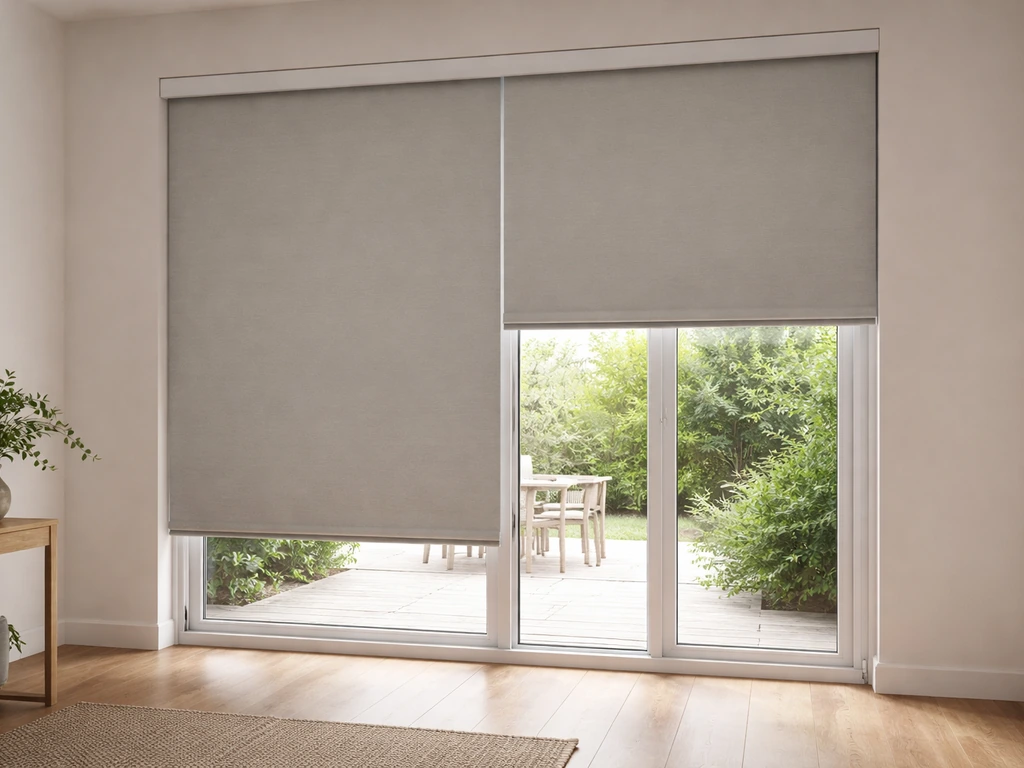
A single wide roller blind is the most popular replacement for vertical blinds in the UK right now. Made-to-measure rollers can be manufactured up to around 3000mm wide, which covers most sliding patio doors in one clean drop. They sit on a headrail above the door, roll up completely when you want full access, and create a genuinely tidy look that vertical slats never quite manage.
For patio doors, fit outside the recess so the blind overlaps the frame and reduces side light gaps. A cassette roller (where the rolled fabric sits inside a housing) looks neater and keeps dust off the fabric. Cordless or motorised options are worth considering here because reaching up to operate a wide roller blind by chain every time you use the door gets old quickly.
Panel track blinds
Panel tracks are essentially wide fabric panels that hang from an overhead track and slide sideways, stacking neatly to one or both sides. They are the closest functional replacement for vertical blinds and work brilliantly on wide sliding doors. When you open the door, the panels stack out of the way without any slats clattering or twisting. You can choose from light-filtering, solar, or blackout fabrics, and the panels themselves are easy to remove for cleaning.
The track needs to be ceiling or top-frame mounted, so check your clearance, but for most patio door openings this is straightforward. One practical note: individual panels can be slid back by hand to clean the glass behind them without taking the whole system down.
Roman blinds
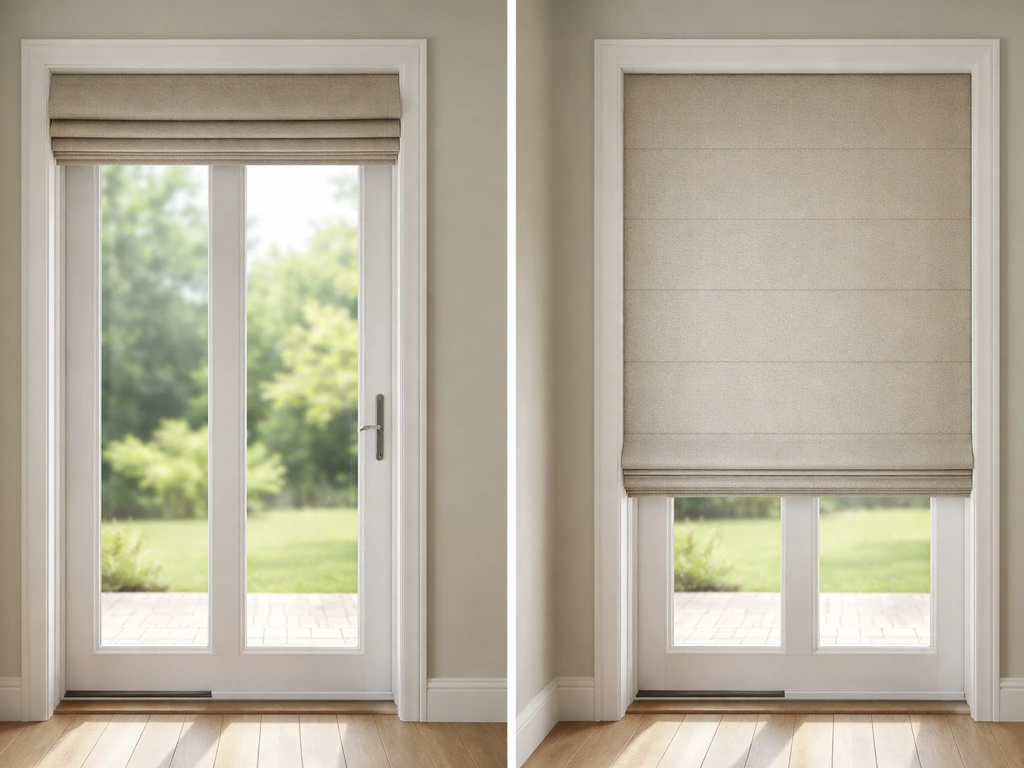
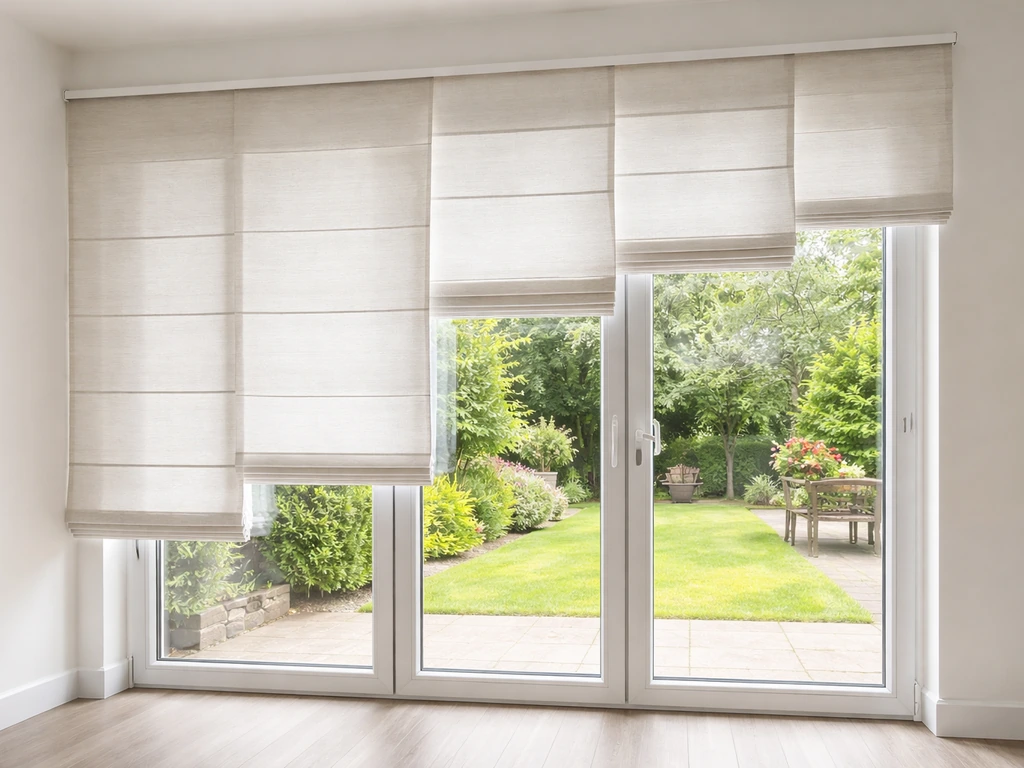
Roman blinds fold up into neat pleats when raised and give a softer, more traditional look than rollers. They are made-to-measure and available in a wide range of fabrics, including blackout linings. The honest trade-off for a patio door is width: very wide Romans across a full door opening can be heavy and slow to operate, and the fabric takes up more stack space when raised than a roller does.
They work best when fitted as two separate blinds side by side, each covering roughly half the door. That also means you can raise just one side if you only need partial access. Moisture is worth thinking about too, since the pleated fabric can hold condensation in a draughty or cold patio doorway, so keep the room well ventilated.
Curtains on a ceiling or top-fixed track
Full curtains on a wide track or pole are arguably the most flexible option for patio doors if you rarely need them to stack completely clear of the door. A ceiling-fixed track with gliders works better than a wall-mounted pole for patio use because the track can extend well past the door frame on one or both sides, letting the curtains park completely clear of the glass. This is critical if you open the door regularly.
Wave-pleat curtains on a ceiling track give a contemporary look and stack tighter than traditional pinch-pleat. For a sliding door, most fitters recommend extending the track at least 30cm beyond each side of the frame so the curtains genuinely clear the opening. Yes, you can put curtains on patio doors, but they work best when you extend the track so the curtains fully clear the opening.
Whether to use a pole or a track is worth discussing with a fitter because the door header and ceiling height both affect what is possible.
Quick comparison of the main options
| Option | Best for | Stack clearance | DIY-friendly | Approx. supply cost (made-to-measure) |
|---|---|---|---|---|
| Roller blind (wide single) | Simple look, frequent use | Excellent (rolls up fully) | Yes | £60–£200+ |
| Panel track | Wide doors, modern style | Excellent (panels slide aside) | Moderate | £150–£400+ |
| Roman blind (pair) | Softer style, partial coverage | Good (two separate stacks) | Moderate | £150–£500+ for two |
| Curtains on ceiling track | Maximum light block, cosy feel | Good if track extends far enough | Moderate–No | £200–£600+ fitted |
Getting light control and privacy right
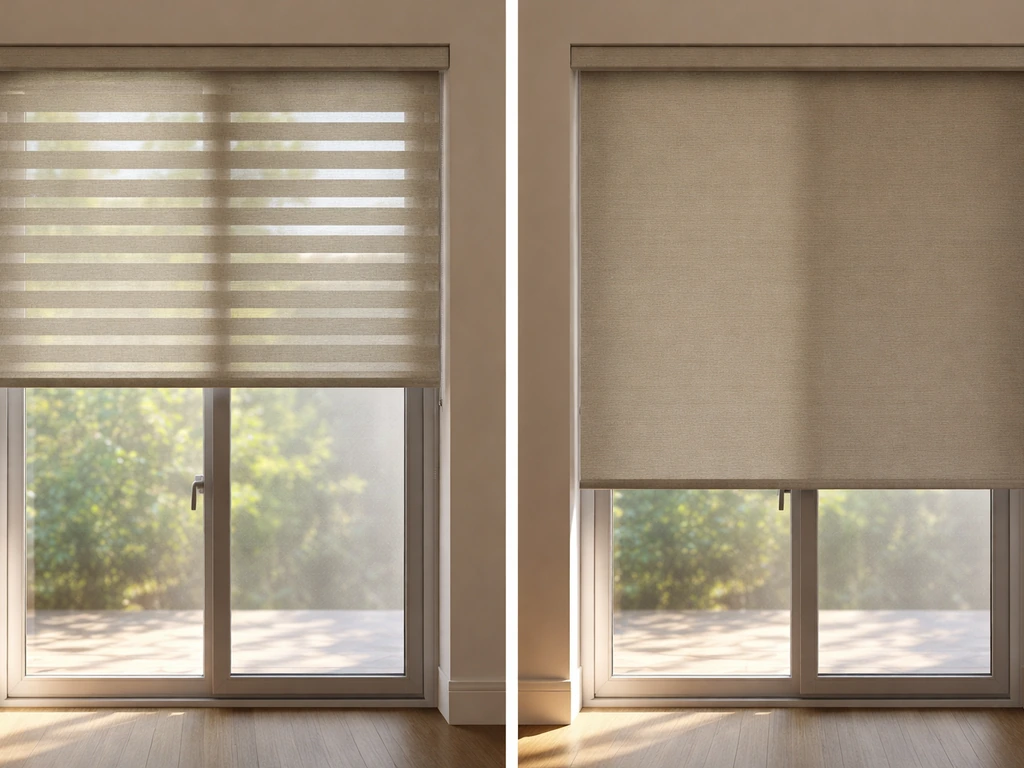
This is where most people make a mistake by treating light control as a single setting. For a patio door, you usually need two modes: daytime privacy with some light coming in, and full blackout or near-blackout in the evenings. Fabric choice is the key lever here.
For daytime use, a solar or screen fabric roller (with an openness factor of 3 to 5 percent) lets natural light through while cutting glare and limiting how much people outside can see in. The darker the fabric colour, the better the outward view from inside. At night, the relationship reverses as soon as you have lights on indoors, so a screen fabric alone will not give you evening privacy.
A day/night roller blind (also called a zebra or duo blind) alternates sheer and opaque bands; aligning the sheer bands lets light through during the day with reasonable privacy, and shifting to the solid bands gives more cover at night, though it is not full blackout. For complete blackout, you need a lined or coated blackout fabric fitted outside the recess with [a proper 10cm overlap on each side](https://www. blinds-direct. co.
uk/how-to-measure-roller. html) and ideally a cassette headrail to close the top gap.
The most practical solution for a busy living room patio door is a layered approach: a screen or day/night roller for daily use, with full-length curtains that you pull across in the evenings or for complete privacy. This also gives you a thermal benefit in winter, which matters in a UK climate. If layering feels like too much, a blackout roller with a high-quality side-channel or side-guide system is the closest single-product solution to genuine edge-to-edge coverage.
Security, drafts, and weatherproofing
Vertical blinds were never great for security or draft control, and most replacements are not fundamentally different. A window covering is not a security device, but there are some practical points worth knowing. Roller blinds fitted with side guides (channels that the fabric runs inside) reduce both light bleed and drafts noticeably, and they are used commercially for exactly this reason. For a domestic patio door they are a step up from a standard cassette roller in terms of edge sealing, though they add cost and the fabric must run clean inside the channels.
From a draft perspective, any gap between the blind and the frame is a weak point. Outside-recess mounting with a generous overlap helps, but the bigger culprit is usually the door itself: worn or damaged seals around the sliding frame let cold air in regardless of what covering is on the glass. If your patio door is draughty, check the perimeter seals and the threshold before spending money on a new blind. That said, full-length lined curtains do provide a meaningful secondary thermal barrier over a cold glass panel, and there is evidence that even interior roller blinds reduce heat loss compared to uncovered glass.
On security: none of these coverings prevent forced entry, but they do limit sightlines into your home, which matters for opportunistic burglary. A blackout or opaque blind drawn at night removes the visual invitation that an uncovered patio door creates. Ensure your patio door lock hardware is in good condition separately, and note that some blind tracks or curtain poles mounted across the door frame can act as an additional visual indicator that the door is occupied and watched.
Installation, operation, and keeping them clean
Installation: DIY vs. professional
Roller blinds are the most DIY-friendly option here. A single wide roller on a standard bracket above the door frame is straightforward if you are comfortable with a drill and can find solid fixings above the door. The main pitfall is the size: a 2400mm wide roller blind is heavy and awkward to hang solo, so having a second pair of hands helps.
Panel tracks need a ceiling or top-fixed track run, which is also manageable for a confident DIYer but requires accurate ceiling fixings and a level rail. Roman blinds in pairs are similar in difficulty to rollers.
Curtains on a ceiling-fixed track are where most people benefit from professional fitting, partly because ceiling fixing above a patio door frame needs to find solid joists or use appropriate fixings, and partly because the track alignment affects how well the curtains stack and travel. Companies like Hillarys offer a measure-and-fit service where an advisor visits to check what is feasible before anything is ordered.
Manual, cordless, and motorised operation
For a patio door you use daily, cordless or motorised operation is a genuine quality-of-life upgrade. A chain-operated wide roller is functional but pulling a 2-metre-wide blind up and down multiple times a day by chain starts to feel like a chore. Cordless spring rollers work well up to around 1800mm wide but can become stiff on wider spans.
Motorised rollers, which now typically start from around £120 for a made-to-measure unit, can be controlled by a remote or paired with a smart home system and make a wide patio door covering genuinely easy to use. For panel tracks, most systems are manually operated by hand-gliding the panels, which is simple and trouble-free. Curtain tracks can be motorised but that adds meaningful cost.
Cleaning and long-term maintenance
Roller blinds are the easiest to maintain. Wipe down the fabric with a damp cloth for marks and vacuum the rolled-up surface periodically. Cassette rollers stay noticeably cleaner than open rollers because the fabric is protected when rolled up. Panel track fabrics can be removed and wiped down or vacuumed individually.
Roman blinds need more attention: use the soft brush attachment on a vacuum regularly to stop dust settling into the folds, and follow the specific fabric care instructions for anything more than light dusting. Most fabric Romans should not be immersed in water at home and may need dry-cleaning. One important caution for patio door blinds specifically: condensation is common on cold glass, and if moisture settles in pleated or folded fabric regularly it can cause mildew.
Keep the room ventilated and check for moisture behind the blind during cold months. Curtains are the most maintenance-intensive because they need periodic washing or dry-cleaning depending on fabric weight, but they also handle light incidental contact and daily opening better than any blind fabric.
UK buying tips, sizing, and realistic costs
Made-to-measure is the right route for a patio door in virtually every case. Ready-made blinds almost never fit a wide sliding door cleanly, and the light gaps you get with an off-the-shelf product undermine the whole point of the covering. Most UK blind suppliers, including Blinds2go, Blinds Direct, English Blinds, and Dunelm's made-to-measure service, offer online ordering with delivery in two to three weeks. For curtains and fitted track systems, Hillarys and similar appointment-based services are worth using if you want a professional to measure and fit.
On cost: a supply-only made-to-measure roller blind for a typical patio door (around 2000mm to 2400mm wide) in a mid-range fabric runs roughly £80 to £200. A motorised version starts from around £120 and can reach £350 depending on spec. Panel track systems in the same width range typically run £150 to £400 supply-only. Roman blinds in pairs for a patio door are usually £150 to £500 depending on fabric.
Curtains with a ceiling track professionally fitted can reach £400 to £600 or more, but some homeowners DIY the track and buy curtains separately to keep costs down. Supply-and-fit roller blind pricing from local installers typically starts from around £48 for a basic roller and scales up with width and fabric.
A made-to-measure blind that is professionally measured and fitted should last five to ten years with reasonable care, so the per-year cost is manageable even at the higher end of the range.
Before you contact any supplier, have these figures ready: the exact width of your door opening (inside the recess or across the full frame, whichever applies to your chosen mount), the drop from your planned fixing point to the floor or sill, the available overlap space on each side, and how the door opens. Knowing whether you need the covering to clear completely to one side or split to two sides changes your product shortlist immediately. For wide doors, ask suppliers specifically whether their product is available in your width as a single unit or whether you will need two side-by-side, and what the join looks like in the middle if so.
A few things worth asking any seller or fitter before you commit: Can this product be fitted outside the recess with a 10cm side overlap on a patio door frame? Yes, shutters can be added to patio doors, but the right option depends on whether your door slides and how much clearance you have around the frame patio door frame. What is the stack width or roll-up depth when fully open? Is cordless or motorised available at this width? What is the lead time and the returns or remake policy if measurements are slightly out? Those four questions will save you from the most common and expensive mistakes.
Which option should you actually go with
If you use the patio door daily and want the simplest, most cost-effective upgrade from vertical blinds, go with a made-to-measure roller blind in a solar or day/night fabric, fitted outside the recess with a 10cm overlap on each side. Add a cordless or motorised mechanism if the door is wider than 1800mm.
If you want better style, more fabric choice, and a truly clean look when the door is open, a panel track system is the upgrade worth spending a bit more on. If light control and cosiness matter most, full-length curtains on a ceiling track with a lining or interlining give the best thermal and blackout performance, though they need the most thought around track extension and installation.
Roman blinds work well in pairs if you like a softer look and do not mind slightly more maintenance. Whichever direction you go, measure twice, order outside-recess with overlap, and check the door clearance before the fitter leaves.
FAQ
Can I use an alternative to vertical blinds if my patio door has a narrow recess or uneven frame?
Yes, but you usually need an outside-recess (or over-frame) fit, otherwise light gaps appear at the sides when the door slides. Measure the recess width and the available overlap space on both edges, then ask the supplier for a side overlap target of about 10 cm per side for blackout-like performance.
What should I prioritise if I want better privacy and less draught but budget is tight?
For daily use, prioritise overlap and edge control before fabric darkness. If you can only choose one improvement, add a roller with side guides or a channel system, because it reduces both glare leaks and draughts without relying solely on thicker fabric.
Will a solar or screen fabric roller give me privacy at night?
Not exactly. Solar and screen rollers are mainly about daytime glare and outward visibility, while nighttime privacy depends on what you have indoors turned on. If you want evening privacy from inside lights, look for a day/night (zebra) option or add lined curtains.
How do I know if a roller blind will foul the sliding door panel when it opens?
Check whether the blind stacks fully clear of the opening. A cassette roller helps keep the fabric protected, but you still need clearance for the moving door panel and enough headroom for the headrail housing. If you have limited clearance above the frame, a thinner track fabric system or ceiling-mounted curtain track may suit better.
Can I keep a panel track partially closed and still move the patio door smoothly?
Yes, you can open the door with the panels partially covered, but you need to confirm the panel stacking direction. Most panel track systems can stack to one side or both, and some allow panels to slide back by hand for glass access, so choose a configuration that matches how you use the door.
Are Roman blinds a good option for very wide patio doors?
Often, but it depends on your fixing and stack depth. Roman blinds in particular may look fine in measurements but can feel slow if they are very wide or made from heavier blackout fabrics. For a wide door, consider splitting into two blinds and test whether the stack depth stays clear of door movement.
What measurements matter beyond width and height when choosing between rollers, panel tracks, and curtains?
Ask for an estimated stack or roll-up depth in millimetres, then compare it to your ceiling height and any obstructions (lights, pelmets, window handles, or radiator positions). Two systems can both be “outside recess” but still differ a lot in how much space they need above the frame.
Is motorised blind control worth it for patio doors, and will it fit in low headroom?
Motorisation is usually easiest with rollers and can be fitted as part of a made-to-measure unit, but check battery access and control type (remote, app, or smart pairing). Also confirm whether a motor will affect the cassette depth, since some installs need a slightly different headroom allowance.
Can I go fully DIY with blackout coverage, or is professional fitting better?
You can, but it is a lot harder than you might expect. The blackout side seals and overlap typically assume a precise external width, so if the door is not square or your recess is off, you can get uneven gaps. If you are ordering, choose suppliers that explicitly confirm remakes or allowances for small measurement errors.
Which covering type copes best with condensation on cold patio doors?
If condensation is an issue, prefer systems that avoid holding fabric in deep pleats. If you choose Romans or heavier lined options, ventilate regularly and inspect behind the covering during cold months. A roller with a cassette and tighter edge control usually handles condensation better than open-pleat styles.
Do patio door blinds really improve security?
Not for security alone. These coverings mainly reduce sightlines, so burglary risk depends on your door and lock condition, plus any lighting or alarm. If you want the biggest visibility deterrent, choose an opaque blackout option and make sure it closes fully at night with proper edge overlap.
Which option is easiest to clean, rollers or panel tracks or Roman blinds?
Yes for maintenance, but check whether removal is designed for your system. Panel track fabrics are often removable panel by panel, while cassette rollers are easier because the fabric is enclosed. For Romans, plan for vacuuming the folds with the correct attachment and follow fabric care rules for any deeper cleaning.
What is a good layered setup if I want daylight in but full blackout in the evening?
A practical compromise is a day/night (zebra) roller for everyday privacy plus a curtain for evenings, rather than trying to get full blackout from one product. That also reduces how often you open and close heavy blackout curtains, which helps them stay in better condition.