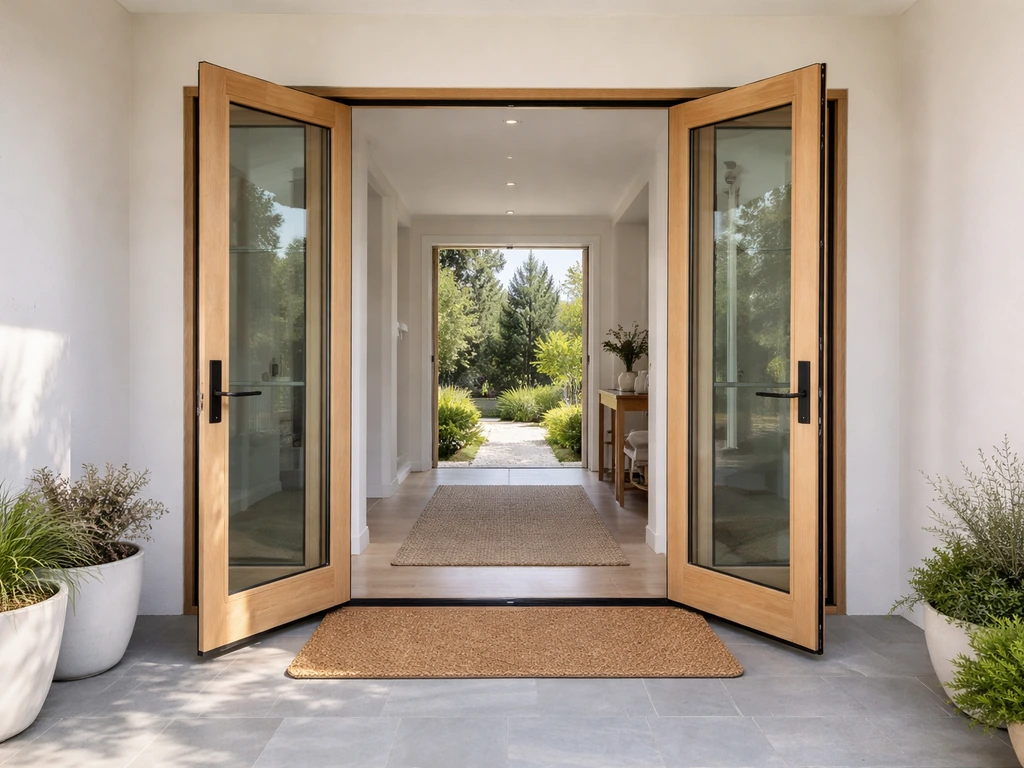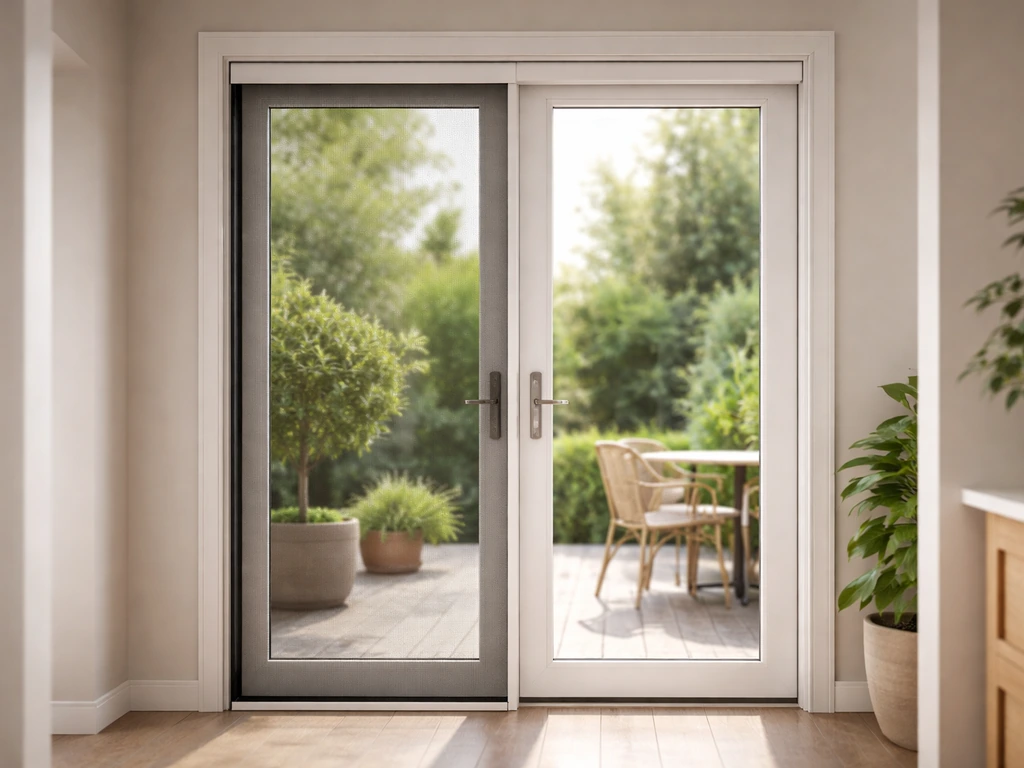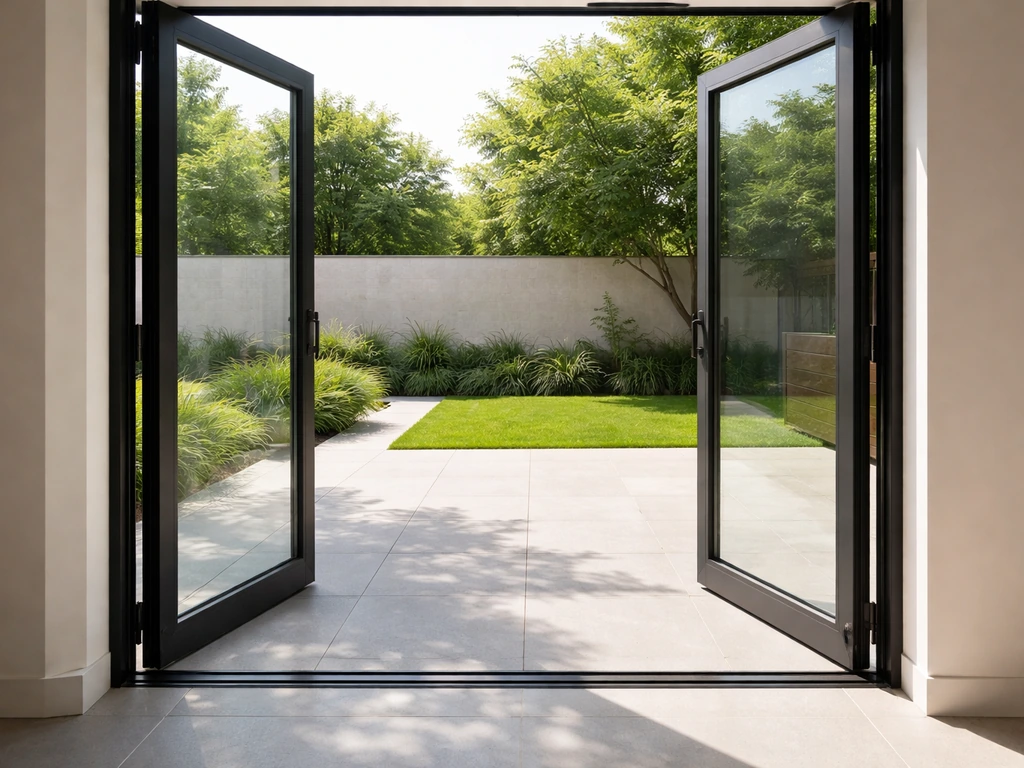
French patio doors with built-in blinds are one of the smartest upgrades you can make to a back door opening. You get the classic look of full-lite hinged doors, light control without a tangled cord flopping against the glass, and a cleaner interior that actually stays clean. The catch is that "built-in blinds" covers three very different product types, the sizing math trips up a lot of DIYers, and material and energy choices can quietly add or subtract hundreds of dollars over the life of the door. This guide walks you through every decision point so you can buy the right door, size it correctly, and know what you're getting into before the installer shows up. For comparisons and top picks, see our guide to the best french doors patio to help narrow choices by performance, style, and value.
Best French Patio Doors with Built-In Blinds: Buyer's Guide

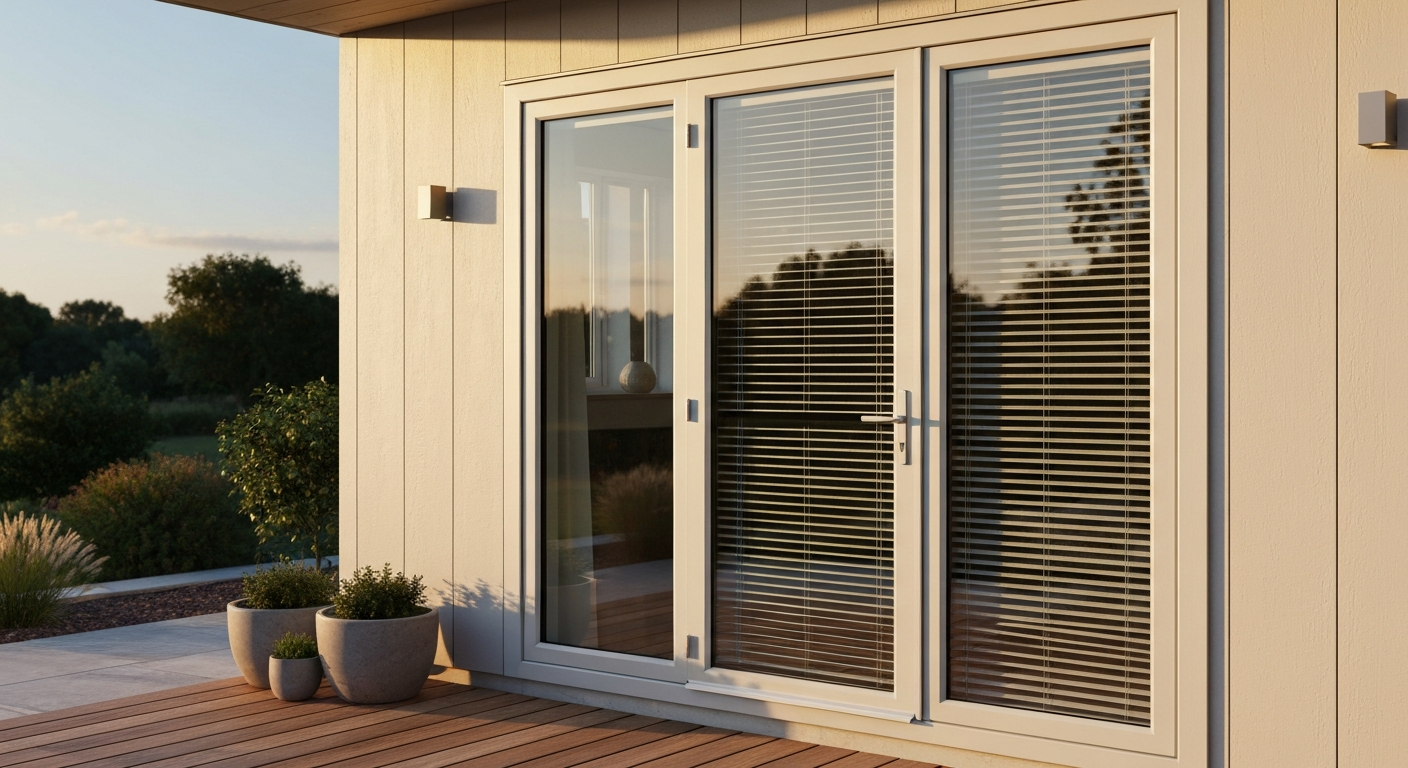
What a French patio door actually is
A French patio door is a pair of side-hinged (swinging) doors with large glass lites that meet in the middle of the opening. Oxford Learner's Dictionaries, French door (definition) describes a French door as a pair of side-hinged doors that meet in the middle, often with large glass panes blank" rel="noopener noreferrer">Oxford Learner's Dictionaries — French door (definition). Both panels are typically glazed from nearly top to bottom, which is where the name "full-lite" comes from. When you open them, you get a full-width clear opening with no center post to duck around. That is the main practical difference between a French door and a sliding patio door: a slider never clears the full opening because one panel always sits in front of the other, while a French door can throw both panels back and give you the entire rough opening minus the frame. For a clear definition and detailed overview, see what is a French patio door.
The trade-off is floor space. French doors swing into or out of the room, so you need a clear landing area of at least the door width on the inside (for inswing) or outside (for outswing). If your layout is tight, that swing arc can conflict with furniture or a deck railing. Sliding doors avoid that problem entirely but limit the clear opening to roughly half the rough opening width. That trade-off is worth thinking through early, especially on narrower openings.
French door styles, divided lites, and transom options
Beyond the basic full-lite pair, French patio doors come in several style variants that affect both aesthetics and how built-in blinds can be integrated. Full-lite doors have one uninterrupted glass panel per leaf, which is the standard format for between-glass blinds. Divided-lite doors use internal grilles (SDL grilles applied to the glass surface) or true divided lites (separate panes in a muntined sash) to give a colonial or craftsman look. True divided lites complicate blind integration because the glass area is broken up, so most built-in blind systems work best in full-lite configurations.
Transom windows and top-window variants sit above the main door pair, either as a fixed rectangle (a flat transom) or as a curved fanlight. See french patio doors with top window for examples and sizing considerations. These add height and light without affecting the operable door section. If you're adding built-in blinds, the transoms are usually left as standard glazing or fitted with a separate shade system, since the transom IGU is separate from the door leaf IGU. Some manufacturers sell coordinated shading packages that cover both zones. Swing types also matter: inswing doors keep hardware protected from weather but push water inward during rain; outswing doors keep the interior dry and work better on covered patios but require the hinge side to clear whatever is on the deck.
The three types of built-in blinds for French doors
This is where most buyers get confused because all three types get marketed as "built-in blinds" even though they work very differently. Understanding which type you're buying changes how you evaluate cost, warranty coverage, and long-term repairability.
Between-glass (sealed integral) blinds
These are the most common type on factory-built French patio doors. The blind sits inside a hermetically sealed insulating glass unit (IGU), sandwiched between the two panes of glass. You tilt or raise the slats using a magnetic slider on the door frame that transmits motion through the sealed IGU without breaking the seal. Because the blind is enclosed, it never collects dust, kids can't grab the slats, and the mechanism is extremely quiet. The downside is repairability: if the IGU seal fails or the mechanism breaks, you typically need an authorized service center or a full IGU replacement rather than a simple blind repair.
Accessible or snap-in blind modules
Some manufacturers, most famously Pella with its Slimshade system, design the IGU with a hinged or snap-out glass panel so the blind assembly can be serviced or replaced without pulling the whole door. This is a meaningful improvement in repairability over a permanently sealed unit. The blind is still inside the glass cavity, so it still looks clean and dust-free, but you or a technician can get to it. These systems cost more upfront but can save money over the door's lifetime if a mechanism or slat eventually needs replacing.
Retractable cassette or roller systems
The third option is a retractable shade or blind integrated into the door frame rather than inside the glass. These work like a roller shade cassette built into the top rail: pull down or press a button and a shade rolls out across the glass. They can be retrofitted to existing doors more easily than the other two types and offer more fabric choices (blackout, solar weave, light-filtering). The visible cassette housing changes the door's look slightly, and the shade is exposed to interior air, so it will collect dust over time. Still, for retrofit situations or when you want more fabric variety, a cassette system is worth considering.
Motorized built-in blinds
Motorized versions are available across all three categories but are most common in sealed and cassette systems. Power options include replaceable or rechargeable batteries (wire-free, easiest to install), low-voltage DC hardwired, AC mains hardwired, and solar-assist charging. For smart-home integration, the major motor vendors (Somfy, Lutron, Hunter Douglas PowerView) support Apple HomeKit, Google Home, and Amazon Alexa, typically via a bridge device. If whole-home automation matters to you, check which protocol the door manufacturer's motor uses before committing, because swapping motor brands later is rarely straightforward.
| Type | Dust-free | Repairability | Smart home ready | Best for |
|---|---|---|---|---|
| Sealed between-glass | Yes | Factory/authorized service only | With motorized upgrade | New installs, low-maintenance priority |
| Snap-in/accessible module | Yes | Field-serviceable by technician | With motorized upgrade | New installs, repairability priority |
| Retractable cassette/roller | No (interior exposed) | DIY-friendly replacement | Yes, wide options | Retrofits, fabric variety |
| Motorized (any type) | Depends on type | Depends on type | Yes (check protocol) | Smart homes, convenience |
Do French patio doors come with screens?
Most factory-built French patio door units do not include screens as a standard component, and this surprises a lot of buyers. See Do French patio doors have screens for a full explanation of screen options and installation considerations. Because the doors swing open, a traditional fixed screen frame would block the swing arc. Some manufacturers offer add-on screen door kits that hinge to the outer jamb, but these add visual bulk and can interfere with outswing door hardware.
The most practical solution for French doors is a retractable screen system. Brands like Phantom Screens make single and dual-door retractable units sized to custom openings. When you don't need the screen, it disappears into a slim housing mounted to the door frame. Mesh choices matter: standard fiberglass insect mesh (Phifer's 18x14 weave is a common spec) handles bugs; BetterVue and similar fine-mesh options improve visibility while still blocking insects; solar fabric meshes like SheerWeave or SunTex add glare and UV control without blocking airflow. Pet-friendly meshes with reinforced weaves are worth the upcharge if you have a large dog that leans on the screen.
If you are retrofitting screens onto existing French doors, measure the clear opening width carefully because most retractable systems mount to the face of the exterior casing, not inside the rough opening. A door with a wide casing profile can reduce the usable screen width by an inch or more on each side. Order screens after the door is installed and you have final measurements.
Materials: wood, fiberglass, vinyl, aluminum, and clad systems
Material choice affects price, maintenance schedule, energy performance, and how long the door actually lasts in your climate. Here is an honest rundown of each.
| Material | Typical cost range (door unit, installed) | Maintenance level | Energy performance | Best climate |
|---|---|---|---|---|
| Wood | $1,800–$4,500+ | High (painting/staining every 3–5 yrs) | Good if properly sealed | Dry/moderate climates |
| Fiberglass | $2,200–$5,500+ | Low | Excellent (low expansion/contraction) | All climates, especially humid or cold |
| Vinyl (uPVC) | $1,200–$3,000 | Very low | Very good (multi-chamber profiles) | Cold to moderate climates |
| Aluminum | $1,500–$3,500 | Low | Poor without thermal break | Mild climates only |
| Aluminum-clad wood | $2,500–$6,000+ | Low exterior, medium interior | Very good | All climates, premium look |
Wood doors look beautiful and can be painted or stained to match virtually any exterior. The problem is that wood moves with moisture and temperature, which can stress the IGU seal over time and cause the door to bind seasonally. If you live in a humid climate like the Southeast or Pacific Northwest, wood requires real commitment to maintenance. Fiberglass is my top recommendation for most homeowners: it is dimensionally stable, does not rot or warp, takes paint, and holds up in both hot and cold climates without the maintenance burden of wood.
Vinyl is the budget-friendly choice and works well for between-glass blind systems because the vinyl frame's multi-chamber profile already provides good thermal performance. Aluminum without a thermal break is a bad choice in any climate with temperature extremes because the frame conducts heat and cold directly, causing condensation and high energy loss. If you want the slim aluminum look, pay for the thermally broken profile. Aluminum-clad wood gives you the best of both worlds (aluminum exterior, wood interior) but at a premium price.
Glass and energy performance
The glass is typically 60 to 70 percent of the door's surface area, so it dominates the energy numbers. Double-pane IGUs are the baseline; triple-pane is available on premium units and makes sense in Climate Zones 5 through 7 (most of the northern U.S. and Canada) where the incremental cost is justified by heating season savings. Low-E coatings are non-negotiable in any climate: they reduce infrared heat transfer and cut UV fading. The coating position and type vary: hard-coat Low-E (pyrolytic) goes on the interior surface of the outer pane and is more durable; soft-coat Low-E (sputtered) goes on interior glass surfaces inside the IGU cavity and performs better thermally but is more vulnerable to seal failure.
Gas fills (argon is standard, krypton is used in thinner triple-pane units) slow conductive heat transfer through the air gap. The combination of Low-E plus argon fill is the sweet spot for cost vs. performance. Two numbers to check on the NFRC label are U-factor (lower is better for insulation, target 0.30 or below for a good double-pane unit) and SHGC (solar heat gain coefficient, range 0 to 1). In a hot climate, you want a low SHGC (around 0.25 or lower) to block solar heat. In a cold climate, a moderate SHGC (0.35 to 0.45) lets passive solar heat in during winter. ENERGY STAR qualification requires an NFRC label, and the program's regional thresholds vary by climate zone, so look up your zone before you shop.
Here is where between-glass blinds add a real bonus: when closed, sealed integral blinds can meaningfully reduce the effective SHGC of the door assembly because the blind layer blocks a large portion of solar radiation inside the IGU before it enters the room. Manufacturer testing using NFRC methods has confirmed this effect. It won't show on the standard door label (which rates glass open), but it is a real-world benefit on hot, sunny afternoons. Pella technical materials reference STC/OITC reporting that glazing strategy (glass type, interlayers, air gap, spacers) delivers the largest acoustic gains, with between‑glass blinds offering smaller additional benefits when fully closed.
Security: locks, multipoint systems, and glass options
French patio doors have a reputation for being less secure than sliding doors, and that reputation is partly earned when the door ships with a single-point deadbolt and a basic strike plate. The fix is a multipoint locking system, which engages bolts or hooks at the top, middle, and bottom of the door simultaneously when you turn the handle. Most quality French door manufacturers offer multipoint hardware as standard or as an upgrade, and it is worth every penny.
Active and passive panels matter here. In a standard French door pair, one leaf (the passive panel) is typically secured by surface bolts at the top and bottom, and the active leaf is the one you latch and lock. A multipoint system on the active leaf plus throw bolts on the passive leaf is a solid security baseline. For glass security, tempered glass (required by code in door applications) will shatter into small cubes rather than daggers, but it can still be broken for entry. Laminated glass (two panes bonded with a PVB interlayer) is harder to break through and significantly reduces the risk of smash-and-grab entry. Adding door/frame contact sensors or glass-break detectors to a home security system rounds out the package and can satisfy insurance requirements in some areas.
Sizing standards and how to measure correctly
Getting the size right upfront saves you from expensive framing changes later. French patio doors are sold by the combined slab width (both leaves together) and height. Common widths are 60 inches (two 30-inch leaves), 64 inches (two 32-inch leaves), and 72 inches (two 36-inch leaves). Heights are typically 80 inches (6/8) for standard ceilings, with 96-inch (8/0) units available for taller openings. The rough opening (RO) needs to be about 2 inches wider and 2 inches taller than the door unit to allow for shimming and squaring.
For egress compliance, the IRC requires at least one side-hinged exterior door with a minimum clear width of 32 inches (measured at 90 degrees open) and a minimum clear height of 78 inches. A 60-inch French door with a 1.5-inch center astragal gives each leaf about 28.5 inches of clear width at the opening, which falls short of the 32-inch egress requirement. If your French door is the primary egress door, size up to a 64-inch or 72-inch unit to clear the 32-inch requirement per leaf. Always check your local adopted code edition because some jurisdictions have amendments.
- Measure the rough opening width at three points (top, middle, bottom) and use the smallest measurement to size the door unit.
- Measure the rough opening height at three points (left, center, right) and use the smallest measurement.
- Account for the sill or threshold height: the floor to the top of the finished sill should leave at least 80 inches (or 96 if using 8-foot doors) to the top of the RO.
- Check swing clearance: measure the full arc of the door swing on the landing side and confirm no obstacles (furniture, railings, steps) fall within it.
- For outswing doors, confirm the exterior landing is within 7.75 inches of the threshold per IRC R311.3 (a step down is permitted but limited).
- If replacing an existing door, note the exterior casing width: it determines whether you can cover the old RO framing with the new door's flanges or casing.
Costs: what to budget for the full project
Door unit prices are only part of the number. A mid-range fiberglass French door unit with sealed between-glass blinds typically runs $1,800 to $3,500 for the door itself. Add professional installation (framing adjustment, flashing, casing, and hardware) at roughly $400 to $900 depending on complexity and region. If you need framing work because the existing RO is wrong, add $300 to $800 more. Premium units with motorized blinds, triple-pane glass, and aluminum-clad frames push the total to $5,000 to $9,000 installed. Budget-end vinyl units with manual between-glass blinds can come in under $2,000 installed if framing is clean.
The between-glass blind upgrade typically adds $200 to $600 to the door unit price over the equivalent non-blind model, depending on the manufacturer and whether the system is manual or motorized. Retractable screens are a separate line item: expect $400 to $900 for a dual-door retractable screen unit, professionally installed. Factor in potential ENERGY STAR rebates and utility company incentives, which can offset $50 to $200 depending on your state and utility. Ask for the NFRC label for the specific door configuration you're buying to verify it qualifies.
Brand and model selection: what to look for
Rather than naming a single winner, here are the criteria that separate good products from ones you'll regret. First, confirm the door carries an NFRC label for the exact configuration (with blinds, with the glass package you want). Second, check whether the built-in blind system is serviceable: ask the dealer whether the IGU can be replaced in the field without a full door replacement, and what the replacement part cost is. Third, look at the warranty structure: a good door warrant covers the IGU seal for at least 10 years and the mechanical hardware for at least 5 years, with a transferable option if you sell the house.
Pella, Andersen, Marvin, Milgard (west of the Rockies), and Therma-Tru are the names that come up most often in the French patio door category, and all offer at least one between-glass blind configuration. Pella's Slimshade snap-in system has a meaningful servicing advantage. Andersen's E-Series and A-Series offer broad customization. For value-tier buyers, Reliabilt (Lowe's) and JELD-WEN offer more affordable vinyl and fiberglass units with sealed blind IGUs, though the warranty terms and service network are more limited. Always buy from a dealer who can order replacement IGU components, not just a big-box store that stocks only full door replacements.
Installation: new install vs. retrofit and what to DIY
If you are replacing an existing French door with another French door of the same size, and the framing is square and in good shape, a competent DIYer with some carpentry experience can handle the swap. The critical steps are: protecting the rough opening from water infiltration during the install, setting the door plumb and square before shimming, flashing the head and sides correctly (not just caulking), and setting the sill pan flashing. Missing any of these leads to rot or water intrusion inside the wall that you won't find for years.
If you are converting a window to a door opening, or enlarging an existing rough opening, hire a contractor. Moving a header or cutting a load-bearing wall without proper structural support is a code issue and a safety issue. The permit and inspection process for a new door opening exists for good reason. For a straight replacement in a non-load-bearing situation, the permit requirement varies by jurisdiction, but it is always worth calling the building department first.
Maintenance and warranty: what to expect long term
Between-glass blinds require almost no maintenance because they are sealed. What you do need to monitor is the IGU seal: fogging or haziness between the panes is the first sign of seal failure. A failed IGU does not mean the door is ruined, but it needs to be addressed before condensation causes moisture damage inside the wall or frame. Check caulking and weatherstripping annually, especially after a hard winter.
For wood and wood-clad units, plan to inspect and refinish or repaint the exterior wood surfaces every 3 to 5 years. Fiberglass and vinyl frames need only occasional cleaning with mild soap. Hardware lubrication (hinges, multipoint lock mechanism, threshold adjusters) once a year keeps everything operating smoothly and extends the life of expensive mechanical components. For motorized blinds, battery-powered motors typically need new batteries every 2 to 4 years depending on usage; hardwired motors are essentially maintenance-free on the power side.
Decision checklist before you buy
- Measure your rough opening at three points in each dimension and confirm which direction the door swings (inswing vs. outswing) given your interior layout and exterior landing.
- Decide on built-in blind type: sealed between-glass for lowest maintenance, snap-in/accessible for best repairability, retractable cassette for retrofit or fabric variety.
- Choose material based on climate and maintenance tolerance: fiberglass for most homeowners, wood-clad for premium aesthetics, vinyl for budget, thermally broken aluminum for modern look.
- Request the NFRC label for your exact door configuration and verify U-factor and SHGC match your climate zone's ENERGY STAR requirements.
- Confirm the door unit meets IRC egress requirements if it is the primary exit: 32-inch clear width per leaf at 90 degrees, 78-inch clear height.
- Ask about multipoint locking hardware and specify laminated glass if break-in security is a priority.
- Budget for the full project: door unit, installation, framing if needed, retractable screens, and any smart-home motor integration.
- Review warranty terms for the IGU seal, the blind mechanism, and the door hardware separately, and confirm replacement IGU parts are available through local dealers.
- Get at least two installation quotes and ask each contractor how they handle sill pan flashing and exterior casing to assess their experience level.
FAQ
What is a French patio door and how does it differ from sliding patio doors?
A French patio door is a pair of side‑hinged doors that meet in the middle and swing open (often called double or paired hinged doors). Unlike sliding doors, French doors provide a full‑width clear opening at the threshold but require swing clearance and a suitable landing/threshold. Operation, hardware, and rough‑opening requirements are the main differences.
What types of built‑in blinds are available for French patio doors?
Three main approaches: (1) Between‑glass (integral) blinds sealed inside the insulated glazing unit (IGU); (2) Accessible/removable blind modules or snap‑in assemblies that allow servicing or IGU removal; (3) Retractable cassette/roller systems integrated into the door frame or mounted on the sash. Each balances protection, serviceability, and cost differently.
What are the pros and cons of between‑glass (integral) blinds?
Pros: protected from dust, pets, and kids; low maintenance; improved appearance and consistent operation; can reduce solar heat gain when closed. Cons: more limited repair options (often factory/authorized service) if the IGU seal or mechanism fails; higher initial cost; restricted retrofit options unless door/IGU designed for it.
How do motorized integrated blinds work and what power options exist?
Motorized integral or cassette blinds use small motors to raise/lower or tilt slats. Power options include rechargeable or replaceable batteries (wire‑free), low‑voltage DC hardwiring, mains AC hardwiring, and solar‑assist charging. Many systems support remotes, wall switches, and smart‑home integration through manufacturer bridges (Somfy, Lutron, Hunter Douglas).
Will built‑in blind French doors come with screens? How do I add screening?
Most factory French patio doors with built‑in blinds do not include a screen by default. Common screening options: retractable door screens (Phantom, Rolscreen) sized for double doors; fixed or removable screen panels; or custom framed screens. Retractable screens are popular because they tuck away when not needed and offer different mesh options (insect, solar, privacy).
How do built‑in blinds affect energy performance and ratings?
Between‑glass blinds act as an internal shading layer and can lower center‑of‑glass solar heat gain (SHGC) and improve occupant comfort when closed. NFRC has procedures to rate fenestration with shading; buyers should request NFRC labels for U‑factor and SHGC for the exact door configuration to compare energy performance across products and claim ENERGY STAR qualification where applicable.