Traditional blinds are not your only option for a patio door, and in many cases they are not even the best one. National energy savings potential of cellular shades: A measurement and simulation study, ORNL notes that ORNL (Oak Ridge National Laboratory) published a measurement + simulation study concluding that insulated cellular (honeycomb) shades can materially reduce window heat transfer and have substantial national energy‑savings potential when widely deployed (study: “National energy savings potential of cellular shades”) blank" rel="noopener noreferrer">National energy savings potential of cellular shades: A measurement and simulation study — ORNL. Depending on your door type, how much privacy or light control you need, and whether you have kids or pets, curtains, roller shades, cellular shades, panel tracks, plantation shutters, solar screens, or window film can each outperform a standard horizontal blind in one or more ways. This guide walks through every realistic option, with real cost ranges, sizing guidance for the most common patio door widths (60", 72", and 96"), honest trade-offs, and a recommendation matrix at the end so you can make a decision without guessing.
Patio Door Blind Alternatives: Best Picks by Door Type Guide
When to ditch the blinds (and a quick decision checklist)
Most homeowners start questioning their patio door blinds for one of four reasons: the slats break or warp, cords become a safety hazard for kids or pets, the blinds rattle when the door opens, or they simply look dated. All of those are legitimate reasons to explore alternatives. But before jumping to a replacement, it helps to get clear on your actual priorities, because a blackout roller shade solves a different problem than an exterior solar screen.
Run through this checklist before you shop. Check every box that applies to your situation:
- I need full privacy at night (neighbors or streetlights are visible)
- I want to reduce glare without blocking the view during the day
- Energy bills are a concern and I want better insulation at the glass
- I have children or pets and cords are a safety issue
- My door is wider than 72" and standard blinds look undersized or sag
- I want something that looks more polished or custom
- The door is a bifold or multi-panel and most blinds do not fit the operating style
- I am open to exterior solutions (screens, awnings) that stop heat before it hits the glass
- I want something virtually maintenance-free
The more boxes you check in the energy or safety categories, the more seriously you should look at cellular shades or exterior screens. If aesthetics are the main driver, curtains and plantation shutters tend to win. If you checked the bifold box, you will need to skip several interior options entirely and focus on panel tracks, curtains on a ceiling track, or exterior solutions. Keep your checklist answers handy as you read through each option below.
How your door type and size shapes every covering decision
The covering that works beautifully on a 60" sliding door can be completely impractical on a 96" bifold. This is one of the most common mistakes homeowners make: buying a covering based on photos online without accounting for how the door actually operates or how wide it is. Here is how the three most common patio door types affect your options.
Sliding patio doors (most common: 60" and 72" wide, also 96")
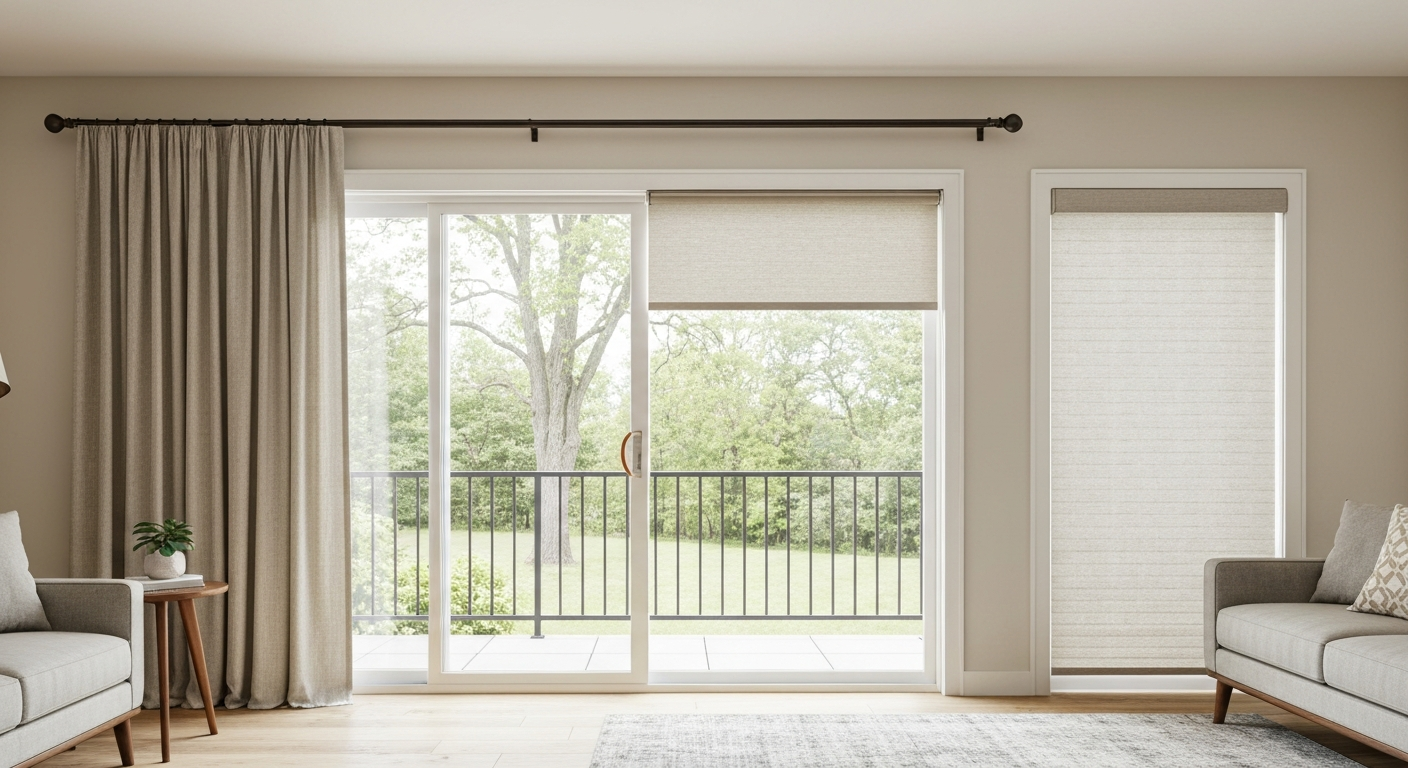
Standard sliding glass doors come in nominal widths of roughly 60", 72", and 96". The active panel slides behind the fixed one, which means any covering mounted inside the frame has to clear the handle hardware and cannot obstruct the slide path. Because of that, inside-mount depth on most modern sliding doors is very shallow (often under 3"), making inside-mount shades difficult to fit. The practical solution is outside-mount: hang the covering on the wall above the door frame and extend it 3 to 4 inches past each side of the frame so it fully covers the glass and clears the handle when open. For a 72" door, that means ordering or cutting to roughly 78" to 80" wide. Vertical options like panel tracks and curtains are naturally suited to sliding doors because they stack in the same direction the door travels.
French patio doors (typically 60" to 72" total, two active panels)
French doors swing open, and both panels are often active. That creates a real challenge for any single wide covering: it either blocks the door from opening fully or gets damaged by the swinging panels. The most common solutions are either two separate coverings (one per panel, inside- or outside-mounted on each door leaf) or a single wide curtain on a tension or ceiling-mounted rod that can be fully pushed to the side when the doors open. Roller shades and cellular shades work well on French doors when mounted per-panel. Plantation shutters are arguably the most natural match because the shutter panels can fold back with the door.
Bifold patio doors (often 96" to 144" or wider, multiple folding panels)
Bifold doors fold and stack to one or both sides, which means they eat up significant wall space when open. Most traditional interior blinds simply do not work here. Your best inside options are a ceiling-mounted curtain track that spans the full opening with panels that can stack completely clear of the door, or a panel track system engineered for large openings. Exterior solutions (retractable screens, solar shades, awnings) are often the most practical choice for bifolds because they operate independently of the door panels entirely.
How to compare your options: the six criteria that matter
Every option in this guide is scored against six criteria. Here is what each one actually means in practical terms before we get into the comparisons.
- Privacy: Does it block the view from outside at night when your interior lights are on? Full privacy means no silhouettes visible. Partial privacy means shapes or movement may be seen.
- Light control: Range from sheer (softens light, no glare reduction) to room-darkening (blocks most light) to blackout (blocks virtually all light). Important if you have a TV or bedroom adjacent to the patio door.
- Energy efficiency: How well does the covering reduce heat gain in summer or heat loss in winter? Measured loosely by R-value contribution or SHGC reduction. Exterior options stop solar heat before it enters; interior options trap it or reflect it after it passes through the glass.
- Durability: How well does it hold up to repeated door use, pet contact, cleaning, and direct sun exposure? Fabrics fade; vinyl and aluminum hold color longer; wood warps in humidity.
- Pet and child safety: Cordless, motorized, or shuttered designs are the safest. Looped cords are the most dangerous. Look for WCMA/ANSI cordless or inaccessible-cord designs if you have young children.
- Aesthetics: Does it look polished or utilitarian? Custom fabrics and painted shutters tend to look the most finished. Panel tracks and roller shades can look clean or institutional depending on the fabric.
Curtains and drapes: the most flexible interior option
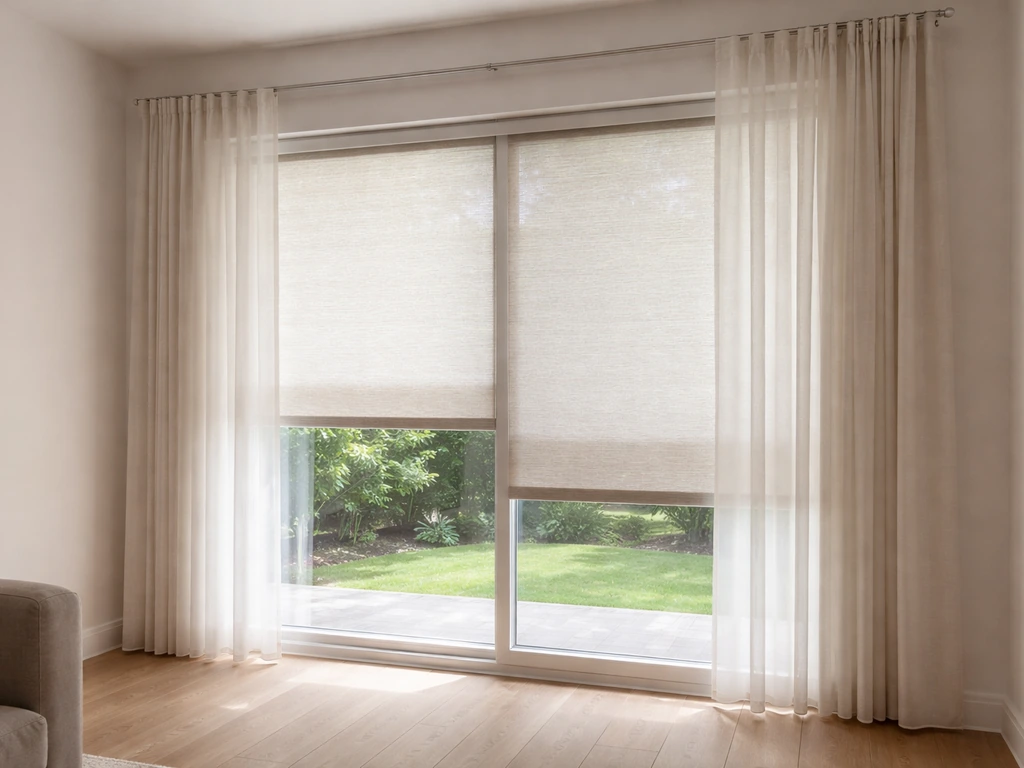
Curtains are the oldest patio door covering for a reason: they are flexible, cheap to replace, and easy to make look intentional in almost any room. A full-length drape on a patio door can cost anywhere from about $30 for a basic polyester panel pair from a big-box store to $300 or more per panel for custom lined drapes from a specialty workroom. For most sliding or French doors, you will need panels wide enough to stack completely clear of the glass when open, which usually means buying panels that are 1.5 to 2 times the total width of the opening.
Pros, cons, and sizing by door type
The biggest practical advantage of curtains is that they are easy to DIY, easy to remove for washing, and easy to change seasonally or when you redecorate. The downsides are that cheap fabrics fade quickly in direct sun (a real issue on south- or west-facing patio doors), they do not provide meaningful energy savings unless you use insulated or blackout-lined panels, and they can feel bulky if you have limited wall space beside the door for the stack. For a 72" sliding door, plan on at least 18" of clear wall space on each side for the curtain stack, or consider a single panel that parks on one side only.
For French doors, the cleanest approach is two separate panels, one mounted per door leaf on a rod attached to the door itself. This way the panel swings with the door and does not obstruct opening. Tension rods that mount inside the glass frame work for lightweight sheers; for heavier blackout panels you will want screwed-in hardware. For bifold doors, a ceiling-mounted traverse or ripple-fold track spanning the full opening is the most practical curtain solution, with enough fabric to stack completely clear on one or both ends.
Cost, DIY vs. pro, and maintenance
- Off-the-shelf panels: $30 to $150 per panel pair, DIY installation, 30 to 60 minutes with a basic rod and bracket kit
- Semi-custom panels (online retailers like Pottery Barn or West Elm): $80 to $250 per panel, DIY-friendly, ships in 1 to 4 weeks
- Fully custom with lining and interlining: $200 to $600+ per panel, typically requires a workroom or designer, professional installation recommended for traverse rod systems
- Maintenance: most polyester/cotton-blend panels can be machine washed on a gentle cycle; dry clean only for heavyweight or lined custom drapes; re-hang while slightly damp to prevent wrinkling
Roller shades (including blackout): clean, low-profile, and easy to size
Roller shades have become one of the most popular patio door alternatives precisely because they are low-profile, easy to order in custom widths, and available in fabric types that range from sheer solar screen fabric (great for daytime glare control without killing the view) to full blackout (useful if your door opens to a bedroom or home theater area). A basic cordless roller shade in a standard width runs $50 to $150 from retailers like Blinds.com or The Shade Store; custom-sized blackout rollers for a 96" bifold opening can reach $400 to $600 per panel.
Installation difficulty and sizing guidance
Roller shades are one of the easier DIY installations: two brackets, a level, a drill, and about 20 minutes. The tricky part is measuring correctly. As noted in the sliding door section, outside-mount is almost always the better choice for patio doors. Order the shade width to match your desired coverage width (opening plus 3" per side), not the door frame width. Height should run from the mounting point (typically 4" above the frame) down to the floor or just above the sill, depending on how much light you want to block at the bottom. For French doors, order one shade per panel and mount each on the door leaf itself using a friction or adhesive mount if you do not want to drill into the door.
One thing to watch: very wide roller shades (over 72") can sag or bow in the middle if the tube diameter is undersized. Quality retailers will upsize the tube automatically for wider shades, but it is worth asking. For openings over 96", a split two-shade installation (two shades meeting in the center) is often more reliable than a single oversized roller.
Cost ranges and what you get at each tier
| Shade Type | Typical Cost Range | Light Control | Best For |
|---|---|---|---|
| Solar/screen fabric roller | $50–$200 (off-shelf) / $100–$350 (custom) | Glare reduction, partial privacy | Living rooms, daytime use |
| Room-darkening roller | $60–$250 (off-shelf) / $120–$400 (custom) | 85–95% light block | Most patio doors |
| Blackout roller | $80–$300 (off-shelf) / $150–$600 (custom) | Near-total light block | Bedroom-adjacent doors |
| Motorized roller | $200–$800+ per shade (custom) | Any fabric available | Bifold, large openings, accessibility |
Cellular (honeycomb) shades: the best energy-efficiency upgrade you can hang
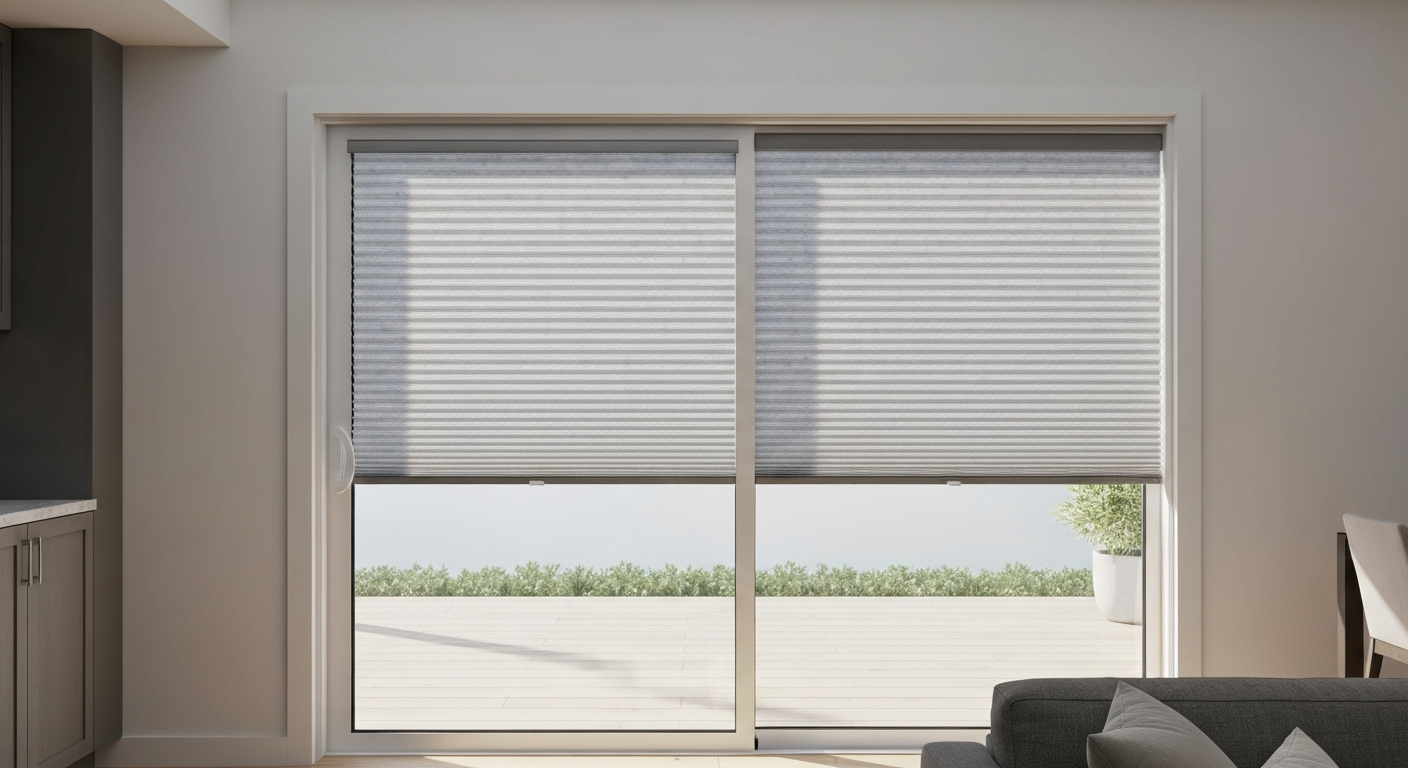
If your main concern is energy efficiency, cellular shades are the option backed by the most credible research. Interior Cellular Shades Boost Home Energy Performance, U.S. DOE states they are among the most effective interior attachments for increasing window R‑value and reducing winter heat loss and summer solar heat gain when used properly Interior Cellular Shades Boost Home Energy Performance — U.S. DOE states they are among the most effective interior attachments for increasing window R‑value and reducing winter heat loss and summer solar heat gain when used properly.. Studies from Oak Ridge National Laboratory and Pacific Northwest National Laboratory have both documented measurable HVAC energy savings in homes that installed high-quality cellular shades, and the U.S. Department of Energy includes them in its technical guidance for window attachments as one of the most effective interior treatments for improving window R-value. The double-cell (or dual-cell) construction traps air in two layers of honeycomb pockets, which slows heat transfer in both directions: heat gain in summer and heat loss in winter. The Attachments Energy Rating Council (AERC) now issues verified energy performance ratings for shade products, so you can look for AERC-rated cellular shades (Hunter Douglas was among the first to receive these ratings) when comparing brands.
Light control and privacy performance
Cellular shades come in light-filtering and room-darkening fabric options. Light-filtering cellular shades diffuse sunlight nicely without blackout, which works well for daytime privacy without making the room feel like a cave. Room-darkening cellular shades block most light and provide solid nighttime privacy. Full blackout cellular shades are available from premium brands but add cost. One limitation compared to roller shades: cellular shades do not offer the same view-through as a light solar screen fabric because the honeycomb cell structure scatters rather than transmits the image.
Pet and child safety, costs, and mounting notes
Cellular shades are widely available in cordless and motorized versions, making them among the safest options for households with young children or pets. Cordless cellular shades for a 72" patio door typically run $150 to $350 from mid-tier retailers; motorized versions from premium brands like Hunter Douglas can reach $500 to $900 per shade for a large patio door width. As with roller shades, outside-mount is generally the right choice for sliding patio doors due to limited jamb depth. Hunter Douglas Duette literature, for example, specifies maximum width and height limits by operating system, so check those specs before ordering a very wide or very tall shade in a top-down/bottom-up configuration.
Roman and soft-fold shades: the most elegant soft option
Roman shades fold into horizontal pleats when raised and lie flat when lowered, which gives them a tailored, upholstered look that suits traditional or transitional interiors well. Soft-fold (or relaxed) Romans have a slight bow at the bottom when lowered, which reads as a little more casual. Both styles work best on French doors (mounted per panel) or on single-panel fixed glass beside a sliding door. They are not ideal for very wide openings: Roman shades wider than about 72" become heavy and the lift mechanism struggles, so for wide patio doors you would need to use two Romanshades side by side.
Durability, costs, and where they fall short
Roman shades are more vulnerable to sun damage than roller shades because the horizontal folds hold shape better in some fabrics but fade unevenly and can yellow along the folds with prolonged UV exposure. Lining (especially blackout lining) helps protect the face fabric and adds some insulating value. Expect to pay $80 to $200 for a ready-made Roman shade in a standard size, and $250 to $600 or more for a custom lined Roman in a quality fabric. Professional installation is recommended for corded Romans on wide patio doors because improper cord tension causes uneven folding; cordless motorized versions are available but add $200 to $400 to the cost. Roman shades are one of the harder options to clean: spot-clean only for most lined versions, and dry clean for silk or heavyweight fabrics.
Top-down / bottom-up shades: privacy without losing the sky
Top-down/bottom-up (TDBU) shades are exactly what the name says: you can raise the bottom up from the sill, lower the top down from the header, or do both simultaneously to create a privacy band at eye level while leaving the upper portion of the glass open to daylight and sky views. On a patio door, this solves a specific and common problem: you want to block the view from outside at eye level (especially from neighbors or a street) without making the room feel dark during the day. It is one of the few interior covering configurations that genuinely delivers both privacy and natural light at the same time.
Benefits and real-world limitations
TDBU shades are available in cellular, roller, and Roman shade styles. Cellular TDBU shades (like the Hunter Douglas Duette in TDBU configuration) are the most popular because they add the energy efficiency benefit on top of the privacy-plus-light advantage. The limitation is mechanical complexity: TDBU shades have more cords or more motorized components than a standard shade, which means more potential failure points and higher cost. Hunter Douglas Duette product specs list specific maximum width and height limits for TDBU operating systems, and going beyond those limits risks uneven operation or mechanism failure. For a standard 72" patio door, most TDBU cellular shades will operate reliably; for a 96" opening, verify the specific width limit of the product you are buying.
Cost, installation, and when to choose TDBU
TDBU cellular shades typically cost 20 to 40% more than equivalent single-direction cellular shades. Budget roughly $200 to $450 for a cordless TDBU cellular shade on a 72" patio door from mid-tier retailers; motorized TDBU from premium brands runs $600 to $1,200 or more for the same size. Installation difficulty is similar to a standard cellular shade (outside-mount, two brackets) but the initial adjustment of both the top and bottom rails takes a few minutes to get right. TDBU shades are the right choice when you need daytime privacy at eye level without sacrificing natural light, when you do not want to close off an attractive view of the sky or tree canopy above the fence line, or when you are covering a patio door in a bathroom or ground-floor bedroom where full daytime privacy is essential.
Panel tracks: the purpose-built solution for wide sliding and bifold doors
Panel tracks (also called sliding panel blinds) are essentially large fabric panels that slide along an overhead track, much like the door itself does. They are the most natural visual match for a wide sliding glass door and one of the few interior options that work without modification on bifold openings up to 144" or wider. Retailers like Blinds.com and Home Depot carry panel track kits in 3-panel and 4-panel configurations; kit prices for a 6- to 9-foot opening typically run $500 to $700 at retail, though custom fabric and motorized versions go higher. The panels can be made from sheer, room-darkening, or blackout fabric, and some configurations include thermal or blackout lining.
The main trade-off with panel tracks is stack depth: when fully open, the panels stack on one or both ends and require clear wall space. For a 96" door with three panels stacking to one side, you need roughly 32" of clear wall. If your layout does not have that clearance, the panels will partially cover the glass even when open. The other limitation is light gaps at the panel seams: panels do not overlap significantly, so there are visible vertical light lines between panels when the shade is closed. This is usually not a problem for general privacy but can be noticeable at night.
Plantation shutters: the premium interior option
Interior plantation shutters are the highest-cost interior option but also the most durable and arguably the most polished-looking. Louvers can be tilted to control light and privacy without opening the shutter panels, and full-height bi-fold shutter panels can swing clear of the door opening entirely. They are particularly well-suited to French doors because the shutter panels can be designed to fold flush against the door when it swings open, eliminating the clearance problem that plagues most fabric treatments on French doors.
The cost is real: Home Depot's service and cost guidance cites a national average of around $3,841 installed for custom interior plantation shutters. That number can go lower (roughly $1,500 to $2,500 for a standard 60" to 72" patio door opening with basic poly/composite shutters) or significantly higher for wide openings or painted wood shutters. Professional installation is strongly recommended because the shutter frames have to be perfectly square and plumb to operate correctly, and patio door frames are not always either. On the durability side, composite and poly shutters hold up better in high-humidity environments (like a door that opens to a pool deck) than painted wood, which can warp or chip with moisture cycling.
Built-in blinds (blinds between glass): when they work and when they cause problems
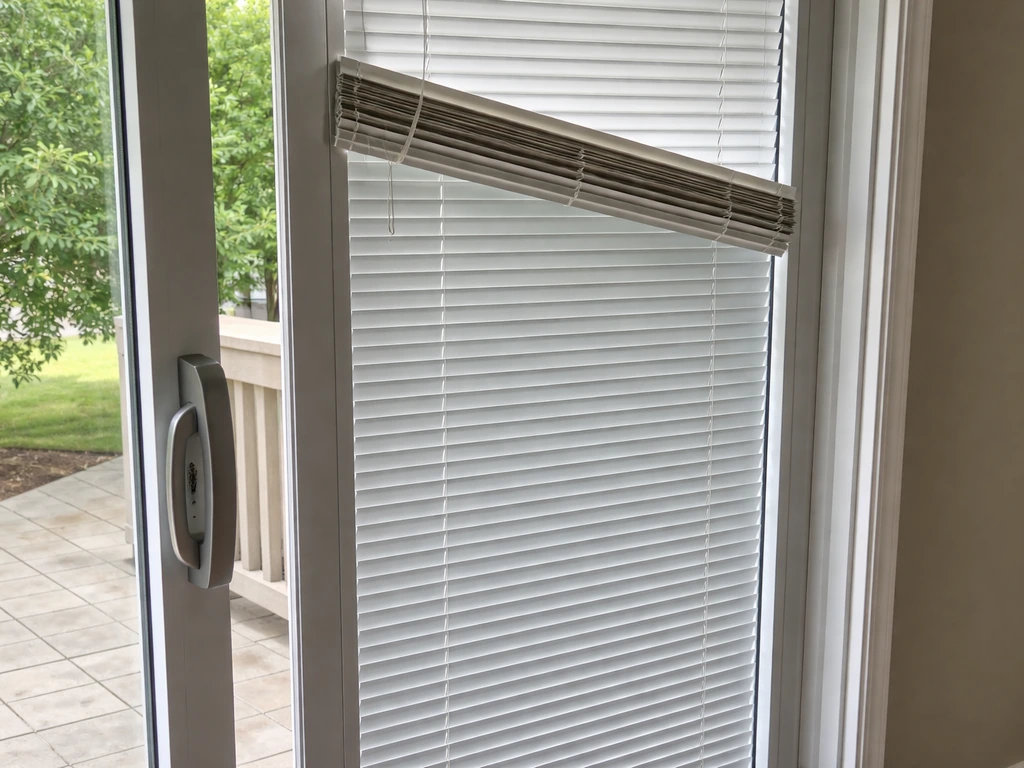
Built-in or between-glass blinds are sealed inside the door's insulated glass unit (IGU) and operated by a small magnetic or mechanical slider on the door edge. For a deeper discussion of common failures and maintenance, see our guide on patio doors with built in blinds problems. Companies like ODL supply these as add-on panels or factory-integrated options. The appeal is obvious: no dusting, no cords, no pets or children can damage the slats. ODL markets their Blinds + Glass product line with 5- to 10-year warranty coverage on the sealed unit.
The problems are also real. If the IGU seal fails (a common occurrence in doors older than 10 to 15 years, and sometimes earlier), moisture gets inside the sealed unit and the blinds fog, rust, or the slats stick. Replacing a failed between-glass IGU is expensive, typically $300 to $700 or more per panel for a replacement unit, and not all door manufacturers make replacement IGUs for older models. The operating mechanism is also limited: you can tilt the slats or raise and lower them, but the range of motion is smaller than with a standard blind and you cannot achieve the same degree of light control or privacy as a cellular or blackout shade. If you already have built-in blinds that are failing, an exterior-mount cellular or roller shade is the most practical replacement strategy because it does not require touching the door IGU.
Window film and frosted glass: permanent and semi-permanent privacy options
Solar control window film is a different category from blinds or shades: instead of covering the glass, it modifies the glass itself. 3M and other manufacturers produce films that reduce solar heat gain significantly (3M's technical data for their Ceramic Architectural series documents substantial solar heat rejection and UV blocking), which makes them genuinely useful on south- and west-facing patio doors where summer heat gain is a problem. The solar film does its job 24 hours a day without requiring you to remember to close a shade, and it does not interfere with the door's operation at all.
The limitation is privacy: most solar-control films are not opaque and do not provide nighttime privacy. Daytime, from outside, they create a mirror effect that hides the interior. At night, when interior lights are on, that effect reverses and the film offers little privacy. For nighttime privacy you would need a frosted or decorative film, which provides privacy around the clock but eliminates the view entirely. Frosted film is a solid semi-permanent option for bathroom patio doors or doors adjacent to close neighbors; it costs $3 to $8 per square foot DIY installed and can be removed without damaging the glass if you change your mind. Professional window film installation runs $8 to $15 per square foot depending on film type and market.
Exterior options: solar screens, retractable screens, awnings, and shutters
Exterior coverings are fundamentally different from interior ones in one important way: they stop solar heat before it enters the glass, which makes them significantly more effective at reducing summer cooling loads. Interior shades absorb or reflect heat that has already passed through the glass, which means some of that heat still radiates into the room. Exterior options intercept it first.
Solar screens
Exterior solar screen fabric (like Phifer's SunScreen line) is woven mesh with a measured openness factor, typically ranging from 5% to 25% open area. A 25% openness fabric lets more light and view through but blocks less solar heat; a 5% fabric gives better solar control and privacy but reduces view-through more. Phifer's product documentation lists SHGC and visible light transmittance values by fabric for precise comparison. Fixed exterior screen frames can be custom-made by local screen shops for $150 to $400 per opening depending on size and material; removable systems (magnetically attached or Velcro-mounted) are popular for homeowners who want screens in summer and removal in winter.
Retractable screens
Retractable screens (motorized or manual cassette systems like Phantom Screens) are the most convenient exterior option for patio doors because they retract into a housing when not in use. Installed pricing is wide-ranging: basic manual retractable screens start around $600 to $1,000 installed for smaller openings, while motorized systems for large bifold or multi-panel openings can run $2,500 to $5,000 or more installed. Market pricing aggregators cite typical installed ranges of about $600 to $4,000 for most residential retractable screen projects, with per-square-foot costs of roughly $8 to $24 depending on product, opening size, and installation complexity. They also add an insect-barrier function that interior shades simply cannot provide, which makes them especially popular on back-patio doors in warm climates.
Exterior shutters and awnings
Exterior roller shutters (motorized aluminum shutters that roll down over the door opening) are common in Europe and increasingly available in the US. They provide excellent security, near-total blackout, and strong insulation when fully closed, but they are expensive ($2,000 to $6,000+ installed per opening) and require structural mounting into the wall above the door. Awnings are a lower-cost exterior option ($500 to $2,500 installed for a basic manual retractable fabric awning over a 72" door) that reduces solar heat gain on south-facing doors very effectively by shading the glass from above, but they do not provide privacy or insect control.
Head-to-head comparison: which option wins on each criterion
| Option | Privacy | Light Control | Energy Efficiency | Durability | Pet/Child Safety | Approx. Cost (72" door, installed) |
|---|---|---|---|---|---|---|
| Curtains/Drapes | Full (blackout lining) or partial | Moderate to full | Low–moderate (lined) | Moderate (fades in sun) | Safe if cordless/motorized | $60–$600+ |
| Roller Shades | Partial to full | Sheer to blackout | Low–moderate | Good | Cordless options available | $80–$450 |
| Cellular Shades | Partial to full | Filtering to darkening | High (best interior option) | Good | Cordless/motorized available | $150–$900 |
| Roman/Soft-Fold Shades | Partial to full (lined) | Moderate to full | Low–moderate (lined) | Moderate (fold fading) | Cordless options available | $120–$700 |
| Top-Down/Bottom-Up Shades | Adjustable/partial | Filtering to darkening | High (cellular versions) | Good | Cordless/motorized available | $200–$1,200 |
| Panel Track | Full | Filtering to blackout | Low–moderate | Good | Cordless track, no cords | $400–$900 |
| Plantation Shutters | Full (louver tilt) | Very good (louver control) | Moderate | Excellent | Excellent (no cords) | $1,500–$5,000+ |
| Built-In/Between-Glass Blinds | Partial | Moderate | Low (IGU benefits) | Poor (seal failure risk) | Excellent (sealed) | $300–$700 per IGU replacement |
| Window Film (solar) | Daytime only | Glare reduction | Good (solar heat) | Very good (10–15 yr) | Excellent (no cords) | $200–$600 installed |
| Exterior Solar Screen | Daytime/partial | Glare reduction | Very good (intercepts heat) | Good (UV exposure) | Excellent | $200–$600 per opening |
| Retractable Screen (motorized) | Partial | Glare/insect control | Good | Good | Excellent | $1,500–$5,000+ |
| Exterior Awning | None | Overhead shade only | Good (south-facing) | Moderate (fabric) | Excellent | $700–$2,500 |
Recommendation by homeowner priority
No single option wins across all criteria, which is why most real decisions come down to two or three top priorities. Here is where I would point a homeowner based on each common priority combination:
- Best for energy efficiency on a budget: cordless cellular shades, double-cell if possible, outside-mounted
- Best privacy + light control combination: top-down/bottom-up cellular shades for French or sliding doors; panel track for bifold
- Best for homes with young children or pets: cordless or motorized cellular shades, plantation shutters, or panel tracks (all cord-free at the operating level)
- Best aesthetic upgrade: plantation shutters (highest cost, longest lifespan) or custom lined curtains on a ceiling-mounted track
- Best for summer heat reduction (south or west-facing doors): exterior solar screens or window film as the primary treatment, with a sheer interior shade for nighttime privacy
- Best low-maintenance option: window film (solar control) combined with frosted film stripe at eye level for privacy, or built-in blinds in a new door if the door is being replaced (keeping the seal-failure risk in mind)
- Best for a wide bifold opening: ceiling-mounted curtain track with stackable panels, or motorized retractable exterior screen
- Best budget option that actually works: cordless roller shade in room-darkening fabric, outside-mounted, ordered to the correct overlap width
How to measure, order, and install: your next steps
Before you order anything, grab a tape measure and write down three numbers: the exact width of the door frame opening (jamb to jamb), the height from the top of the frame to the floor, and the wall space available on each side of the door frame. If you are doing an outside-mount, your order width should be the frame width plus 6 to 8 inches total (3 to 4 inches per side). Your order height should be the frame height plus 4 inches above (to cover the header) down to the floor or 1/2 inch above the sill.
- Measure width (jamb to jamb), height (header to floor), and available side wall clearance
- Decide inside-mount or outside-mount (outside-mount is correct for most patio doors)
- Add your overlap: 3–4" per side for width, 4" above for height
- Choose your covering based on the priority matrix above
- Check the manufacturer's maximum width/height specs before ordering wide or tall shades
- For TDBU or cellular shades, verify the operating system's size limits (Hunter Douglas Duette specs are a good reference benchmark)
- For panel tracks or curtain tracks on bifold doors, confirm wall clearance for full stack
- Order cordless or motorized if you have children under 6 or pets
- For exterior options, get at least two installed quotes: prices vary widely by market
- If replacing a failed between-glass IGU, call the door manufacturer first to check replacement part availability before assuming you need a full door replacement
One last thing worth saying plainly: the best patio door covering is the one you will actually use. A $900 motorized cellular shade that stays fully open because operating it is annoying does less for your energy bill and privacy than a $80 cordless roller shade you actually close each evening. Match the operating style and cost to your real habits, not just the spec sheet.
FAQ
What are the best practical alternatives to traditional patio door blinds?
Interior: curtains/drapes, roller shades, cellular (honeycomb) shades, Roman shades, top‑down/bottom‑up shades, sliding panel‑track systems, plantation shutters, blinds‑between‑glass. Exterior: retractable/solar screens, exterior shutters, awnings, security screens, window film/frosted glass. Each option trades off privacy, light control, energy performance, durability, safety, cost, and aesthetics — pick based on which attributes matter most for your home and door type.
How do these options compare for privacy and light control?
Curtains/drapes: excellent privacy and blackout with lined/thermal panels; variable light control. Roller shades: good to excellent depending on fabric (blackout to sheer).Cellular shades: very good — strong light control when closed; top‑down/bottom‑up variants add flexible daylighting. Sliding panel tracks: good with overlapping panels; can be lined for blackout. Plantation shutters: excellent adjustable light control. Exterior screen/solar screens: reduce glare and visibility from outside but don’t fully block light. Window film/frosted glass: permanent privacy with varying light diffusion; not adjustable.
Which options give the best energy efficiency?
Cellular (honeycomb) shades are among the most effective interior attachments for improving window R‑value and reducing heat transfer — national lab studies (ORNL, PNNL) and DOE guidance confirm measurable HVAC energy savings. Thermal/blackout curtains and lined roller shades also improve performance. Exterior solar/retractable screens and awnings reduce solar heat gain before it enters glass, improving summer comfort. Window films can reduce solar heat gain depending on film selection.
What about durability and suitability for homes with pets and children?
Plantation shutters and exterior security screens are very durable and pet‑resistant but can be expensive. Retractable screens vary; heavy‑duty frames resist pets better. Roller and cellular shades can be damaged by active pets/kids unless installed out of reach or motorized. Top‑down/bottom‑up and cordless/motorized systems are safer for homes with small children (reduce cords). Blinds‑between‑glass are dust‑free and child‑safe but can have service issues (see "built‑in blinds" FAQ).
How do aesthetics and style vary across options?
Curtains/drapes offer the most fabric/style flexibility. Plantation shutters provide a classic, high‑end look. Panel tracks deliver a modern, minimalist look suitable for large glass areas. Roller/Roman shades can be tailored to many design styles. Exterior shutters/awnings change the exterior appearance significantly and are architectural elements as well as functional.
Typical cost ranges (materials + installation) for each main option?
Curtains/Drapes: $50–$1,000+ per opening depending on fabric and custom work. Roller shades: $100–$700 per panel. Cellular shades: $150–$900 per panel (higher for custom/motorized). Panel tracks (retail kits): ~$300–$1,000+; custom installs higher. Plantation shutters: commonly thousands installed (retailer averages ~ $1,500–$5,000+ per opening). Retractable exterior screens: manual basic units from several hundred; professionally installed/motorized systems commonly $2,500–$5,000+ for large openings. Window film: $100–$600 depending on quality/coverage. Blinds‑between‑glass: mid‑range to high depending on door manufacturer; warranties vary.