For most patio doors, you want curtain panels that are 84, 96, or 108 inches long. Which one depends on how high you hang the rod and the look you're going for. The standard approach: mount your rod 4–6 inches above the door frame, measure from the rod down to the floor, then subtract about half an inch so the panels clear the floor cleanly. That number tells you exactly which off-the-shelf length to buy. If your rod-to-floor measurement lands at 92 inches, for example, you'd round up to 96-inch panels and either let them break slightly at the floor or hem them. Simple as that.
What Length Curtains for Patio Doors: Sizing Guide
Owen Delaney
12 May 2026
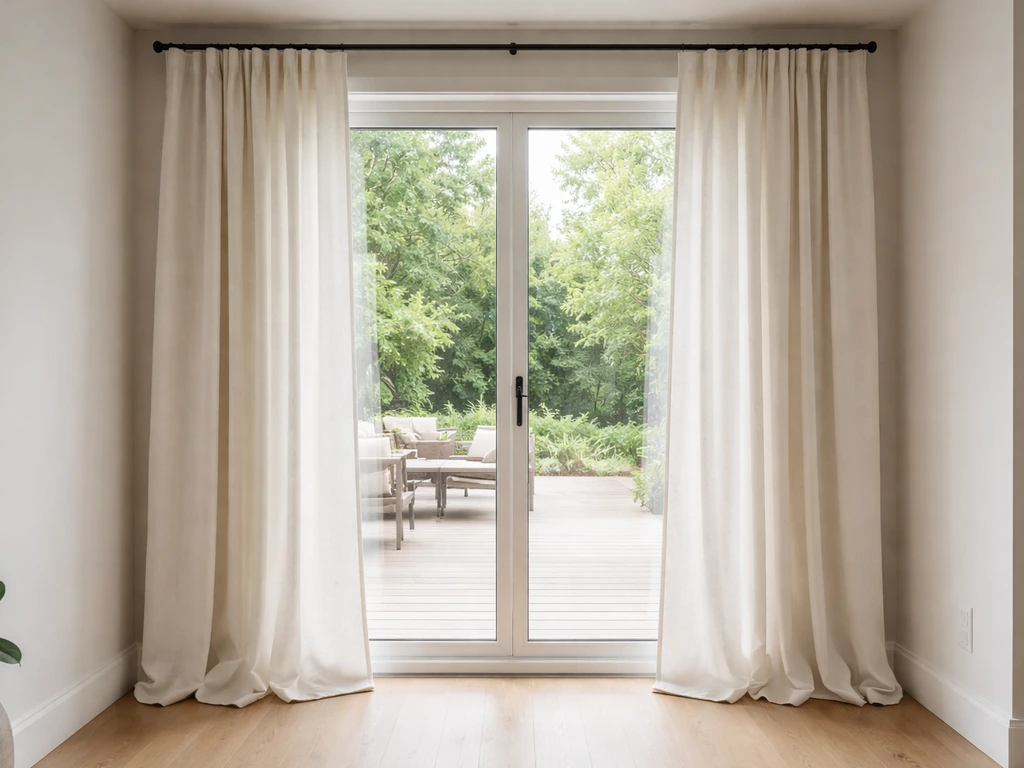
Why curtain length actually matters for patio doors
Patio doors are tall, wide, and usually the focal point of an entire wall. That means a length that's even a few inches off looks noticeably wrong. Panels that hover three or four inches above the floor look like high-waters. Panels that pile too much fabric on the floor become a tripping hazard every time someone slides the door open. And since patio doors get used constantly, you need a length that holds up operationally, not just aesthetically.
There's also the visual height game. Hanging your rod higher and using longer panels makes the ceiling feel taller and the door feel more architectural. This is why most designers push you toward floor-length panels over sill-length ones for patio doors specifically. Sill-length panels work fine on small bedroom windows; on an 8-foot sliding door, they just look stunted.
Floor clearance also affects how well the door functions. If you have a sliding patio door, panels that touch or drag on the floor can catch on the track hardware, which gets old fast. French doors that swing inward need enough clearance that the panels don't snag on the door handles. Getting the length right from the start saves you a lot of frustration.
How to measure before you buy anything
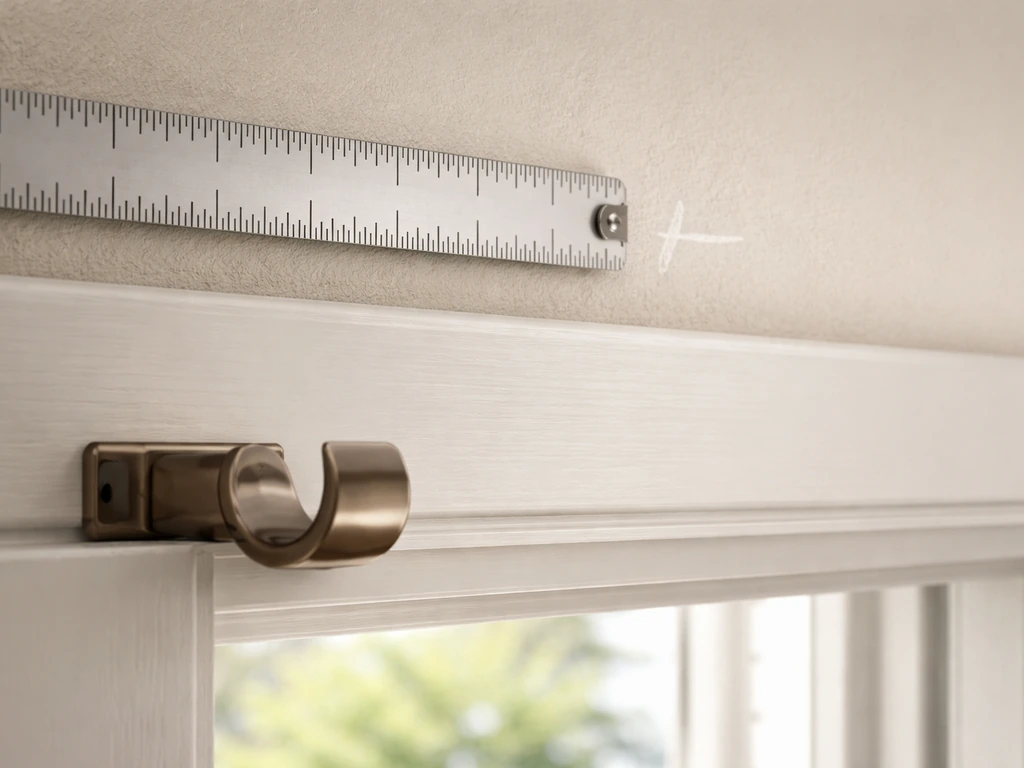
Grab a metal measuring tape, not a fabric one, and measure in three steps. Write everything down to the nearest 1/8 inch. Eyeballing this almost always leads to a return trip to the store.
Step 1: Decide where your rod will go
Mount your curtain rod 4–6 inches above the top of the door frame. Some people push this to 8–10 inches above the frame to maximize the sense of height. The higher you go, the more you'll need to factor that into your panel length. Mark that spot on the wall (or if you've already installed the rod, measure from the rod itself).
Step 2: Measure rod to floor
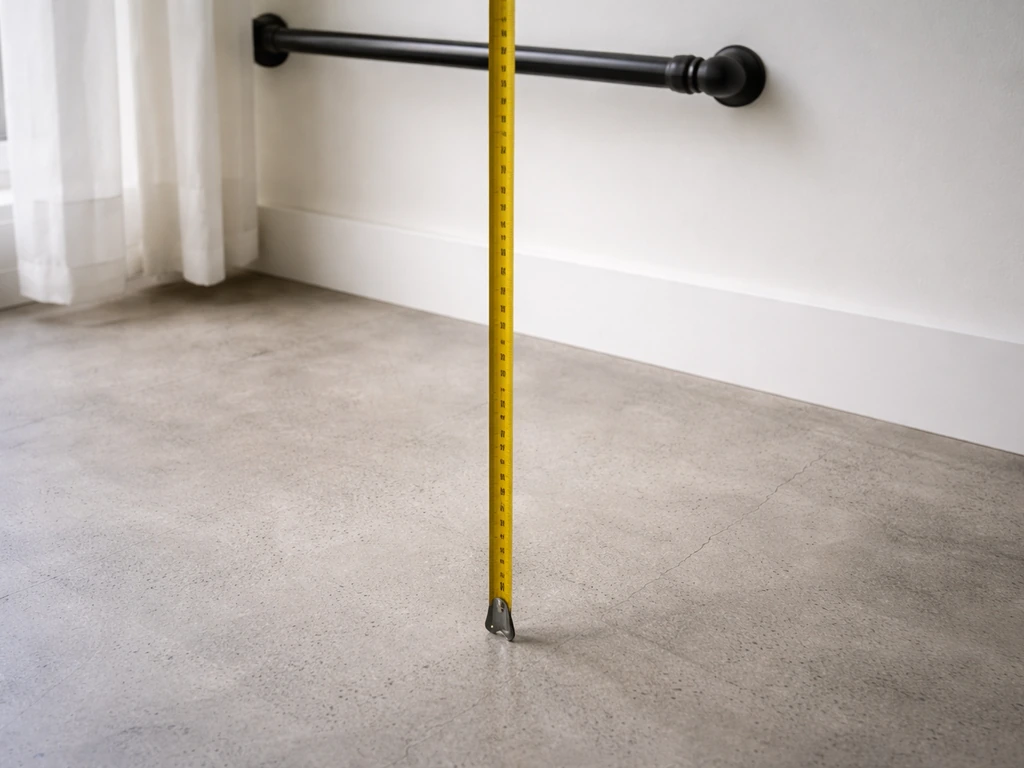
Measure from your rod position (or the bottom of the rings if you're using ring-top panels) straight down to the floor. This is your base measurement. For most patio doors with 8-foot ceilings, hanging the rod 4–6 inches above an 80-inch door frame, you'll land somewhere between 88 and 95 inches rod-to-floor. Note: if you're using clip rings, the clip adds about 1–1.5 inches between the rod and the top of the fabric, so factor that in or your panels will hang lower than expected.
Step 3: Add or subtract for your desired style
Once you have your rod-to-floor number, adjust it based on how you want the panels to land. Here are the three main options and what they mean in practice:
| Style | Bottom Landing Point | What to Do with Your Measurement |
|---|---|---|
| Float (off the floor) | 1/2" above the floor | Subtract 1/2" from rod-to-floor |
| Graze (barely touching) | Just at the floor | Use your rod-to-floor number as-is |
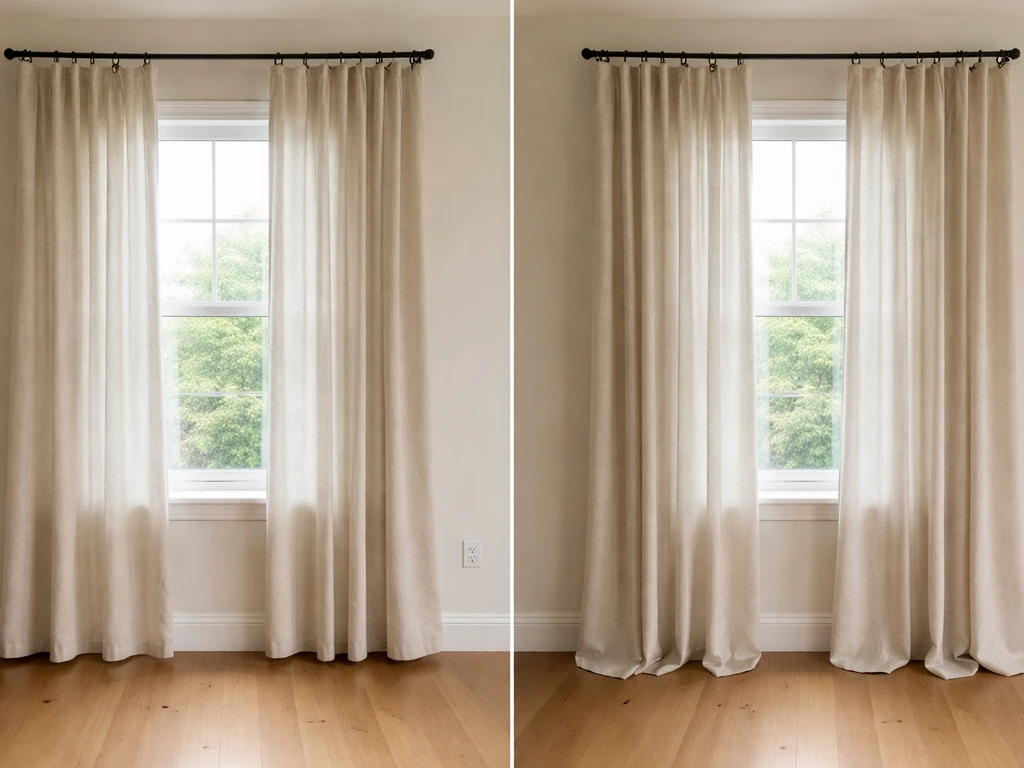
| Break (slight fold) | 1"–2" on the floor | Add 1"–2" to rod-to-floor |
| Puddle (pooled fabric) | 6"–10" on the floor | Add 6"–10" to rod-to-floor |
For patio doors specifically, float or graze is usually the most practical choice. Bali Blinds’ drapery measuring guide recommends allowing 1 inch above the floor for drapery under another drapery float or graze. Puddle looks dramatic in formal dining rooms but gets destroyed fast when kids and dogs are sliding the door open twenty times a day.
Picking the right length from standard panel sizes
Ready-made curtain panels typically come in these standard lengths: 63, 84, 96, 108, and 120 inches. Custom panels can be made to any size, but off-the-shelf options from most retailers cover those five lengths. Here's how they match up to typical patio door setups:
| Panel Length | Best for... | Typical Ceiling Height / Rod Position |
|---|---|---|
| 63" | Sill or apron length only | Not typically used for patio doors |
| 84" | Floor-length on low rod placement, 8' ceilings | Rod at 85"–86" from floor (float style) |
| 96" | Most common for patio doors, 8'–9' ceilings | Rod at 90"–97" from floor |
| 108" | Higher rod placement or 9'–10' ceilings | Rod at 98"–109" from floor |
| 120" | Dramatic floor-length or puddle, 10'+ ceilings | Rod at 110"+ from floor |
The most practical length for the average patio door in a home with 8-foot ceilings is 96 inches. It gives you enough room to hang the rod properly above the frame and still have a clean floor clearance without hemming. If you have 9-foot ceilings or want to hang the rod especially high, jump to 108 inches.
One thing worth knowing: if your measurement falls between standard sizes, always round up to the next size and hem if needed. Bali Blinds notes that their drapery comes in five different curtain lengths and uses a floor-length convention that is typically about 1/2 inch above the floor floor-length convention about 1/2 inch above the floor. Panels that are too long can be pinned or hemmed; panels that are too short can't be fixed without looking patched.
Getting the width right: how wide your curtains need to be
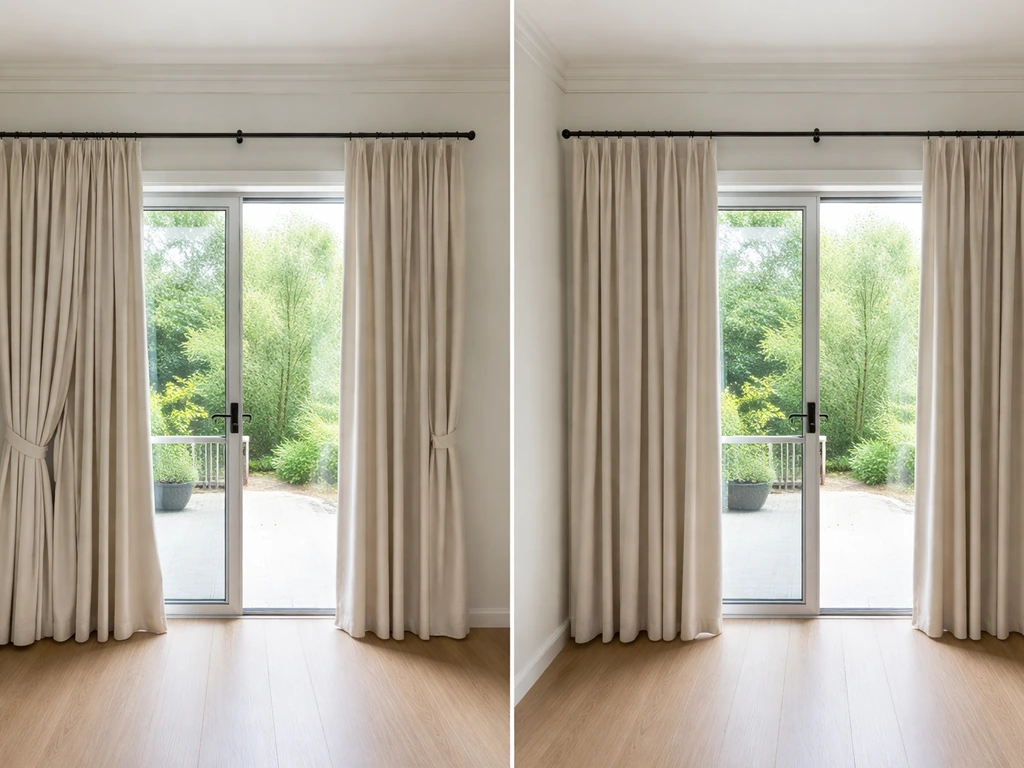
Length gets most of the attention, but width is where a lot of people go wrong with patio doors. Curtains that don't have enough width look skimpy and flat, like they're stretched tight across the window. The standard rule is to multiply your rod width by 2 for a basic full look, or by 2.5 to 3 for a more dramatic, gathered effect. So if your rod spans 100 inches across your patio door, you want between 200 and 250 inches of total fabric width distributed across your panels.
There's another factor that often gets skipped: stackback. When you pull the panels open, they need somewhere to go. For a sliding patio door, you want the rod to extend at least 12–16 inches beyond each side of the door opening so the stacked fabric doesn't eat into the glass and block the light you're trying to let in. Blindsgalore recommends extending the rod at least 4–6 inches past each side of the frame as a minimum, but for wide patio doors, going wider gives you much better clearance.
Your curtain rod sizing directly affects how wide your panels need to be, and the two decisions are linked. If you're still working out where to mount the rod, that topic is worth nailing down before you buy panels, since a wider rod means more total fabric.
How many panels you need depends on your door type
The number of panels is a product of your door type and your total required fabric width. If you already know your patio door width and want a quick number, use this how many curtain panels for patio door guide as a starting point before you shop. Here's how to think about it for the three most common patio door styles:
Sliding patio doors (typically 72" or 96" wide)
A standard 72-inch sliding patio door with the rod extending 12 inches on each side gives you a rod span of about 96 inches. At 2x fullness, you need 192 inches of fabric. If you're using panels that are 50 inches wide each, that's 4 panels. Two per side, stacking toward the edges when open. For a 96-inch sliding door with the same rod overhang, your rod spans about 120 inches, and at 2x fullness you need 240 inches of fabric, which is still 4–5 panels at 50 inches each. This lines up with Home Depot's panel-count guidance that recommends 4 panels for door/window widths in the 73–96 inch range.
French patio doors (two hinged panels, typically 60"–72" total width)
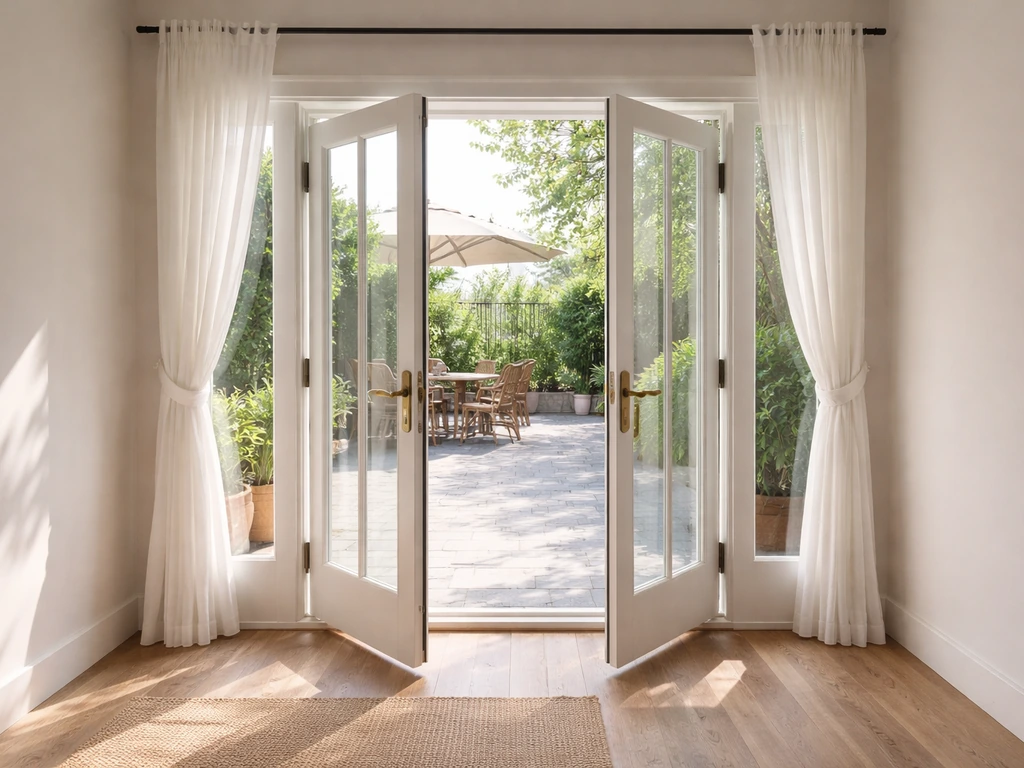
French doors swing open, which creates a different challenge. If your doors swing inward, floor-length panels need to either be tied back far enough to clear the door swing, or you need to think seriously about whether floor-length is even practical. If the doors swing outward, you have more flexibility. Most French door setups work well with 2 or 4 panels: one or two panels per door side, held back with tiebacks when open.
For an inward-swinging French door, many people opt for panels that sit just at sill height or slightly below to avoid the constant interference, though that sacrifices some of the visual impact. If you want full-length panels on inward-swinging French doors, make sure your tiebacks pull the fabric fully clear of the door handle radius.
Bifold patio doors (wider openings, often 8'–12' or more)
Bifold patio doors fold and stack to one or both sides, which typically means a very wide opening. For openings from 96 to 144 inches, you're usually looking at 4–6 panels. The key with bifolds is making sure the stacked panels have enough wall space to sit completely clear of the opening when the door is fully open. Measure your wall space on the stacking side before committing to panel count. A too-narrow wall section leaves panels hanging in front of the open door, which defeats the whole point of a bifold.
Quick panel count reference
| Door Width (Opening) | Recommended Rod Span | Total Fabric Needed (2x fullness) | Panels at 50" each |
|---|---|---|---|
| 60" | 84" | 168" | 4 panels |
| 72" | 96" | 192" | 4 panels |
| 96" | 120" | 240" | 5 panels (round to 6 for symmetry) |
| 120" (bifold) | 148" | 296" | 6 panels |
| 144" (bifold) | 172" | 344" | 7 panels (round to 8 for symmetry) |
Always round up to an even number of panels so you have symmetrical coverage on both sides. An odd panel count usually means one side looks heavier than the other.
Mistakes people make (and how to avoid them)
After going through this process a few times, including once where I had to return two sets of 84-inch panels because I forgot to account for clip ring depth, here are the errors that come up most often:
- Measuring from the window frame instead of the rod position: Your rod will sit 4–6 inches above the frame, so if you measure from the frame, your panels will be too short.
- Forgetting ring or clip depth: Clip rings add roughly 1–1.5 inches between the rod and the top of the panel. If you don't subtract that from your target length, your panels hang lower than intended.
- Buying panels based on door height alone: The door might be 80 inches tall but your rod is at 92 inches from the floor. A 84-inch panel won't reach the floor.
- Not accounting for stackback width: A rod that doesn't extend far enough past the door means panels block part of the opening when pulled back.
- Choosing sill-length panels to 'save fabric': On a tall patio door, this almost always looks unfinished.
- Buying panels first, then the rod: The rod width determines your total fabric need. Buy or measure the rod first.
- Ignoring floor type: Thick rugs raise the floor level by 1/2 inch to 1 inch. If you have a rug in front of the patio door, account for that height when calculating floor clearance.
- Assuming all 96-inch panels are the same: Panel widths vary by brand (48", 50", 54" are all common). Check the width spec, not just the length.
Quick checklist before you buy
- Rod position marked or installed, measured from floor to rod (or ring bottom)
- Chosen your style (float, graze, break, or puddle) and added or subtracted accordingly
- Matched your rod-to-floor number to the nearest standard panel length (rounding up)
- Measured rod span (including overhang on each side) and multiplied by 2 for total fabric width
- Divided total fabric width by individual panel width to get panel count (rounded up to even number)
- Confirmed panel width spec on the product listing, not just the length
- Checked that rod overhang gives enough wall space for panels to stack fully clear of the opening
- Accounted for rug height if there's a rug in front of the door
- Noted heading type (rod pocket, tab top, grommet, clip ring) and adjusted length reference point if needed
What to do next
If you've worked through the measurements above, you should have two numbers in hand: your target panel length and your total required fabric width. From there, it's a matter of choosing the right style of panel for your door type. Once you know your length and width, you can compare options to find the best curtains for your specific patio door setup best curtains for patio door.
Blackout panels are worth looking at if the patio door faces east or west and you get strong morning or afternoon sun. If you want the best blackout patio door curtains for glare and privacy, focus on light-blocking fabric and the right length for proper coverage at the floor Blackout panels. Thermal drapes are a smart upgrade if your patio door is a major heat-loss point in winter.
And if bugs through the open door are an issue in warmer months, there are curtain-style screening options designed specifically for patio openings that work alongside standard curtain panels. If you want the best fly curtains for patio doors, focus on options that cover the opening fully while still letting the door slide smoothly curtain-style screening options designed specifically for patio openings.
Bug curtains for patio openings can help keep insects out while still letting you enjoy fresh air through the door.
The panel count question is closely tied to how the curtains will actually hang and stack, so if you're still uncertain about how many panels to order for your specific door configuration, that's worth digging into before you add to cart. Getting the count wrong is the most common reason patio door curtains end up looking either too skimpy or awkwardly bunched.
FAQ
Should I buy 84, 96, or 108 inch curtains for an 8-foot sliding patio door if my rod-to-floor measurement is 95 inches?
If your rod-to-floor is 95 inches, round up to 96 inch panels. If you want a fuller floor graze, you can hem or use a slightly lower clearance, but avoid choosing 84 inches because it will look short and usually cannot be corrected without looking uneven.
What should I do if the curtains touch the sliding track or the door hardware when the panels are closed?
Reduce the panel length by adjusting for the real clearance, not just the visual floor line. If the bottom is catching, you may need to re-measure from the rod to the floor with the door fully closed and then shorten or re-hem so the fabric floats just above the most forward hardware points.
How much clearance should I leave for curtains on French doors that have handles?
For inward-swinging French doors, target enough clearance that the fabric does not enter the handle swing path. A practical approach is to position tiebacks so the panel edge stays outside the handle’s arc, and if you cannot get clearance without pulling too far, consider sill-length or near-sill placement instead of true floor-length.
Will clip rings change how long my curtains should be for patio doors?
Yes. If you use clip rings, the clip adds about 1 to 1.5 inches between the rod and the top of the fabric. Measure from the rod to the floor, then add that clip depth to your calculation, otherwise the finished curtain length will end up shorter than you expected.
Is “puddle” or “float” better for high-traffic patio doors?
For patio doors that are opened frequently, float or graze is usually the safest. Puddle can look dramatic, but the extra fabric often gets stepped on or dragged during daily use, which leads to faster wear and dirt buildup.
What happens if I end up with curtains that are slightly too long by a few inches?
You can usually fix small overage with pinning or hemming, especially if you bought standard widths that allow you to keep the hem level. Avoid leaving a long “break” on the floor for sliding doors, since it increases the chance of snagging on track-adjacent hardware.
Can I use 120-inch curtains on a patio door with a 8-foot ceiling?
You can, but only if you hang the rod high enough and want a noticeable pooling look. In most standard 8-foot setups, 120-inch panels often create excess fabric that can become a safety issue on sliding doors, so it’s safer to choose 96 or 108 unless you’re planning a custom hem or a deliberate puddle effect.
Do I measure to the floor from the rod or from the curtain ring bottom?
Measure from the rod for standard rod-top placement. If your panels use rings that set the curtain height, measure from the bottom of the ring (or subtract any hang height differences), then add back any extra stack or clip depth so the final fabric length lands where you intended.
If I’m rounding up to the next curtain length, how do I decide between hemming versus letting it rest on the floor?
Letting a panel rest on the floor can work for a tiny amount of overage, but for patio doors it is riskier because the fabric can drag during operation. If the difference is more than about an inch or if you have a sliding door, hemming is usually the cleaner and safer choice.
Should I match my curtain length to blackout or thermal drapes exactly?
Treat blackout or thermal panels like they are their own finished length. Some thicker fabrics hang differently (a small amount of extra weight can pull the hem down), so confirm the labeled finished length and plan for a small clearance margin, especially if you need the fabric to graze without touching.