The best alternatives to curtains for patio doors are panel-track blinds, vertical blinds, roller shades (solar or blackout), cellular honeycomb shades, plantation shutters, between-glass blinds, and exterior awnings. Each one handles the specific challenges curtains struggle with on patio doors: wide spans, door operation clearance, egress access, and the awkward mix of privacy, light control, and insulation in one large glazed opening. Which one is right for you depends on your door type (sliding, French, or bifold), your budget, and what problem you're actually trying to solve. For a detailed comparison of each option, see our guide on alternative to patio doors.
Alternative to Curtains for Patio Doors: Best Covering Options
Owen Delaney
6 Aug 2026
Why homeowners ditch curtains on patio doors
Curtains work fine on windows. On patio doors, they create real problems. A standard sliding patio door is 80 inches tall and anywhere from 60 to 96 inches wide, and floor-length curtain panels on a track that wide tend to bunch, drag, get caught in the door frame, and block egress when you need to get out fast. French doors swing in or out and need clearance on both sides. Bifold doors fold back in accordion sections, making any fabric covering that stacks to one side basically pointless. If you've been struggling with curtains that won't stay out of the way, you're not alone, it's genuinely the wrong product for the job. If you're wondering whether to use curtains at all, read our short guide on do you put curtains on patio doors for a clear yes/no answer and practical considerations.
This guide covers every practical alternative: blinds of all types, shades, shutters, window film, screens (including security screens), and exterior awnings. For each option I'll cover how it handles door operation, what it costs, who should install it, and which door types it actually suits. I'll also flag child and pet safety considerations, because corded coverings on accessible patio doors are a real hazard the CPSC takes seriously.
Can you put blinds or shutters on patio doors?
Yes, you can put both blinds and shutters on patio doors, but you need the right hardware for a sliding or bifold door specifically. A standard window blind mounted on a stationary headrail across a sliding door will block the door from opening. The products designed for patio doors either stack to the side out of the door's path (panel tracks, bypass-track shutters), operate in sections that move with the door (between-glass blinds), or mount on each individual door panel (French door blinds). Vertical blinds are the classic patio-door solution precisely because the vanes stack sideways. Interior plantation shutters work on patio doors only when installed on a bypass or bifold track, not as fixed panel mounts. So the short answer is yes, but buy door-specific products or verify the mounting system before you order. If you're wondering 'can you put shutters on patio doors', the short answer is yes, use bypass or bifold track hardware so shutter panels slide or fold out of the way without blocking door operation. For a step-by-step answer and product recommendations, see can you put blinds on patio doors.
All your options at a glance
| Covering type | Best door type | Privacy | Light control | Insulation | Child/pet safe | Rough cost (DIY supply) | DIY friendly? |
|---|---|---|---|---|---|---|---|
| Vertical blinds | Sliding | Good | Good | Low | Cordless versions only | $60–$200 | Yes |
| Panel-track blinds | Sliding, bifold | Good–Excellent | Good–Excellent | Medium (cellular panels) | Yes (no exposed cords) | $150–$500 | Moderate |
| Roller shades (solar/blackout) | French, sliding | Solar: moderate / Blackout: excellent | Solar: filters / Blackout: blocks | Low–medium | Cordless/motorized | $80–$400 per panel | Yes |
| Cellular (honeycomb) shades | French, sliding (per panel) | Good | Good | Best of interior options | Cordless recommended | $100–$600 per panel | Yes |
| Roman shades | French doors | Good | Good | Low–medium | Cordless recommended | $80–$350 per panel | Yes |
| Interior plantation shutters | Sliding (bypass), French | Excellent | Excellent | Medium | Yes (no cords) | $400–$1,500+ | Hard — pro recommended |
| Between-glass (enclosed) blinds | Sliding, French (IGU replacement) | Good | Good | Depends on glass unit | Yes (fully enclosed) | $300–$800+ (glass unit) | No — professional |
| Window film / frosting | Any | One-way or full privacy | Minimal reduction | Minimal | Yes | $20–$150 | Yes |
| Security/insect screens | Sliding, bifold | Low | Minimal | None | Yes | $100–$600+ | Moderate–No |
| Exterior awnings | Any | Low | Blocks direct sun | Reduces solar gain | Yes | $300–$2,000+ | No — pro recommended |
Vertical blinds for patio doors
Vertical blinds are the product most people picture when they think 'patio door covering,' and there's a good reason for that: they genuinely solve the stacking problem. The vanes hang from a headrail and traverse left, right, or split to the center, so you can push them clear of the door opening without removing anything. Vane widths are typically 3.5 inches, and they come in fabric, PVC, or faux-wood materials. PVC is the most durable for high-traffic doors and handles humidity well, useful if your patio door leads to a pool area or a coastal deck.
The downsides are real. Individual vanes break and tangle, especially with kids and pets involved. Corded versions carry strangulation risks, the CPSC actively promotes cordless options and the 2018 industry safety standard pushed manufacturers toward inaccessible-cord designs, so look for wand-operated or motorized vertical blinds specifically. Fabric vanes show wear faster than PVC, and neither material looks particularly modern. If you want a contemporary look or you're staging a home to sell, vertical blinds read as dated. Costs run roughly $60 to $200 for a standard 72-inch-wide sliding door, making them one of the cheapest options on this list. If you've been wondering whether to replace vertical blinds with something else, panel tracks or roller shades are the most common upgrade paths. For a quick comparison of options, see this guide on an alternative to vertical blinds for patio doors which outlines panel tracks, roller shades, cellular shades, and shutters with pros and cons for each.
Pros and cons at a glance
- Pro: Designed specifically for wide, tall patio door openings
- Pro: Vanes stack completely clear of the door path
- Pro: Lowest cost option — $60 to $200 for most sliding doors
- Pro: Easy DIY installation with standard headrail hardware
- Con: Individual vanes break, tangle, and look worn quickly
- Con: Corded versions are a child and pet safety hazard
- Con: Dated aesthetic — not a good fit for modern or minimalist interiors
- Con: Limited insulation — minimal R-value improvement over bare glass
Panel-track and sliding-panel systems
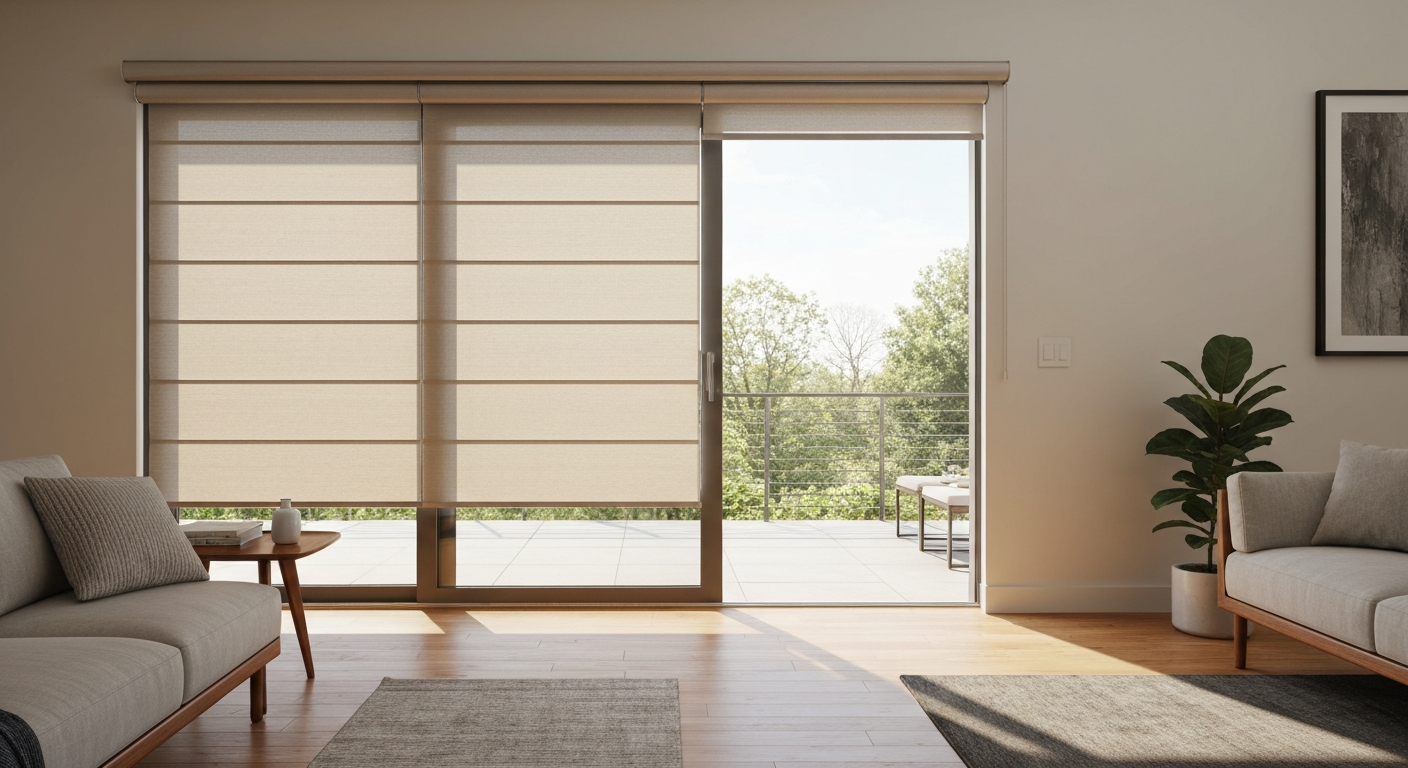
Panel-track blinds are the modern upgrade from vertical blinds. Instead of individual vanes, you get wide fabric panels (typically 18 to 24 inches wide) that hang from a multi-track headrail and slide sideways in overlapping tracks. They stack to one side like a sliding door itself. The visual effect is clean and contemporary, closer to a sliding barn door than a blind. Fabric choices are wide: sheer, light-filtering, blackout, solar, and even cellular-fabric panels that add insulation.
Measuring for panel tracks is more involved than for standard blinds. Levolor's technical guide specifies inside-mount flush depth requirements of roughly 2. Levolor's blank" rel="noopener noreferrer">Panel Track | Reference Guide (Levolor) lists inside‑mount flush depths of about 2½"–3½" and notes minimum inside‑mount depth commonly 1¾" depending on the number of tracks. 5 to 3.5 inches depending on the number of tracks, with a minimum inside-mount depth commonly around 1.75 inches. For outside mounts, add 2 to 3 inches on each side beyond the opening width, and allow a 0.5- to 0.75-inch bottom clearance above the threshold or floor track. I'd strongly recommend measuring at three points across the width and using the narrowest dimension, patio door frames are rarely perfectly square. Headrail depth matters too: if your sliding door sits in a shallow pocket or has a top track that protrudes, verify the specific panel-track product spec before ordering.
Panel tracks work best on sliding patio doors and large bifold openings. They do not suit French doors well because there is no single header span, you'd need to mount above both door panels, and swing clearance makes the whole thing awkward. Cost ranges from about $150 for a basic two-panel system to $500 or more for wider openings with higher-end fabrics. Most are DIY-installable with a drill, level, and a half-hour of patience, but measure twice.
Side-to-side and stacking systems for sliding doors
Beyond panel tracks, there are sliding-door-specific blind systems designed to mimic the door's own operation. These include side-to-side roller shade systems where the shade traverses on a track rather than rolling up, and stacking slat systems (similar to a horizontal blind but oriented to slide rather than lift). The key advantage is that the covering moves in the same direction as the door, so operation feels intuitive. You pull the blind to the right, you pull the door to the right, same hand motion, clear opening.
Space is the main constraint. Stacking systems need a clear 'stack zone' beside the door opening where the covering accumulates when open. For a 72-inch-wide sliding door, a panel-track system with 20-inch panels typically needs 20 to 25 inches of stack space. If your sliding door is in a corner or flanked by walls with no room to stack, this is a deal-breaker. Measure your available wall space on the latch side before you commit to any side-stacking system.
Between-glass and integrated blinds
Between-glass blinds are built inside the sealed insulating glass unit (IGU) of the door itself. You control them with a magnetic slider or a small handle on the door frame that moves the blind without breaking the seal. Because the blinds are fully enclosed, they collect zero dust, are completely inaccessible to cords (a genuine child and pet safety benefit), and don't interfere with door operation at all. ODL and similar manufacturers sell replacement door glass units with enclosed blinds already built in, designed to retrofit into existing door frames where the glass can be swapped out.
The important caveat: you generally cannot retrofit between-glass blinds into an existing sealed IGU. The blind is part of the glass unit, so you're replacing the glass assembly, not adding a covering to it. Mechanical failures (a stuck blind, a broken tilt mechanism) typically require replacing the entire unit rather than a simple repair. That makes between-glass blinds a lower-maintenance product in normal use but a higher-cost problem if something goes wrong. Budget $300 to $800 or more for a replacement door glass unit with enclosed blinds, plus professional installation for the glass swap. For people who hate dusting blinds and have young children, the trade-off is often worth it.
Cellular (honeycomb) shades for patio doors
Cellular shades are the insulation leader among interior window coverings. Their honeycomb cell structure traps air in pockets against the glass, reducing heat transfer in both directions. Research published in peer-reviewed journals confirms cellular shades have meaningful national energy-savings potential, and Hunter Douglas publishes R-value improvement data for their Duette line showing measurable gains over bare glass, particularly with double-cell constructions. If your patio door faces north or is on a cold exterior wall and you're losing heat through the glass, cellular shades are the covering to look at.
The sizing limitation is the practical problem. Cellular shades work best when they cover a single, stationary panel, they lift and lower on a headrail, which is fine for a French door panel or a fixed-light panel beside a sliding door. But for a full-width sliding door opening, you either need a single very wide shade (which becomes heavy and awkward to operate and may exceed the manufacturer's width limit) or individual shades per panel. On a bifold patio door, individual shades per panel make more sense but look cluttered when the door is folded open. The sweet spot for cellular shades on patio doors is French door configurations: one shade per door panel, mounted on each panel's frame so it moves with the door. Costs run $100 to $600 per panel depending on cell size (single vs. double), fabric, and width. Always go cordless, the CPSC's child safety guidance is clear on this, and cordless cellular shades on French door panels that children can reach are a non-negotiable safety point.
Roller shades: solar and blackout
Roller shades are the cleanest-looking option on this list. A single tube, a single fabric, no vanes or panels, just a flat sheet that rolls up completely out of sight when open. For patio doors, they work best on French door panels (one shade per panel, top-mounted) or on the fixed side lights and panels of a larger door assembly. On a full-width sliding door, a single roller shade wide enough to cover the opening becomes very heavy and needs motorization to operate smoothly.
Solar shades are specified by openness factor: a 1% openness fabric blocks more solar gain and glare but limits your outward view, while a 10% openness fabric preserves most of your view but does less to control heat. I typically recommend 3% to 5% for most patio door situations, it cuts enough glare to make the room usable on sunny afternoons without making the door feel like a wall. Blackout roller shades use fabrics with approximately 0% transmittance, but practical light-blocking in a room still depends on side gaps at the frame. High-quality blackout shades block around 98 to 99% of incident light, the remaining bleed comes from edges, not the fabric itself. Side-channel systems eliminate most of that edge light if true darkness is the goal.
Motorization is easy to justify for wide roller shades on patio doors. Somfy and other motor manufacturers offer three power options: hardwired (best for new construction or remodel), battery-powered tube motors (no wiring required, rechargeable packs or AA tubes), and solar-powered motors with a small panel on the headrail. Battery or solar options let you add motorization without cutting into walls, a major advantage on a retrofit. Budget $80 to $400 per panel for a quality roller shade, and add $100 to $300 per shade for motorization depending on the drive system.
Interior plantation shutters
Plantation shutters on patio doors look sharp and add genuine resale value, they're one of the few covering options that buyers consistently respond to positively. The challenge is the installation hardware. A standard shutter panel mounted on a fixed frame will block a sliding door. Patio-door shutter installations use bypass track hardware (panels slide past each other, like a sliding door) or bifold track hardware (panels fold back accordion-style). Hunter Douglas installation guides for their Palm Beach line show top carrier tracks, bottom floor guides, and planning requirements for panel overlap, it's more involved than a window shutter installation, and the threshold interaction needs to be measured carefully to avoid interference with the existing door track.
Plantation shutters are the highest-cost interior covering option, running $400 to $1,500 or more depending on material (wood vs. composite vs. PVC), panel count, and installation. PVC or composite shutters are the better choice for patio doors in humid or coastal climates, solid wood shutters can warp or swell with repeated moisture exposure. I'd call this a professional installation job for most homeowners. The track alignment, floor guide placement, and panel sizing tolerances are tight enough that a measurement error creates a covering that won't operate properly.
Roman shades
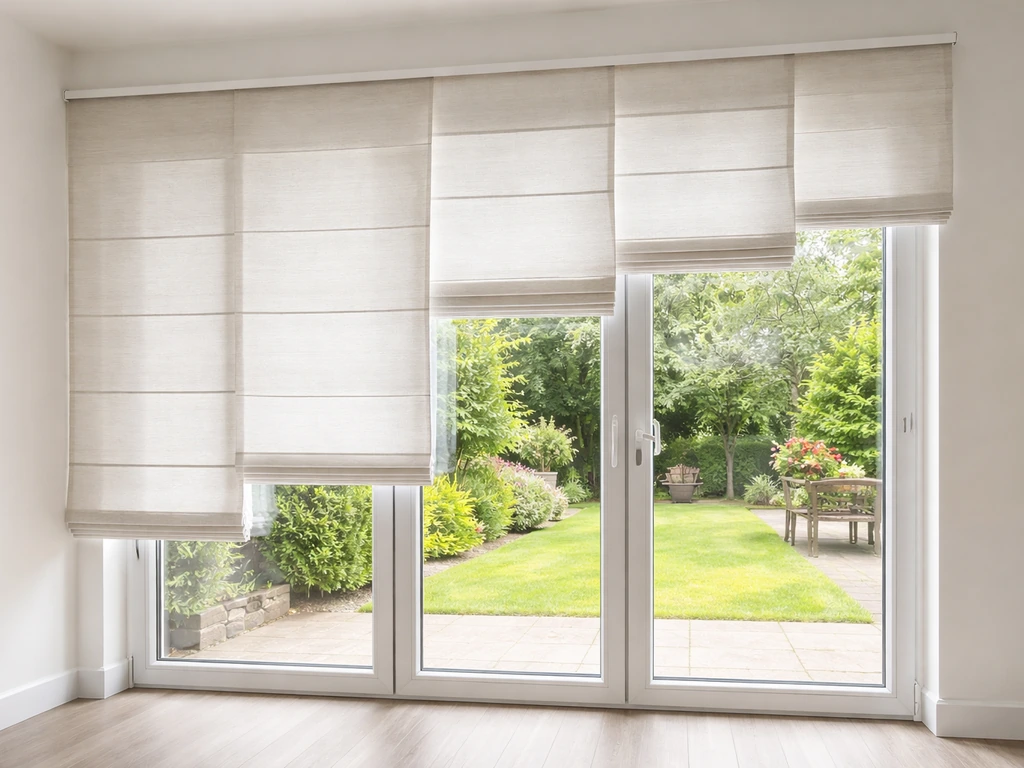
Roman shades fold into horizontal pleats when raised and lay flat when lowered. They're a beautiful option for French patio doors, one shade per panel, mounted on the door panel itself so it swings with the door. The fabric choices are wide, they look tailored rather than utilitarian, and they work well in living rooms or dining rooms where the door is a design feature rather than a utility exit.
Roman shades are less practical for sliding doors because the lift mechanism and stacking bulk make a very wide shade unwieldy. They also have more fabric surface area than a roller shade, which means more dust accumulation and more awkward cleaning. On French doors, where each shade covers a 24- to 36-inch panel, they're manageable. Budget $80 to $350 per panel for custom Roman shades. Go cordless or motorized for any panel a child can reach.
Window film, frosting, and tint
Window film is the most budget-friendly option on this list and requires zero clearance for door operation. Privacy films range from frosted (diffuses light and blocks clear view in both directions) to one-way mirror tint (blocks view from outside during daylight while preserving outward view from inside). Solar tint films reduce UV and heat gain without significantly darkening the room. Application is a true DIY job: clean glass, wet application, squeegee out bubbles. Quality residential window film runs $20 to $150 for a patio door, depending on film type and glass area.
The limitation is that film provides no adjustability. You can't open it for evening privacy. One-way mirror film reverses at night (when interior lights are on and it's dark outside, visibility flips in favor of the person outside). If you want light control or adjustable privacy, film is a supplement to a covering, not a replacement for one. It works well in combination with a sheer or solar shade that you only close part of the day.
Screens: insect and security
Most sliding patio doors come with a basic retractable insect screen. Replacement screens and upgraded retractable screens (including ones that retract into a housing at the side or top when not in use) are widely available and straightforward to retrofit. They do nothing for privacy or light control, but they solve the 'open the door for air without letting bugs in' problem that curtain alternatives don't address at all.
Security screens are a separate category entirely. Products like Crimsafe use woven stainless-steel mesh and multi-point locking frames that resist forced entry, impact, and knife/probe attacks. Crimsafe publishes independent test results including dynamic impact ratings in Joules and cites compliance with RC2 European forced-entry standards for some product lines. Industry standards bodies including FGIA and AAMA have published voluntary specifications for security screen products covering impact, lever, pull, and probe resistance. If your patio door is a ground-floor security concern, a certified security screen adds meaningful protection without blocking light, view, or airflow. Cost ranges from $300 to $600 or more per door opening for quality security screen systems, and professional installation is standard.
Exterior awnings
Exterior awnings don't provide privacy and don't block your view, but they are the most effective tool for controlling solar heat gain through a patio door. By shading the glass from the outside before sunlight enters, an awning can reduce cooling loads significantly, interior shades only work after solar radiation has already passed through the glass and entered the room as heat. Retractable awnings let you deploy coverage on hot afternoons and retract on overcast days or when you want full light. Manual crank or motorized options are available.
Awning installation requires wall or soffit mounting that can handle wind load, and most manufacturers require professional installation for warranty coverage. Budget $300 to $600 for a basic manual retractable awning and $800 to $2,000 or more for motorized systems on larger openings. Awnings work best as a complement to an interior covering rather than a standalone solution, pair one with a sheer roller shade for full sun and privacy control.
Which option suits which door type
| Door type | Top picks | Avoid |
|---|---|---|
| Sliding patio door | Panel-track blinds, vertical blinds (cordless), solar roller shades (per panel or motorized wide), between-glass blinds | Fixed-frame shutters, single wide Roman shade, standard horizontal blinds |
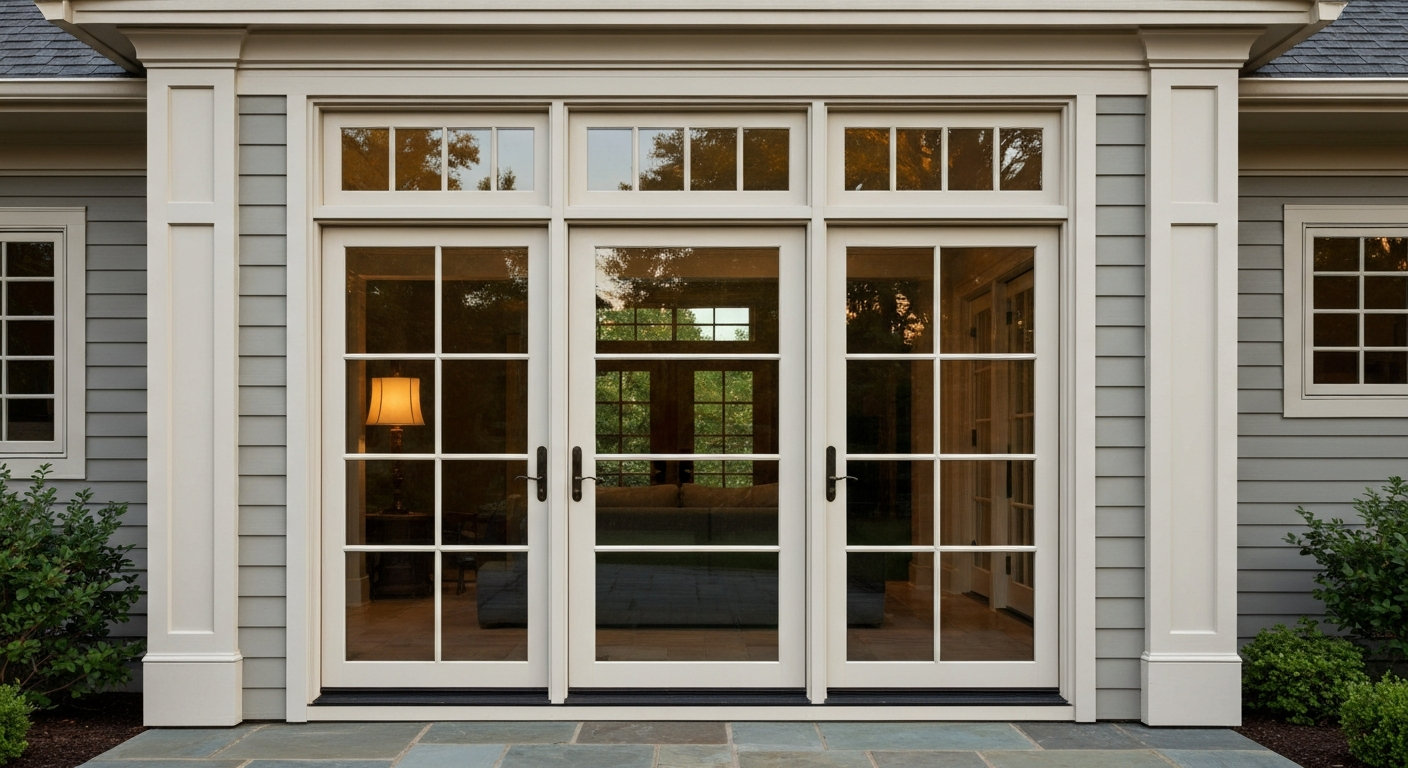
| French patio doors | Cellular shades (per panel), Roman shades (per panel), roller shades (per panel), fixed plantation shutters (per panel), window film | Vertical blinds, panel tracks across both panels |
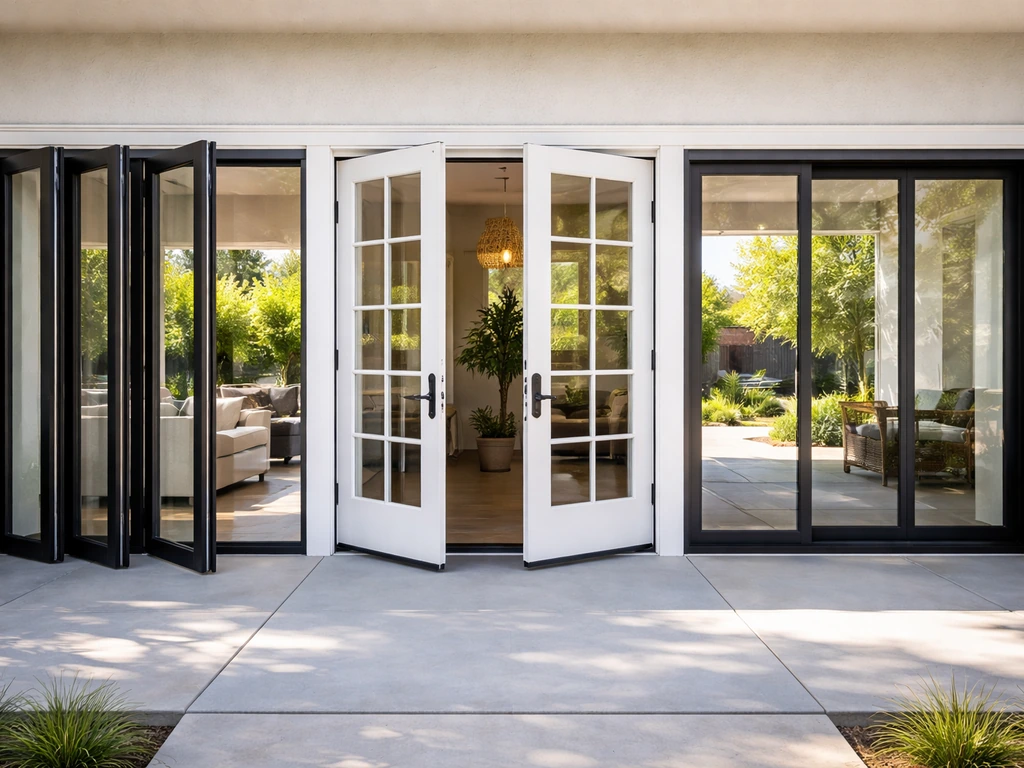
| Bifold patio doors | Panel-track systems across full opening, exterior awning, roller shades per individual panel, security/insect screens | Fabric shades per panel (cluttered when folded), between-glass blinds (usually not available for bifold glass units) |
Scenario-based recommendations
Best for insulation and energy savings
Double-cell cellular (honeycomb) shades on French door panels, or cellular-fabric panels in a panel-track system for sliding doors. Hunter Douglas Duette double-cell shades are the reference product here. Pair with window tint film for maximum thermal performance.
Best for rentals or tight budgets
Cordless vertical blinds ($60 to $150) or a basic panel-track system ($150 to $200). Both are renter-friendly if you use outside-mount brackets that don't require significant wall modification, and both are easy to remove and reinstall.
Best for a modern or minimalist look
Panel-track blinds with linen or sheer fabric panels, or motorized solar roller shades. Both disappear when open and present a clean line when closed. Avoid vertical blinds and PVC faux-wood if contemporary aesthetics matter.
Best for homes with young children or pets
Between-glass blinds (fully enclosed, no accessible cords), cordless cellular shades, or motorized panel tracks. The CPSC's 'Go Cordless' guidance applies directly to patio door coverings because they're at floor level and accessible to children. The 2018 safety standard has made cordless options much more widely available, but always verify before buying.
Best for coastal or high-humidity climates
PVC vertical blinds, composite or PVC plantation shutters, or solar roller shades with moisture-resistant fabric. Avoid natural wood shutters or Roman shades with organic-fiber fabrics, warping, mold, and swelling are real problems in coastal environments.
Best for security
A certified security screen (stainless-steel mesh, multi-point lock, tested to AAMA, FGIA, or AS5041/AS5039 standards) combined with an interior covering for privacy. The screen handles forced-entry resistance; the interior covering handles light and privacy. These are separate problems that need separate products.
Measuring and mounting checklist
- Measure the door opening width at three points (top, middle, bottom) and use the narrowest dimension for inside-mount products
- Measure height at three points (left, center, right) and use the shortest for inside mounts
- Check inside-mount reveal depth — most panel-track systems need at least 1.75 inches, with 2.5 to 3.5 inches preferred
- Measure available stack space on the latch side for any side-stacking system (panel tracks, bypass shutters)
- Confirm the headrail or bracket will clear the door's top frame hardware and any existing cornice or trim
- For outside mounts, add 2 to 3 inches to each side of the width and extend height 2 to 4 inches above the opening
- Allow 0.5 to 0.75 inches of bottom clearance above the floor or door threshold to prevent dragging
- Check the door threshold height before ordering shutters — bypass track floor guides must clear the sliding door's floor track
DIY vs. professional installation
Vertical blinds, panel tracks, roller shades, and cellular shades are all reasonable DIY installations if you're comfortable with a drill and level. The headrail hardware is standard, the products ship with instructions, and the main risk is a bad measurement rather than a technical skill gap. Plantation shutters on bypass or bifold tracks are a different story, the track alignment, panel sizing, and floor guide placement require precision that punishes measurement errors. Between-glass blinds involve glass replacement, which is a professional job unless you've done IGU work before. Security screens require frame fitting and multi-point locking hardware, hire a certified installer. Exterior awnings need structural attachment points and wind-load consideration, another professional job.
Cost summary
| Option | DIY supply cost | Professional install (add) | Notes |
|---|---|---|---|
| Vertical blinds (cordless) | $60–$200 | $50–$150 | Easiest DIY; pro rarely needed |
| Panel-track blinds | $150–$500 | $100–$250 | Moderate DIY; wider systems benefit from pro |
| Solar roller shades | $80–$400 per panel | $80–$200 per panel | Wide/motorized shades justify pro |
| Blackout roller shades | $80–$400 per panel | $80–$200 per panel | Same as solar; side channels add cost |
| Cellular shades | $100–$600 per panel | $80–$200 per panel | Worth pro for French door panel alignment |
| Roman shades | $80–$350 per panel | $80–$200 per panel | Door-mounted versions need careful fitting |
| Interior plantation shutters | $400–$1,500+ | $200–$600+ | Pro strongly recommended for patio tracks |
| Between-glass blinds | $300–$800+ (glass unit) | $150–$400 (glass swap) | Requires IGU/glass replacement |
| Window film | $20–$150 | $100–$300 (optional) | True DIY; pro for large seamless installs |
| Security screens | $300–$600+ | $150–$400 | Certified installer recommended |
| Exterior awnings | $300–$2,000+ | $200–$600+ | Pro required for most retractable systems |
Your next steps
Start by identifying your door type (sliding, French, or bifold) and your primary problem (heat, privacy, security, aesthetics, or a combination). That narrows the list fast. If you're on a sliding door and want an upgrade from vertical blinds, measure for a panel-track system and request fabric samples from at least two suppliers before ordering, fabric openness and weight vary a lot between brands. For more specific recommendations and photos of each option, read our guide on what to put on patio doors. If insulation is the goal, double-cell cellular shades or cellular panel-track fabrics are worth the premium over standard fabric. If you have children at home, filter every option through the cordless or motorized requirement before anything else.
For anyone still deciding whether to cover the existing door or replace it entirely, thinking through what combination of covering, screening, and security hardware gets you where you want to go is worth the time before committing to a full door replacement. A good covering can solve most problems at a fraction of the cost. But if the door itself is the issue, poor sealing, outdated sizing, or wrong style for the space, a covering is a patch, not a fix.
FAQ
What practical, code- and safety‑compliant alternatives are there to curtains for patio doors?
Common alternatives: panel‑track/sliding panels, vertical blinds, roller shades (solar and blackout), cellular (honeycomb) shades, Roman shades, interior plantation shutters (track/bypass/bi‑fold for doors), exterior shutters, between‑glass (enclosed) blinds, sliding/insect screens, security/anti‑intrusion screens, and exterior awnings. Choose cordless or motorized options for child/pet safety to comply with CPSC and industry guidance.
Can you put blinds or shutters on patio doors?
Yes. Blinds and shades can be mounted for sliding, French, and bi‑fold doors using appropriate hardware (panel tracks, top carriers, bypass or bi‑fold tracks). Plantation shutters are available with bypass/bi‑fold hardware. For sliding doors, panel tracks and sliding shutters are the most common. Ensure the chosen system preserves egress and meets local code/egress clearance rules.
How do the options compare by door type (sliding, French, bifold)?
Sliding doors: panel‑track panels, verticals, sliding shutters, roller/cellular shades on a wide headrail, between‑glass units, security screens. French doors: interior shutters (bi‑fold or hinged), roller/cellular shades mounted above frame, full‑height Roman shades. Bi‑fold doors: custom bi‑fold shutters, panel tracks, or multiple narrow verticals/roller shades. Pick treatments that stack or fold clear of door swing and maintain hardware/threshold clearance.
What are mounting and measurement rules I should follow?
Measure head width and reveal depth at three points. For inside mounts verify minimum reveal depth (panel tracks often need 2–3½" headroom). For outside mounts add typical side overlaps of 2–3" per side. Allow ½–¾" bottom clearance for floor/threshold when stacking. Use manufacturer measuring templates; for enclosed/blinds‑in‑glass you usually need to replace the IGU/door glass and measure the door unit size, not the opening.
How do the options compare for operation and access (opening/egress)?
Panel tracks and sliding/track shutters slide clear to one side—best for preserving sliding door operation. Bypass shutters/bi‑folds fold to allow full swing on French doors. Roller/cellular shades can be mounted high and raised fully; motorization eases operation for heavy/large doors. Avoid treatments that impede emergency egress or door handles; verify clearance for thresholds and sliding tracks.
How do the options compare for privacy and light control?
Blackout roller shades and close‑fit plantation shutters give the best privacy and near‑total light control (with side channels). Cellular shades provide strong room‑darkening with appropriate backing. Solar shades control glare and solar heat but preserve outward view (openness factor 1%–10%). Panel tracks and verticals offer moderate control depending on material opacity.