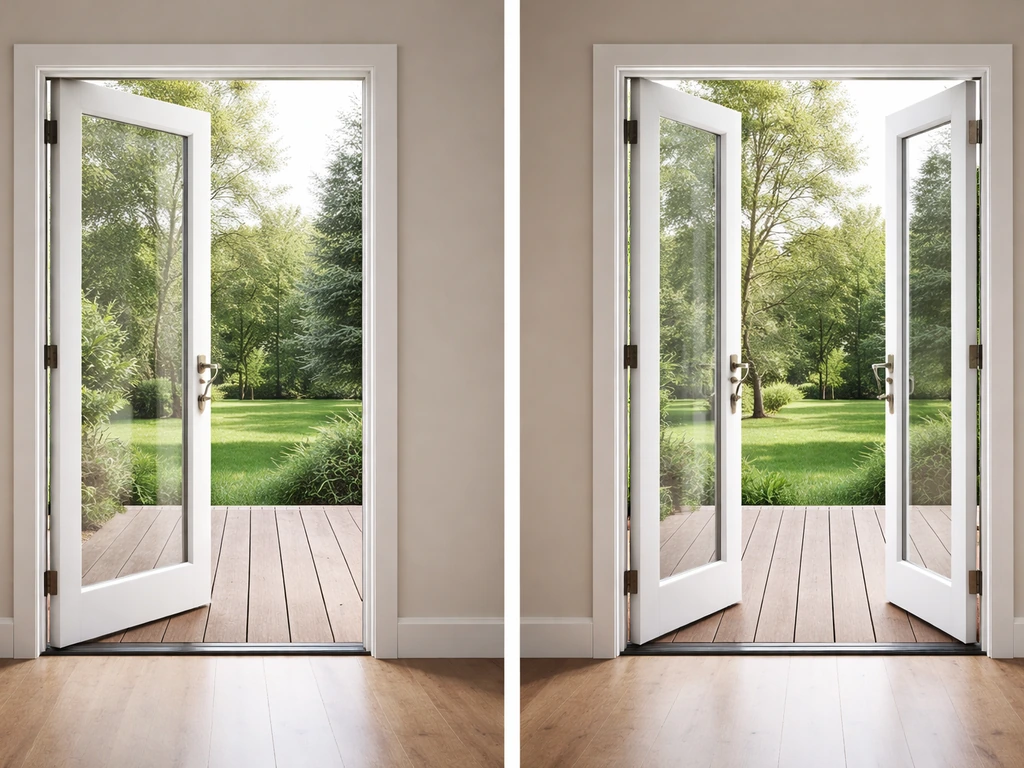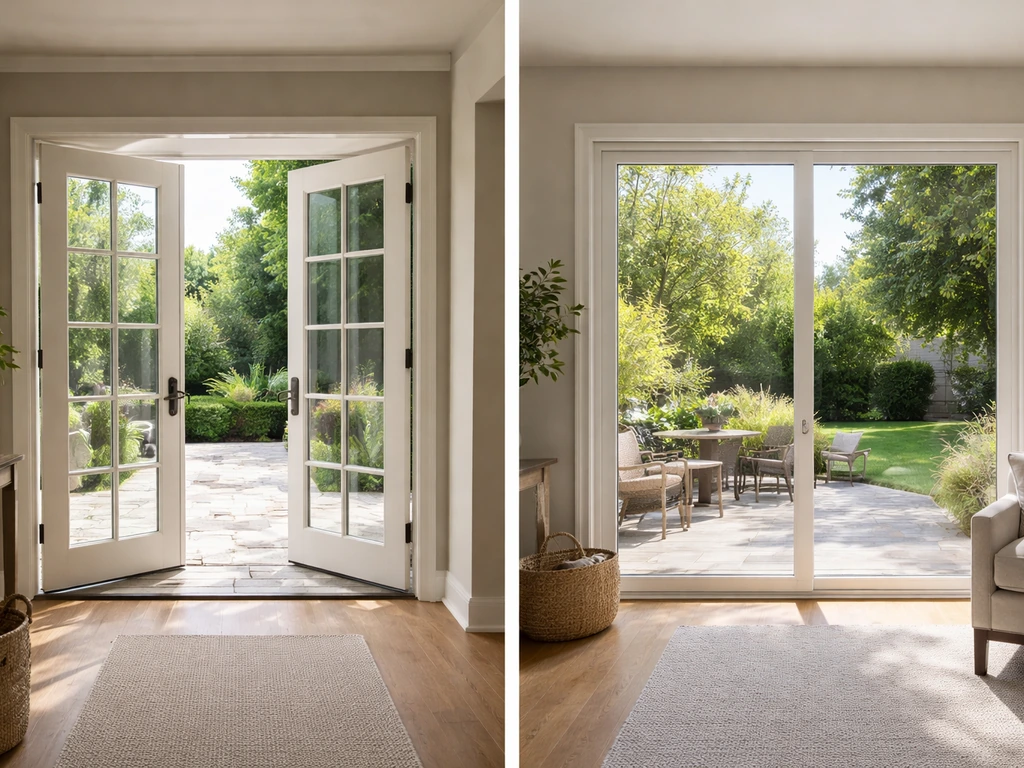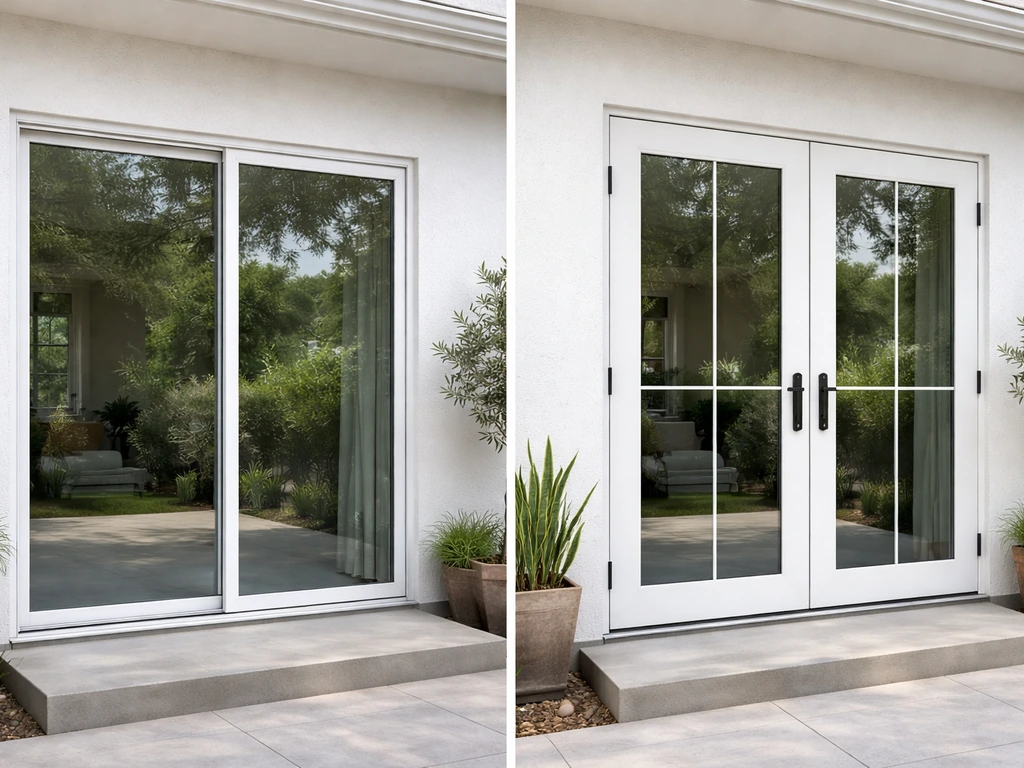
French doors are not automatically more expensive than other patio doors. A standard vinyl French door installed typically runs $1,500 to $4,500, which overlaps heavily with a mid-grade sliding patio door at $1,169 to $4,143 installed. Where French doors can cost more is in the swing clearance, hardware, and any structural work needed for a wider opening. Bifold and multi-panel folding systems are almost always the most expensive option, often starting at $4,000 and climbing past $12,000 installed. So the honest answer is: it depends on the style, material, size, and installation complexity, and I'll walk you through every variable that moves the number.
Are French Doors More Expensive Than Patio Doors? Costs
Owen Delaney
5 Aug 2026
What the terms actually mean
Before comparing costs, it helps to get the vocabulary straight, because the same door gets called different names by different people, and that confusion can send you down the wrong pricing rabbit hole.
- Patio door: the umbrella category covering any glazed exterior door designed to connect interior living space to an outdoor patio, deck, or yard. It includes sliding, hinged, French, bifold, and multi-slide systems. Manufacturers like Pella and Andersen all use "patio door" as the top-level category.
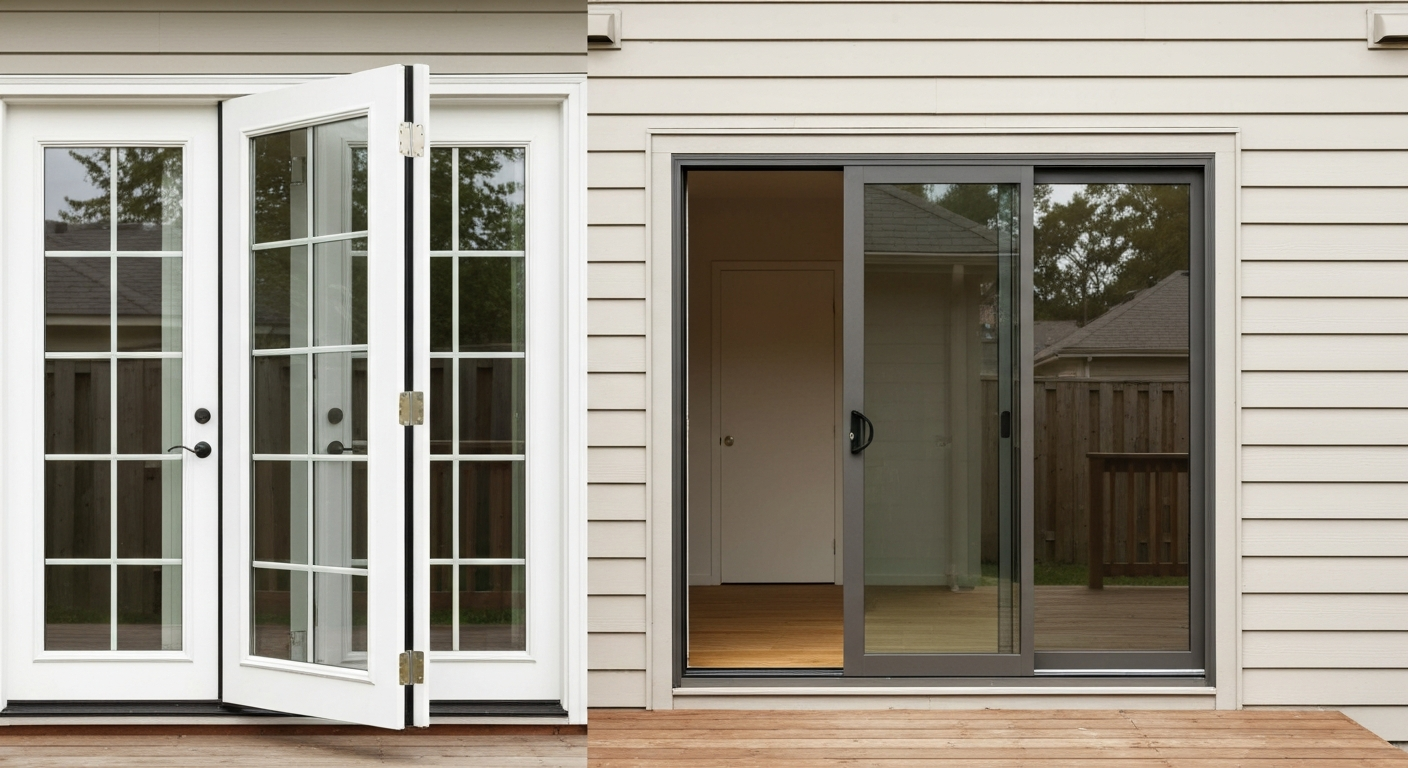
- French door: a hinged patio door with large glass lites and side stiles. Andersen and Pella use "French door" and "hinged patio door" interchangeably. French doors can be single (one active panel) or double (two panels that swing from opposite sides). The defining feature is the hinge operation, not the grille pattern.
- Sliding patio door (gliding door): one or more panels that slide horizontally on a track. The most common residential configuration is a two-panel unit where one panel is fixed and one slides. Sliding doors carry the NFRC product code DDSG for energy rating purposes.
- Hinged patio door: a side-hinged exterior door, sometimes a single panel, sometimes paired. When paired with full-length glass and used as a patio exit, it's the same thing as a French door.
- Bifold / accordion door: two or more panels that fold and stack to one or both sides on a track. These open the widest but require the most structural work and carry the highest price tag.
The key thing to keep in mind: when someone asks whether French doors are more expensive than "patio doors," they're really comparing one patio door style (French/hinged) against another (usually sliding). For a quick comparison of hinged patio door vs french door options, see our detailed guide. Both are patio doors. For a clear guide to the difference between French doors and patio doors, see our detailed comparison. For a focused comparison of styles, costs, and trade-offs, see our guide on patio doors: French vs. sliding.
Unit price vs. installed price: why the number you see online isn't the number you'll pay
Retail unit price (sometimes called "supplied" or "supply-only") is just the cost of the door itself, boxed and delivered. Installed price includes the unit plus labor, fasteners, flashing, sill pans, interior and exterior trim, and any incidental materials like expanding foam, caulk, and shims. Installed price is what you actually write a check for.
Labor runs about $70 to $100 per hour for professional door installers, and a standard patio door swap takes 2 to 7 hours. That puts labor alone at roughly $300 to $800 for a straightforward replacement in an existing rough opening. If the job involves cutting a new opening, relocating a header, or adding structural support for a wider bifold unit, labor and framing costs can add $1,000 to $3,600 on top of that. Always ask for a line-itemed quote that separates materials and labor so you can compare apples to apples between contractors.
Cost comparison by door style
Here are realistic ranges for 2026 based on national aggregator data and installer reports. These cover the most common residential configurations (roughly 60 to 96 inches wide, standard 80-inch height) in mid-grade materials.
| Door Style | Unit / Supply-Only | Installed (Total) | Notes |
|---|---|---|---|
| Sliding (2-panel, 60"–72" wide) | $300–$1,500 | $1,169–$4,143 | Lowest entry cost; average installed ~$2,563 |
| Sliding (wide, 96"+ multi-panel) | $800–$3,500+ | $2,500–$6,500+ | Size and lift-and-slide hardware drive cost up |
| French / Hinged (double panel) | $500–$2,500 | $1,500–$4,500 | Swing clearance and hardware add cost vs. slider |
| French / Hinged (single panel) | $400–$1,500 | $600–$2,500 | Lower end of patio door pricing overall |
| Bifold / Accordion (3–4 panels) | $2,000–$6,000+ | $4,000–$12,000+ | Structural and track work significantly add cost |
As you can see, a single-panel hinged door is actually among the cheapest options you can buy. A double French door in vinyl overlaps closely with a mid-grade slider. The gap widens when you move to premium materials, larger widths, or specialty glass.
Typical cost ranges by material
Frame material is the biggest lever you have when trying to control unit cost. Here's how each material stacks up in typical supply-only price bands, applied across door styles.
| Frame Material | Typical Supply-Only Range | Best For | Watch Out For |
|---|---|---|---|
| Vinyl | $300–$1,200 | Budget-conscious buyers, coastal climates | Lower-end vinyl can warp; check warranty length |
| Aluminum | $650–$2,500+ | Modern aesthetics, slim sightlines, commercial feel | Poor thermal performance without thermal break; adds cost |
| Fiberglass | $1,000–$3,500+ | High durability, low maintenance, good insulation | Higher upfront cost; fewer entry-level options |
| Wood | $1,200–$4,000+ | Classic look, paintable/stainable, interior warmth | Maintenance-heavy; susceptible to moisture without cladding |
| Wood-clad (aluminum or fiberglass exterior) | $1,500–$5,000+ | Best of both: wood interior, weather-resistant exterior | Premium price; repair costs higher if exterior skin is damaged |
Vinyl is the entry point for both French and sliding doors. A vinyl slider in a 60x80 opening starts around $300 to $600 supplied, while a comparable vinyl double French door starts around $500 to $800. The gap between the two in vinyl is modest. Jump to wood-clad and the spread widens because French doors require more hardware (hinges, multi-point locks) that adds to the bill faster than a sliding door's simpler track hardware.
What actually drives the price up
Size and rough opening
Bigger doors cost more, full stop. HomeAdvisor's pricing data shows a 60x80 sliding door around $1,000 supplied while a 96x96 unit climbs to around $1,900 for the door alone, before labor. For French doors, width matters because wider openings often need a larger structural header, which adds framing material and labor. A standard double French door fits a 6-foot rough opening with minimal structural change. Going wider for a triple-panel configuration often means a beam upgrade.
Glass type and energy performance
Standard double-pane insulated glass units (IGUs) are now the baseline for any exterior patio door. Low-E coatings add roughly $100 to $500 to the unit cost, depending on door size and manufacturer. Upgrading from double-pane to triple-pane adds several hundred dollars more. In return, double-pane Low-E units typically achieve whole-unit U-factors around 0.25 to 0.30, while high-performance triple-pane packages can get down to 0.15 to 0.25. ENERGY STAR requires NFRC-rated products to meet climate-zone-specific U-factor and SHGC thresholds, so buying a qualifying product may unlock a federal tax credit that offsets part of the glass upgrade cost.
Hardware
This is where French doors can cost noticeably more than sliders. A sliding door needs a track, rollers, and a simple latch. A double French door needs two or three hinges per panel, a multi-point locking system (which runs $100 to $400 by itself), and often an astragal (the vertical strip between the two panels that provides a weather seal and security backup). Premium hardware finishes (brushed nickel, oil-rubbed bronze, matte black) add $50 to $200 per door over a builder-grade finish.
Energy rating and brand
Brand-name manufacturers like Andersen and Pella typically price 20 to 40 percent higher than value brands for equivalent configurations, but they also tend to offer longer warranties and more consistent energy ratings. NFRC labels on the unit allow you to directly compare whole-unit U-factor and SHGC between brands, which is the most reliable way to evaluate whether the premium is justified.
Installation complexity and site prep
Replacing an existing door in an existing rough opening (a retrofit or pocket replacement) is the cheapest install scenario. A full-frame replacement (removing the entire frame, flashing, and sill) costs more but is often necessary when the old frame is rotted or out of square. Cutting a new opening in a load-bearing wall is the most expensive scenario, adding $1,000 to $3,600 for structural work alone. French doors swinging outward may require exterior deck or patio modifications if clearance is tight. Sliding doors have no swing clearance issue but may require a level, plumb rough opening that an old frame doesn't provide.
French doors vs. sliding vs. bifold: honest trade-offs
| Factor | French / Hinged | Sliding | Bifold / Accordion |
|---|---|---|---|
| Installed cost (mid-grade) | $1,500–$4,500 | $1,169–$4,143 | $4,000–$12,000+ |
| Interior floor space needed | Swing arc (18"–24" minimum clearance) | None (panels stay in frame) | Minimal (panels fold and stack at side) |
| Maximum opening width | Limited by hinge/swing; wider needs more panels | Good for 6–12 ft spans | Excellent for 8–20 ft+ spans |
| Natural light | Full glass panels, excellent | Large glass area, excellent | Maximum glass, best of the three |
| Ventilation | Full opening width when both panels open | Half the width (fixed + sliding panel) | Near-full opening when stacked |
| Security | Multi-point locks standard; door frame integrity critical | Pin locks, security bars available; track can be a weak point | Complex folding hardware; requires quality multi-point locks |
| Climate suitability | Tight seals when closed; outswing better in snowy climates | Good weatherstripping available; threshold can collect debris | High air-sealing demands; premium systems needed in harsh climates |
| Maintenance | Hinges and seals need periodic check | Track and rollers need cleaning and lubrication | More moving parts; higher maintenance complexity |
For most homeowners replacing a standard back-door opening, the choice comes down to French vs. sliding. If you have a small room where a 24-inch swing arc eats into your layout, a slider wins on practicality. If you want a traditional look and have the floor space, a French door is priced comparably to a slider in vinyl or aluminum. Bifold makes sense when you want a wall-to-deck connection and have the budget for it.
Accessory and lifecycle costs: what to budget beyond the door
The door itself is never the whole cost. Here's what typically follows.
- Screens: retractable or standard insect screens for French doors run $150 to $500 per door because the swing operation requires either a separate hinged screen or a retractable cassette system. Sliding doors usually include a sliding screen panel in the base price.
- Window coverings: vertical blinds and panel-track systems for patio doors run $100 to $600 depending on width and material. For French doors, plantation shutters or side-panel drapes that clear the swing are popular but add $300 to $1,200.
- Locks and security upgrades: a standard multi-point lock upgrade for a French door runs $100 to $400 in hardware. A sliding door security bar costs $20 to $80. Smart locks compatible with patio doors start around $150.
- Maintenance costs: vinyl and fiberglass frames are low maintenance (wipe-down cleaning, occasional weatherstripping replacement at $20 to $60 per door). Wood frames need periodic painting or staining ($50 to $200 per door in materials). Track-and-roller replacement for a sliding door typically runs $100 to $250 in parts.
- Warranty: entry-level vinyl doors may carry 5 to 10-year limited warranties. Brand-name manufacturers (Andersen, Pella) commonly offer 20-year to lifetime glass seal warranties and 10-year to limited lifetime frame warranties. Shorter warranty = higher potential repair cost down the road.
- Replacement glass (seal failure): failed IGU seals (fogging between panes) typically cost $150 to $400 per panel to replace just the glass unit. On large patio doors, this is a common 10-to-15 year repair.
Replacement and retrofit vs. full-frame: sizing standards you need to know
Retrofit (pocket) replacement means the new door drops into the existing frame. This works when the original frame is structurally sound and square, and it's the lowest-cost installation option. Full-frame replacement tears out the entire unit including the frame, flashing, and sill plate, then installs a complete new assembly. It costs more in labor but is the right call when there's rot, water damage, or a misaligned opening.
Standard rough opening sizes for common patio door widths: a 5-foot (60-inch) sliding or French door typically needs a rough opening of about 62 inches wide by 82 inches tall. A 6-foot unit needs roughly 74 by 82 inches. Always add 1 to 1.5 inches to the door unit's width and height for the rough opening to allow for shimming and leveling. Headers over patio door openings in load-bearing walls are typically sized by a structural engineer or per local code (common residential sizes are doubled 2x10 or LVL beam for spans of 6 to 12 feet). Confirm header requirements with your contractor before ordering a wider door.
Structural, flashing, and threshold details that affect installation cost
Flashing is non-negotiable. Improper or missing flashing around a patio door is one of the most common causes of water intrusion and structural rot. A proper installation includes a sill pan (either a manufactured plastic pan or site-built with membrane flashing) and head flashing above the door. Budget $50 to $200 in materials for flashing if your contractor itemizes it; if they don't mention it, ask.
Thresholds matter for accessibility. Standard patio door thresholds have a raised lip of 0.5 to 0.75 inches, which meets most residential codes but creates a trip hazard for wheelchair users or those with mobility concerns. ADA guidelines recommend a maximum threshold height of 0.5 inches with beveled edges. Some manufacturers offer low-profile or flush thresholds as an upgrade, typically adding $50 to $150 to the door cost. If you're planning for aging-in-place or ADA compliance, specify this at the quoting stage.
DIY vs. hiring a pro: be honest with yourself
I've seen homeowners save $400 to $700 doing their own retrofit replacement. I've also seen a $1,800 door ruined by a misaligned install that voided the manufacturer's warranty and required a full re-do at additional expense. Here's a quick checklist to help you decide.
- Skill check: Can you frame a rough opening, set a level threshold, flash a sill, and apply weatherstripping correctly? If not, the warranty void risk alone makes DIY a poor trade.
- Tools check: You'll need a reciprocating saw, level, drill, framing square, pry bar, caulking gun, and likely a helper for the door panel weight (patio doors weigh 80 to 200+ lbs).
- Permit check: Many jurisdictions require a permit for exterior door replacement, especially if it involves structural work. Pulling a permit without a licensed contractor can complicate future home sales.
- Warranty check: Most major manufacturers require professional installation to honor the full warranty. Read the warranty terms before deciding.
- Risk check: Any mistake in flashing or shimming can cause water damage that costs far more to repair than the labor you saved. For a retrofit swap of a like-for-like unit in an existing opening that's plumb and square, experienced DIYers can succeed. For new openings, full-frame replacements, or structural changes, hire a pro.
How to reduce cost without giving up performance
- Choose vinyl or aluminum over wood or wood-clad if budget is the priority. Vinyl French doors and sliders perform well thermally and require almost no maintenance.
- Stick to standard sizes. Custom rough openings or non-standard panel widths add cost at both the factory and the job site. Standard 5-foot and 6-foot widths have the widest selection and lowest unit prices.
- Prioritize Low-E double-pane over triple-pane in most U.S. climates. The energy savings difference between a quality double-pane Low-E (U-factor ~0.27) and triple-pane (~0.20) rarely justifies the $300 to $700 price premium unless you're in a very cold climate zone.
- Buy ENERGY STAR-qualified products. The federal energy efficiency tax credit (25C) can cover 30 percent of the cost of qualifying exterior doors, up to $250 per door and $500 total as of current IRS guidance. Always verify current eligibility with a tax professional.
- Time your purchase. Big-box retailers and distributors commonly discount patio doors in late fall (October to November) when new model year inventory arrives. Contractor schedules also open up in the off-season.
- Bundle projects. If you're replacing one door, ask the contractor if adjacent windows or a second door needs replacement. Many contractors reduce per-unit labor for multi-unit jobs.
- Finance strategically. Home improvement loans and contractor financing sometimes offer 0 percent promotional periods. Compare total cost of financing against available cash before committing.
What to ask for in quotes and how to compare them
Not all quotes are built the same. A low number that excludes flashing, trim, and haul-away will end up costing more than a higher quote that includes everything. Request that every quote include these line items explicitly.
- Door unit (manufacturer, model, size, frame material, glass package, hardware finish) — this is the supply cost
- Labor hours and hourly rate, or a fixed labor fee
- Framing or header work (specify whether the existing header stays or needs upgrade)
- Flashing and sill pan materials
- Interior and exterior trim (casing/brickmold)
- Haul-away of old door
- Permit fee (if applicable)
- Warranty: both manufacturer's product warranty and contractor's labor warranty (get labor warranty in writing, ideally 1 to 2 years)
- Change-order terms: what triggers an additional charge and how change orders are priced
Lead time matters too. Standard in-stock vinyl sliding doors and French doors from big-box retailers can be installed within days. Special-order or custom units from Andersen or Pella typically have 4 to 10 week lead times. Ask for the expected ship date before signing, especially if you're working around a seasonal deadline.
How to measure for an accurate quote
Giving a contractor or retailer inaccurate measurements is one of the most common sources of quote errors and change orders. Here's the step-by-step measuring process I walk through on every project.
- Measure the rough opening width: measure between the rough framing studs (or between the inside edges of the existing jamb for a retrofit), at three heights (top, middle, bottom). Use the smallest measurement.
- Measure the rough opening height: measure from the subfloor (or finished floor if replacing in place) to the underside of the header, at three points across the width. Use the smallest measurement.
- Check for level and plumb: use a 4-foot level on the sill and along the side jambs. Note any deviation greater than 1/4 inch over 6 feet, because this adds shimming complexity.
- Measure exterior wall thickness: measure from inside finish surface to outside finish surface (typically 4.5 to 6.5 inches for a 2x4 or 2x6 framed wall). This determines the jamb depth you need.
- Photo documentation: take photos of the existing door from inside and outside, both panels together and each jamb corner. Include a tape measure in the frame photos for scale. Photos help contractors spot rot, improper flashing, or clearance issues before showing up on site.
- Note swing direction for French doors: when facing the exterior, does the active panel hinge on the left or right? Does it swing in or out? This must match your order.
Sample project cost breakdowns
Abstract ranges are helpful, but real-world scenarios make the numbers stick. Here are four typical projects with realistic total costs.
Scenario 1: Single hinged patio door, vinyl, retrofit
A 36x80 single outswing French door in vinyl, replacing an existing unit in a sound 2x4 frame. Supply cost: $400 to $700. Labor (3 hours at $85/hr): $255. Trim and caulk materials: $60. Total: roughly $715 to $1,015. This is the low end of the patio door market.
Scenario 2: Double French door, fiberglass, full-frame replacement
A 72x80 double French door in fiberglass with Low-E double-pane glass, multi-point locks, and brushed nickel hardware, replacing a rotted wood unit requiring full-frame removal and new flashing. Supply cost: $2,200 to $3,200. Labor (5 to 6 hours at $90/hr): $450 to $540. Framing and flashing materials: $200. Trim: $150. Permit: $100. Total: roughly $3,100 to $4,190. This is a mid-to-upper range French door project.
Scenario 3: 6-foot sliding patio door, aluminum, retrofit
A 72x80 two-panel slider in aluminum with thermally broken frame and Low-E glass, direct retrofit into an existing plumb and level rough opening. Supply cost: $900 to $1,800. Labor (3 to 4 hours at $85/hr): $255 to $340. Trim and sealant: $80. Total: roughly $1,235 to $2,220. This lands squarely in the average installed range for sliding doors.
Scenario 4: 12-foot bifold patio door, aluminum-clad, new opening
A four-panel folding door system in aluminum-clad wood at 144x96 inches, installed in a newly cut opening requiring a structural LVL beam, new rough framing, and exterior siding patch. Supply cost: $5,000 to $9,000. Structural framing and beam: $1,500 to $2,500. Labor (12 to 16 hours at $95/hr): $1,140 to $1,520. Flashing, sill pan, trim: $400. Permit and inspection: $200. Total: roughly $8,240 to $13,620. Bifold projects at this scale are renovation-level investments.
Your decision checklist and next steps
Use this checklist to get from "I'm thinking about a new patio door" to "I have three comparable quotes in hand and know which door I want."
- Define your priority: Is cost, aesthetics, energy performance, security, or accessibility the top driver? Knowing your number one priority makes style and material selection much faster.
- Set a realistic budget: Use the ranges above. For a mid-grade retrofit replacement, budget $1,500 to $4,500. For a full-frame replacement or structural work, budget $3,000 to $7,000+. For bifold, start at $8,000 and work up.
- Measure your rough opening using the step-by-step checklist above and photograph the current installation.
- Choose your shortlist: French/hinged vs. sliding vs. bifold, and narrow to two or three frame materials based on your climate, budget, and maintenance tolerance.
- Research ENERGY STAR and NFRC ratings for models you're considering. Look for the NFRC label to compare whole-unit U-factor and SHGC, not just marketing specs.
- Get at least three quotes using the required line-item list above. Ask each contractor for their labor warranty in writing.
- Confirm ENERGY STAR eligibility and check current IRS 25C tax credit terms before finalizing your door selection.
- Confirm lead time and schedule installation. If you need the door by a specific date (before winter, before a home sale), order with enough lead time to account for potential delays.
The bottom line is that French doors and sliding patio doors are priced closely enough in most materials that style and practical fit should drive your decision more than a price difference that may be smaller than you expect. The bigger cost gaps come from material tier, installation complexity, and whether the project involves structural work, not just which operational style you choose. For a deeper breakdown of the specific cost drivers, see why are patio doors so expensive. Get your measurements, get your quotes, and use the comparison framework above to evaluate them with confidence. For a focused comparison of styles and costs, see our patio doors vs French doors guide.
FAQ
What is the difference between French doors and patio doors (sliding and bifold)?
French doors are side‑hinged doors that swing open (single or a pair) and are commonly called hinged patio doors. "Patio doors" is an umbrella term that includes sliding (gliding) doors, hinged/French doors, and folding/bifold or multi‑slide systems. Manufacturers (Andersen, Pella) and standards bodies use operation (hinged vs sliding vs folding) to classify products.
Are French doors more expensive than sliding patio doors?
Generally, yes for comparable glass area and materials: sliding doors (basic vinyl/aluminum) usually have lower supplied and installed costs than comparable French hinged doors because sliders have simpler hardware and fewer finishing requirements. However, the final cost depends on size, material, glass, hardware and installation complexity — in some cases a basic pair of French doors can cost similar to a midrange slider.
Typical supplied and installed cost ranges (national averages) — what should I expect?
Approximate national ranges (supply+install, typical residential replacement): - Sliding patio door: $1,200–$2,800 midrange (overall $1,000–$4,100 depending on size/material). - French/hinged patio door (standard pair): $1,200–$4,500 typical; low‑end replacement kits and smaller single panels can be lower. - Bifold/accordion or multi‑panel folding systems: $4,000–$12,000+ for typical residential installations. These bands combine materials, glazing upgrades and normal installation; custom large‑format systems cost more.
How much do supplied units alone cost by material?
Typical supplied unit price bands (approximate, unit only): - Vinyl/basic slider: $300–$1,200 - Midrange vinyl/wood‑clad/fiberglass: $650–$3,000 - Aluminum or premium wood/clad or contemporary large‑panel systems: $1,500–$6,000+ - Premium lift‑and‑slide or multi‑panel aluminum systems: $4,000–$15,000+ Pricing scales with panel size and performance packages.
How does size affect price?
Size is a major driver. Larger panels and wider openings increase material cost and can require heavier hardware, structural work, or on‑site modification. Example installer reference: a 60×80 sliding door may be near $1,000 unit cost, 72×80 ≈ $1,200, 96×96 and larger increase to $1,900+ supplied; cutting a new opening or structural header work usually adds $1,000–$3,600 to a project.
What are the primary cost drivers I should watch for?
Major cost drivers: - Frame material (vinyl cheapest; wood, fiberglass, aluminum more expensive) - Glazing package (Low‑E, argon fill, double vs triple pane) - Unit size and number of panels - Operation type (sliders generally cheaper; bifold/multi‑slide most expensive) - Hardware quality (locks, multi‑point, hinges, heavy rollers) - Energy ratings/ NFRC/ENERGY STAR requirements - Installation complexity (remove/replace vs new opening, trim, structural work, flashing) - Site prep (sill repair, stucco/brick cutting, deck/step adjustments) - Brand and warranty.