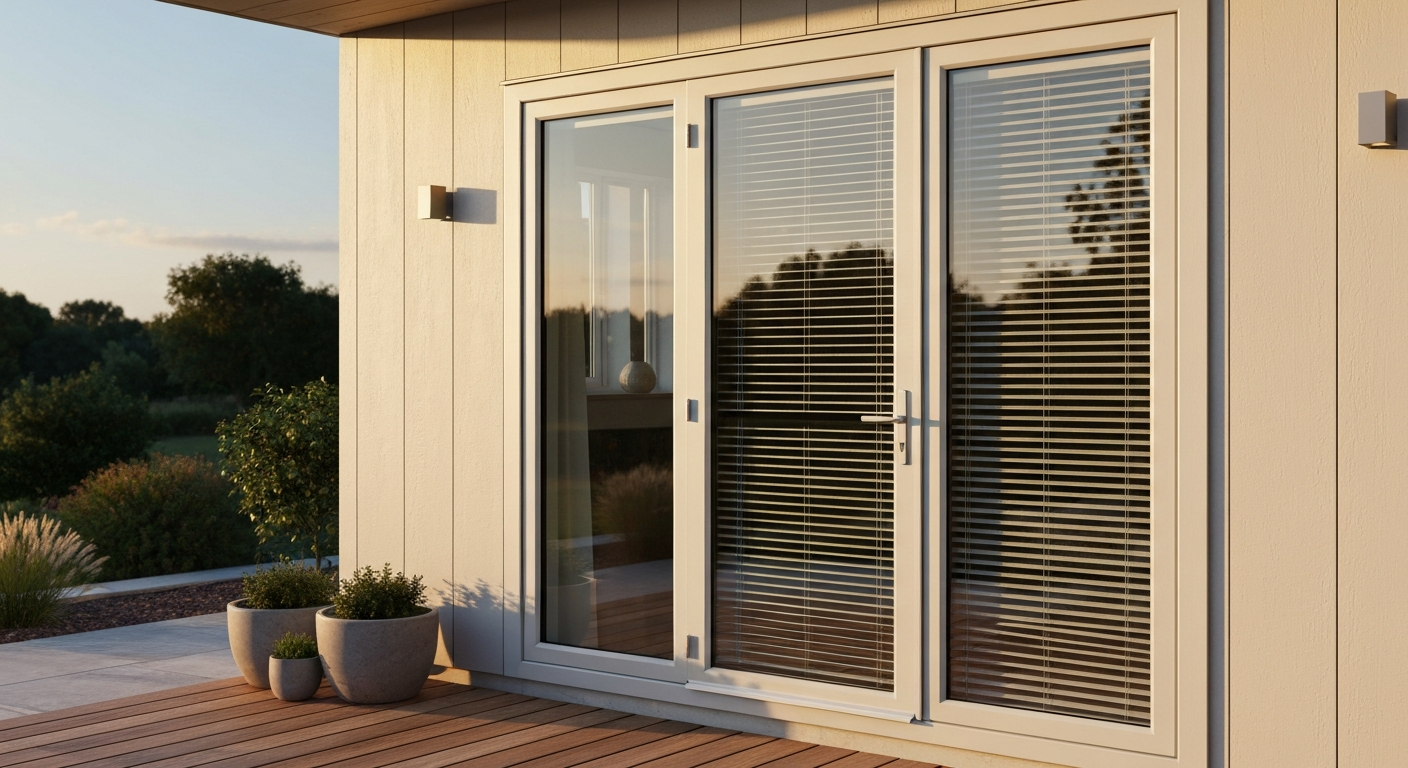
For most French patio doors, outside-mount cellular shades or roller shades are your best bet. They sidestep the clearance problems that come with French door swing, they're easy to size correctly, and they give you real privacy and light control without fighting the door hardware every time you open up. If you want a quick answer: cordless cellular shades in an outside mount, sized with 1.5 inches of overlap on each side, handle about 80% of French door situations beautifully. The rest of this guide covers the details that matter when you want to get it exactly right.
Best Blinds for French Patio Doors: Top Picks and Sizing
Owen Delaney
16 Jun 2026
Why French patio doors need special blind choices
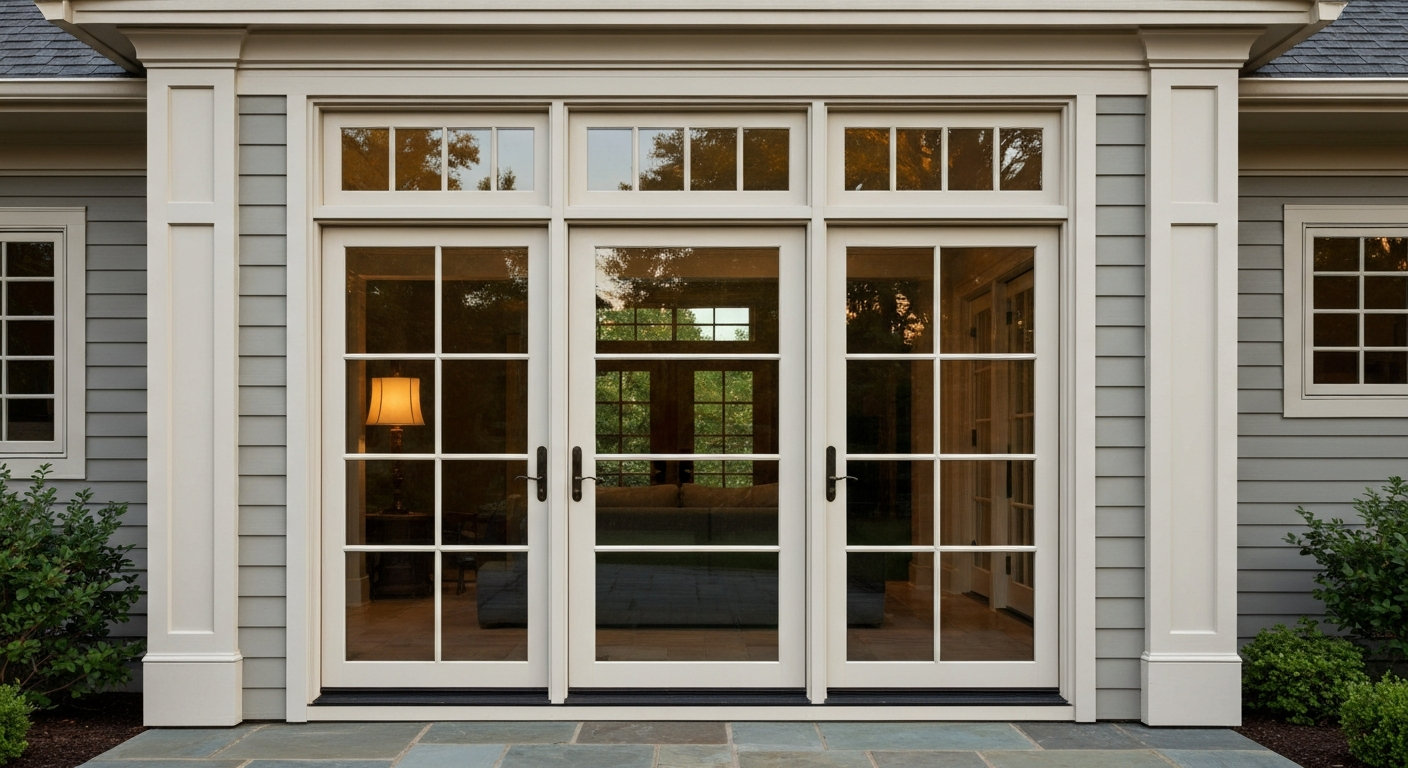
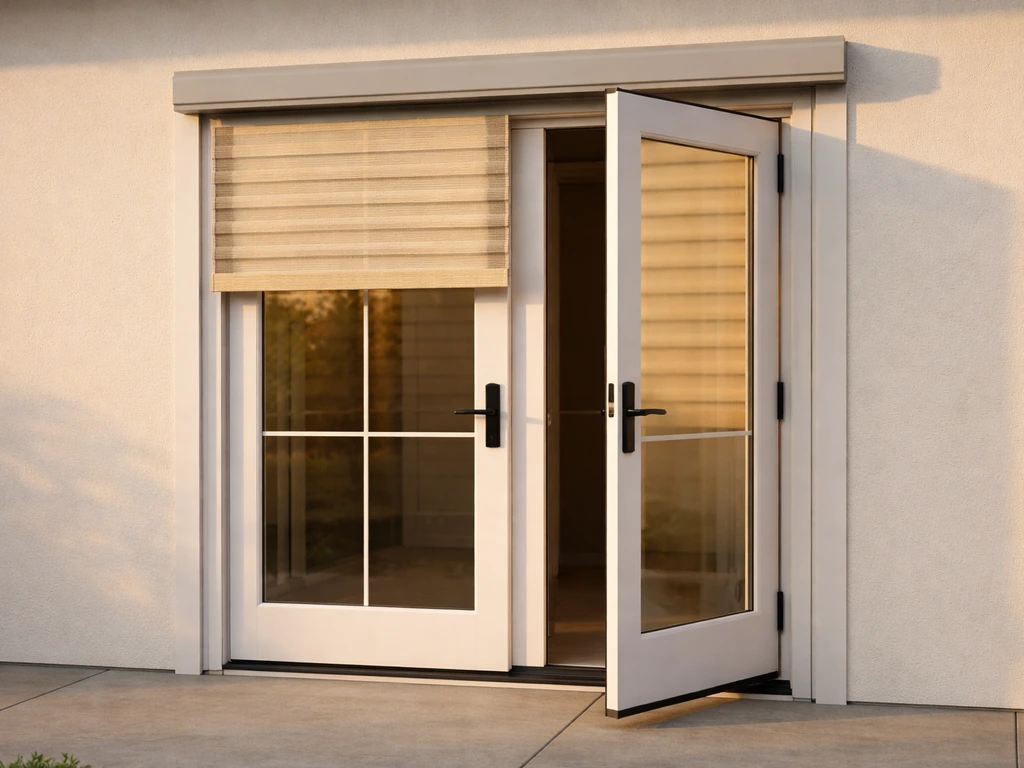
French patio doors are not just fancy sliding doors. They swing open, they have handles and hinges that stick out, and the glass panels usually run very close to the door frame with almost no interior depth to work with. That last part is the biggest issue: most standard blinds assume you have at least 2 to 3 inches of inside-frame depth to mount into. French doors typically don't. That's why retailers like Blindsgalore flat-out call inside mounts 'rare' for French doors and steer shoppers toward outside mounts instead.
The swing is the other thing that trips people up. A French door panel swings inward or outward through a wide arc. If you mount a blind directly on the door glass panel (which is a popular option for single-glass French doors), the blind travels with the door, which is fine. But if you mount over the full door opening from the wall above, you need to make sure the blind clears the door handles and latches when it's down. Miss that and you've bought yourself a very frustrating daily routine of wrestling your blinds every time you want to step outside.
There's also the humidity factor. French patio doors are often in kitchens, dining rooms, or sunrooms where temperature swings and outdoor moisture are a real factor. Real wood blinds can warp and crack in those conditions. If you're in a humid climate or your doors face south or west with heavy sun exposure, material choice matters as much as mount style.
Quick recommendation by goal
Before diving into the full breakdown, here's a fast decision framework based on what you're actually trying to accomplish:
| Your Goal | Best Blind Type | Key Feature to Look For |
|---|---|---|
| Privacy with some natural light | Cellular shades (semi-opaque) | Outside mount, 1.5" side overlap |
| Full blackout (bedroom, media room) | Blackout cellular or roller shades | Side channels (like LightLock®) to close light gaps |
| Sun glare reduction, keep the view | Solar/screen roller shades | 3–10% openness factor; outside mount |
| Light filtering, soft ambiance | Sheer shades or light-filtering cellular | Semi-opaque fabric, cordless lift |
| Top-down privacy (see out, not in) | Top-down/bottom-up cellular shades | Dual rail system, cordless or motorized |
| Humidity/outdoor-facing doors | Faux wood or composite blinds, or PVC roller shades | Moisture-resistant material |
Top blind types for French patio doors (and their tradeoffs)
Cellular shades
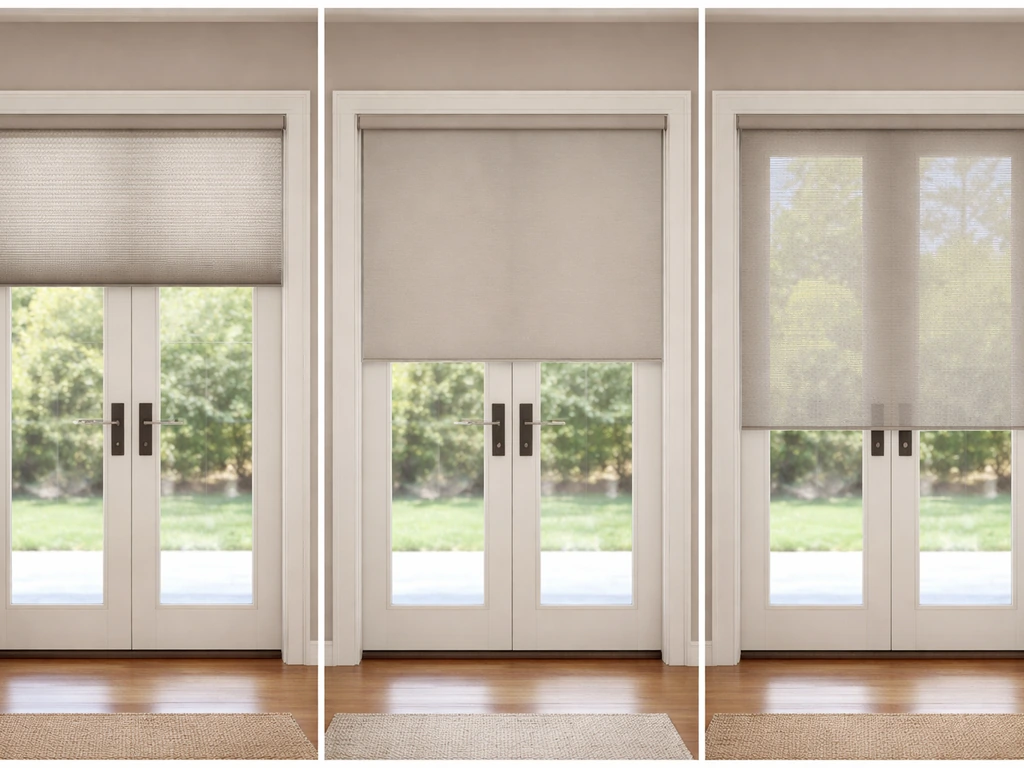
This is the option I recommend most often for French patio doors. Cellular shades (also called honeycomb shades) are lightweight, available in every opacity level from sheer to blackout, and they mount cleanly in an outside configuration without adding a lot of bulk. Hunter Douglas's Duette line is the premium benchmark here, with options for top-down/bottom-up operation that let you drop the shade from the top down to keep a view while blocking sightlines from the street. The main tradeoff: quality cellular shades cost more than basic roller shades, typically $80 to $250 per panel depending on size and features, and they're harder to clean than smooth-surface options.
Roller shades
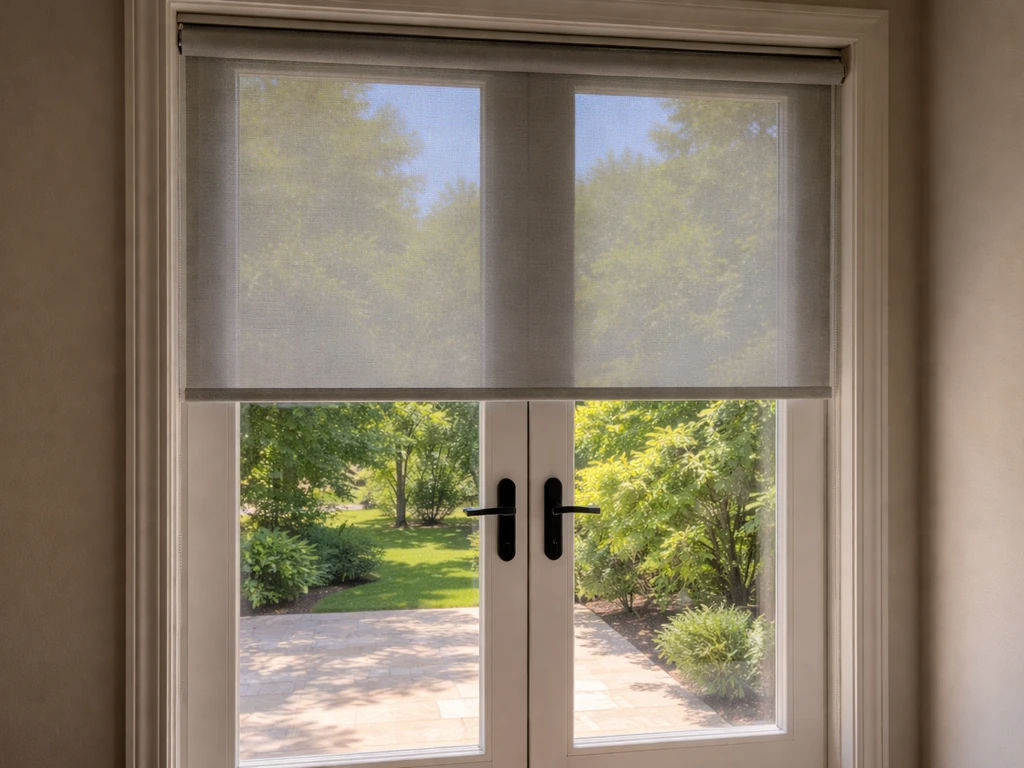
Roller shades are the most affordable and easiest to DIY install. They roll up neatly when you want the door fully clear, and they're available in blackout, room-darkening, solar, and light-filtering fabrics. The catch for blackout performance: standard roller shades have side gaps where light bleeds in. Lutron and Hunter Douglas both address this with side-channel systems that run tracks along the edges to seal those gaps.
The Curtain also explains that Hunter Douglas’s LightLock blackout system uses side channels to block light gaps for the most complete room darkening side channels to seal those gaps. If true darkness matters to you, budget for a roller shade with side channels rather than a bare roll shade. Expect to pay $40 to $120 for a budget roller shade, or $150 to $400 with a side-channel system.
Solar shades
Solar shades are an underrated choice for French patio doors that face south or west. They cut UV glare and heat gain while keeping your view of the backyard. The openness factor (typically 1% to 14%) tells you how much you can see through: a 3% fabric is fairly private during the day while blocking most glare, while a 10% fabric is more transparent but still cuts heat. They won't give you nighttime privacy because light from inside reverses the effect after dark, so think of them as a daytime sun-control solution rather than a full privacy treatment.
Faux wood and composite blinds
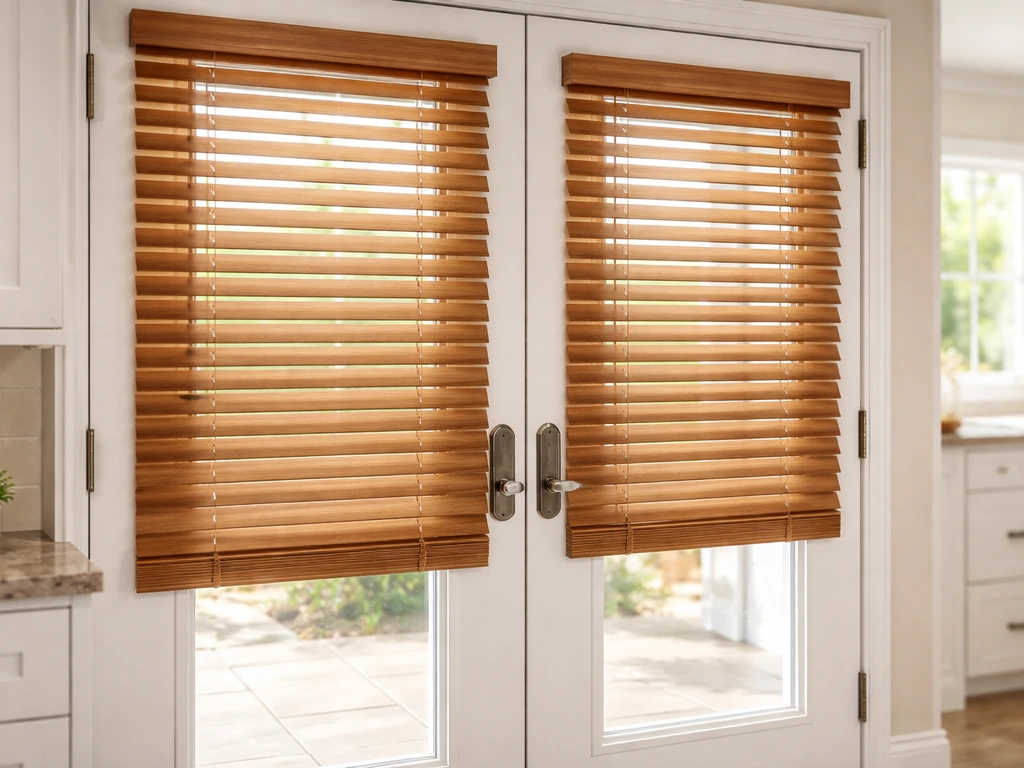
If you like the look of wood Venetian-style blinds but your French doors are in a kitchen or sunroom with humidity swings, go faux wood or composite. Real wood warps in moisture-heavy environments (Bali's own warranty documentation acknowledges this), while faux wood and composite versions are engineered to resist those conditions. These work well when you want adjustable slat control over light direction rather than a solid shade. The downside: when the door swings, horizontal slat blinds take up more clearance space than a rolled-up shade, and you need to factor in the stack height.
Door-mounted panel blinds (on the door itself)
Some homeowners prefer mounting a blind directly on each door panel rather than across the full opening. This way, the blind swings with the door, so there's no conflict between the blind and the door's movement. It's a clean solution especially for French doors with large individual glass panels. The downside is that you need a blind narrow enough to fit each panel's glass width, and you'll have a small gap in coverage where the two door panels meet. Many people find this gap acceptable, especially with an overlap strip or a door with an astragal (the vertical bar between panels).
| Blind Type | Privacy | Blackout Option | Humidity Resistance | Avg. Cost Per Panel | DIY Friendly |
|---|---|---|---|---|---|
| Cellular shades | Good to excellent | Yes (with channels) | Moderate | $80–$250 | Yes |
| Roller shades | Good | Yes (with channels) | Good (PVC fabrics) | $40–$400 | Yes |
| Solar shades | Daytime only | No | Good | $60–$180 | Yes |
| Faux wood blinds | Good (adjustable) | No | Excellent | $50–$150 | Yes |
| Real wood blinds | Good (adjustable) | No | Poor | $70–$200 | Yes |
| Motorized cellular/roller | Excellent | Yes | Moderate to good | $200–$600+ | Sometimes |
How to measure: inside vs. outside mount for French doors
Let me be direct: for French patio doors, you are almost certainly doing an outside mount. Inside mount requires 2 to 3 inches of interior frame depth, and most French doors don't have it. If you're not sure, grab a tape measure and check the depth inside your door frame from the glass to the front edge. Less than 2 inches? Outside mount it is. Blindsgalore notes that most French-door shade applications use an outside mount because there is typically not enough depth inside the glass frame for mounting Outside mount it is..
Measuring for an outside mount
Here's the sequence that works. Measure the full width of the door opening (from outside trim edge to outside trim edge) at the top, middle, and bottom. Use the largest measurement so your blind covers everything. Then add 3 inches total to that width: 1.
5 inches on each side beyond the trim. That overlap is what eliminates light gaps along the edges and gives you real privacy, not just decorative coverage. For height, measure from where you plan to mount the bracket (typically 2 to 4 inches above the top of the door frame or trim) down to the floor or wherever you want the blind to stop. Always measure to the nearest 1/8 inch.
Sloppy measurements mean you order a blind that doesn't cover the door properly, and you're back to square one.
If you're mounting on the door panel itself
Measure the width of the glass pane on one door panel (not the full door panel width, just the glass). Your blind should be sized to fit within that glass width. Measure height from the top of the glass to the bottom, and use a mount kit or tension mount designed for doors. Many cellular shade manufacturers sell French door tension mount kits specifically for this application, so you don't have to drill into the door itself.
Sizing, clearance, and making sure the door can actually open
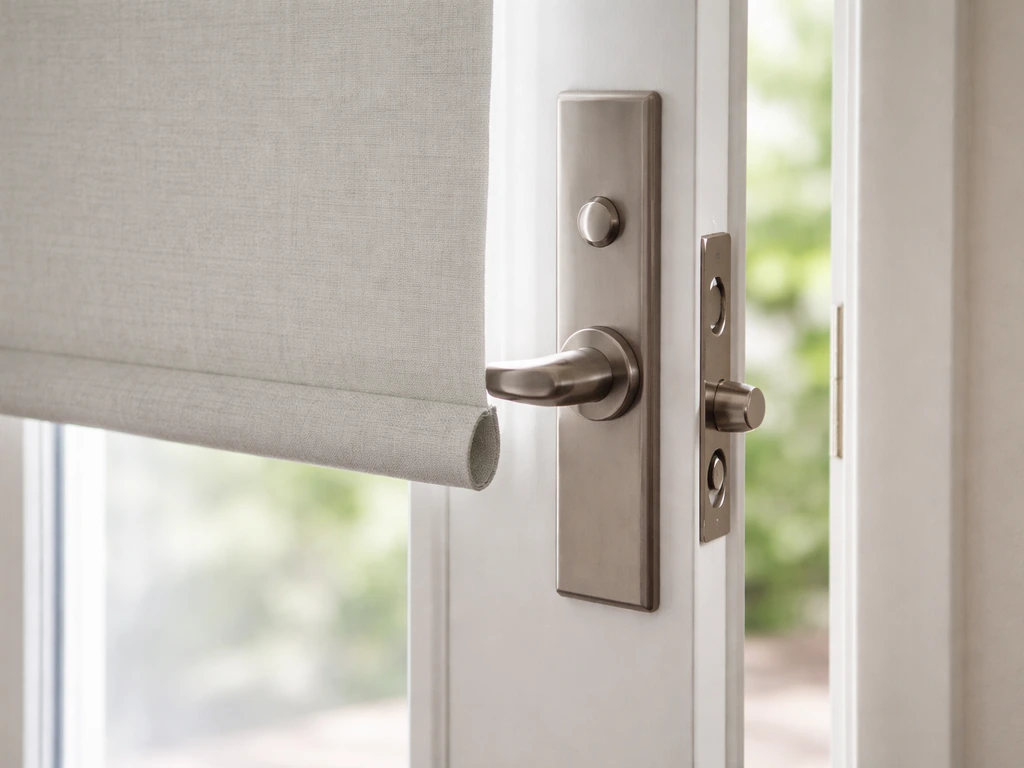
This is where a lot of people get burned. They order the right width and height, install the blind, and then discover it drapes right over the door handle or catches on the latch every time they open the door. Here's how to avoid that.
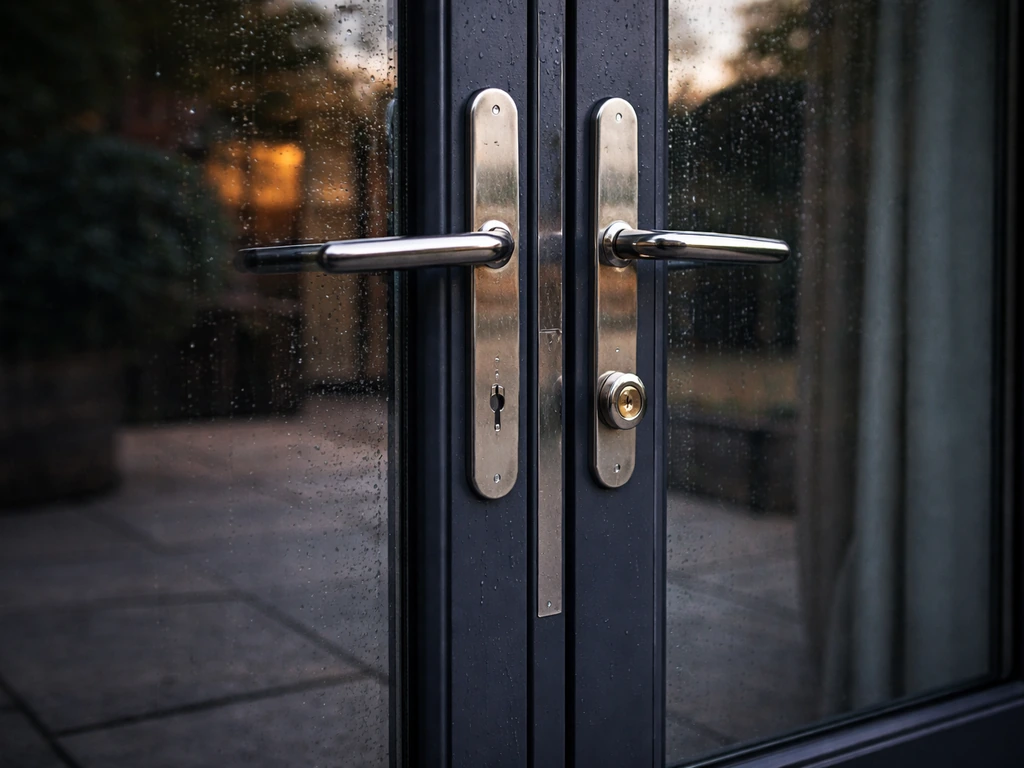
- Measure the projection of your door handles and hardware off the door face. Most lever handles project 2 to 3 inches. Your outside-mount blind needs to hang in a plane that clears those handles when the blind is down.
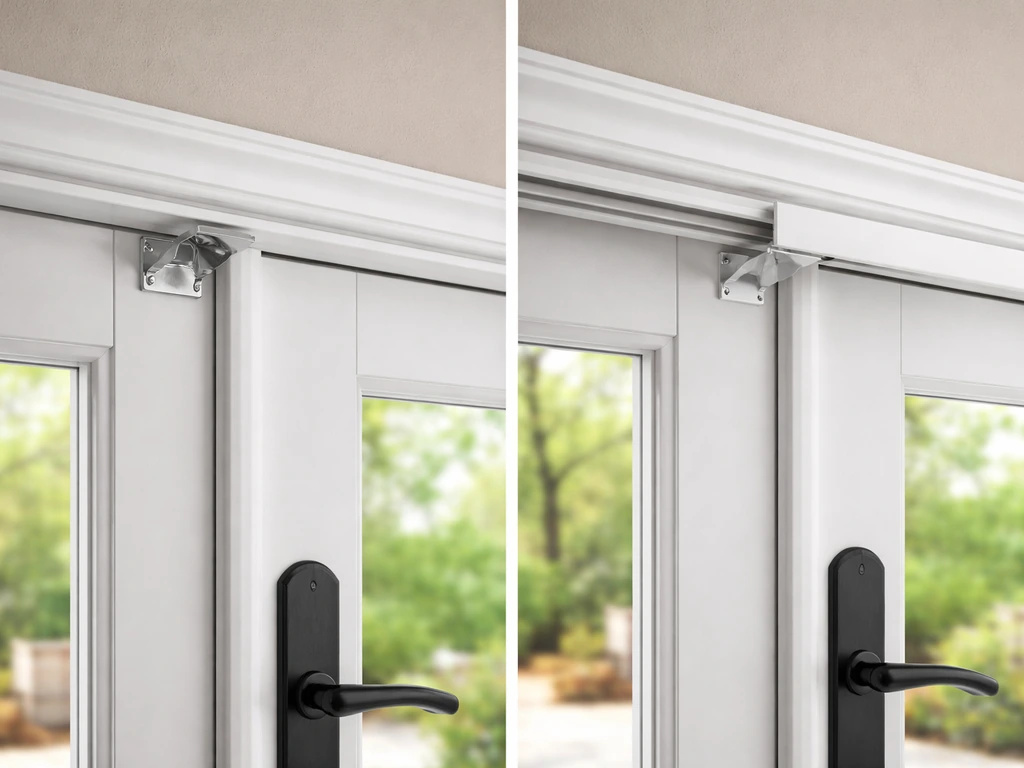
- Check your headrail depth. A standard cellular shade headrail is about 2 to 3 inches deep. Mount the bracket high enough that the headrail clears the top of the door frame trim and doesn't interfere with the door swinging open.
- If you have a center astragal (the vertical bar between double French door panels), account for it in your width measurement. Your outside-mount blind should span the full opening including the astragal, not stop at it.
- Think about the blind in the raised position. When you lift or roll the blind up, where does the stack land? On a 96-inch-tall door, a cellular shade stacks to about 6 to 8 inches. That stack needs to sit above the door frame, not in the path of the top of the door.
- For inward-swinging French doors, the door sweeps toward the room. Make sure your blind mounts to the wall above and outside the arc of the door swing so the door doesn't slam into the blind when opened fully.
If you're mounting directly on the door panel and the blind swings with the door, most of these clearance issues go away. The only thing to watch there is that the blind doesn't slap against the door frame or sill when the door closes.
Cost, installation, and keeping them looking good
What to budget
A pair of French patio doors typically requires two panels of coverage, either two separate blinds (one per door panel) or one wide blind across the full opening. Here's a realistic cost range for common options as of mid-2026:
- Budget roller shades: $40 to $80 per panel (no side channels, light-filtering fabric)
- Mid-range cellular shades: $80 to $180 per panel (cordless, semi-opaque)
- Premium cellular shades (Hunter Douglas Duette, top-down/bottom-up): $150 to $350 per panel
- Blackout roller shades with side channels: $150 to $400 per panel
- Motorized shades: $250 to $600+ per panel depending on brand and motor type
- Professional installation: $75 to $150 per blind, or $200 to $400 for a full French door set
DIY vs. professional installation
Honest take: an outside-mount blind over a French door is one of the more DIY-friendly blind installations you'll do. If you're also shopping for the doors themselves, you'll want to compare brands for durability, hardware quality, and proper fit for patio use who makes the best French patio doors. You're mounting brackets to drywall or trim above the door, not inside a tight frame. If you own a drill and a level, you can handle it.
The part where people go wrong DIY is the measurement stage, not the install. Measure twice (at top, middle, and bottom), double-check your overlap calculation, and confirm the blind's headrail depth before you drill. Most cellular and roller shade manufacturers ship with the bracket hardware included, and the process takes 30 to 60 minutes per blind.
Where professional installation makes sense: motorized systems that need wiring or smart-home integration, unusually large or heavy shade panels, or if your door frame has unusual trim geometry that requires creative bracket positioning. If you're spending $400 or more on a shade, getting a pro to install it correctly is worth the peace of mind.
Keeping them in good shape
French patio doors take more abuse than interior windows because they're opened and closed repeatedly and exposed to outdoor air. Cellular shades can be dusted with a soft brush or blown out with a hair dryer on cool. Roller shades and solar shades wipe down with a damp cloth. Avoid real wood blinds in humid climates entirely (warping is a known issue even with quality brands). Faux wood and composite blinds wipe clean and hold up well in kitchens, sunrooms, and humid coastal climates. For any blind mounted directly on the door panel, check the mounting hardware every 6 months since vibration from the door movement can loosen screws over time.
Mistakes to avoid and what to do before you buy
Here are the most common ways this goes wrong, based on what I see homeowners run into repeatedly:
- Ordering inside-mount when your door frame doesn't have enough depth. Check depth before you pick a mount type. 2 inches minimum for most inside mounts.
- Forgetting the overlap. A blind sized exactly to the opening width will have light gaps. Add 1.5 inches per side to the width for outside mounts.
- Not accounting for door handle projection. Your blind hangs in a plane. Make sure that plane clears the handles and latches when the blind is lowered.
- Buying real wood blinds for a humid or sun-intense exposure. Faux wood or cellular shades handle moisture and UV much better.
- Expecting room-darkening to mean total blackout. Room-darkening shades block around 95% of light; if you need true blackout, you need side channels or a system like LightLock to close the edge gaps.
- Ignoring the stack height. When the blind is raised, that folded or rolled material needs to live above the door frame, not in the door's operating path.
- Measuring only once or at only one point. Measure width at top, center, and bottom. Doors and frames aren't always perfectly square.
Your next steps before you order
- Measure your door opening width at three heights (top, middle, bottom) to the nearest 1/8 inch. Record the largest number.
- Measure the interior frame depth to confirm whether inside mount is even possible (spoiler: it usually isn't).
- Measure the projection of your door handles off the door face.
- Decide on one blind per door panel (swings with the door) or one wide blind over the full opening (fixed to wall above). Both work; your preference for aesthetics and ease of use drives that call.
- Choose your opacity: light-filtering, room-darkening (95% blockage), or blackout with side channels for full darkness.
- Add 3 inches to your measured width (1.5 inches per side) for your outside-mount order width.
- Confirm the headrail depth of the blind you're ordering will clear your door trim when mounted.
- Check whether the fabric is rated for moisture resistance if your door faces south, west, or into a humid space.
If you're also thinking about the security side of your French patio doors, the hardware and locking setup matters as much as the window treatments. If you want to pair the right blinds with the most value-packed doors, start by comparing the best French patio doors for the money in your price range.
For the best security, focus on the best locks for French patio doors that match your door type and mounting style security side of your French patio doors. For the best security, focus on the best locks for French patio doors that match your door type and mounting style. And if you're still in the process of choosing your doors themselves, it's worth comparing French door options across brands before committing to a treatment style, since some door configurations (narrow panels, built-in grilles, or decorative glass) affect which blind types work best.
When it comes to French patio doors, the best choice often depends on the brand and builder behind the doors, not just the window treatment best french patio doors. If you want the simplest way to compare security, look at each door's locking system, glass type, and frame strength rather than just the style.
FAQ
Can I use an inside-mount blind on French patio doors if I have a little depth?
Yes, but only if the door opens without your hardware colliding. For outside-mount blinds over the full opening, confirm the fully lowered bottom edge clears the highest door handle, latch, and any decorative hardware. A good quick check is to hold a cardboard strip at the intended lowered height and swing the door while the strip is in place, then measure the clearance you actually have.
Are solar shades good for privacy at night on French patio doors?
If nighttime privacy matters, avoid relying on solar shades. Solar fabrics reduce glare and heat while keeping daytime visibility limited, but they typically do not block inside-to-outside visibility after dark. To get true after-dark privacy, choose room-darkening or blackout (preferably with side channels if you need darkness) or pair solar with curtains for nighttime coverage.
What should I do if the handle or latch blocks where the shade wants to land?
Most of the time, outside-mounted cellular shades are the easiest, but you still may want a different configuration if you have obstructions. If your door has a prominent lock, handle plate, or thick trim, consider mounting slightly higher and using a shade that lowers to a planned stop position. Some cellular shades also support lift options like top-down/bottom-up, which can keep the view while still avoiding the handle zone.
Is it better to use one wide blind across the opening or two separate blinds?
If you want the widest clear opening when both doors meet, consider two separate shades, one for each panel, or a single continuous wide unit that spans the full opening. Two separate shades usually stack more neatly out of the way during operation, while a single wide shade can be simpler to manage but may create a wider stacked headrail footprint. Choose based on how much clearance you need when the doors are fully opened.
How do I avoid light leaks with French patio door blinds?
It depends on whether you need a tight light seal. If you choose blackout roller shades, side gaps can undermine darkness, so side-channel systems are the safer option. If you go with light-filtering or room-darkening, you may accept minor bleed, but measure for overlap so edges line up with the outer trim, then test from different angles during the day.
If my measurements are correct, why do blinds still not fit right?
Measure to the nearest 1/8 inch, then confirm the headrail depth before ordering. Even if the width and height are correct, a deeper headrail can cause clearance issues when the door swings or when you close in tighter trim geometry. When in doubt, check the manufacturer’s return policy for sizing errors, because many blinds are made-to-order and exchanges are limited.
Will mounting a blind on each door panel leave an obvious gap in the middle?
For inside panel-mounted options (one blind per door panel), you generally need a narrow blind width that matches the glass panel, not the whole door width, and you’ll still have a seam where the panels meet. If you want seam reduction, choose an overlap strip or select a system with consistent overlap coverage, and position the blind so it sits centered on the glass rather than near the meeting stiles.
What material is safest for French patio doors in humid climates?
Humidity changes the best material choice. For kitchens, sunrooms, and coastal climates, real wood can warp or crack over time, even when quality brands do their best. Faux wood or composite usually handles moisture better, and cellular shades also tend to stay stable because they are lightweight and less dimension-sensitive than slatted products.
How often should I check the mounts for blinds installed on French patio doors?
Yes, and the mounting method determines how you should do it. For outside-mount shades, drill location and bracket spacing matter most, and you should verify the bracket level across the full trim before tightening. If the shade is tension-mounted or uses a special door mount kit, recheck tension after a few days of door vibration, because minor loosening can cause drifting alignment.