Perfect Fit blinds can work on sliding patio doors, but there is a significant catch most retailers bury in the small print: the framed Perfect Fit system adds a thin protruding border around the glass, and that border will physically foul the bypass track on many standard sliding patio doors, preventing the sash from closing properly. Whether they are a smart solution or a waste of money depends entirely on your door profile, your bead depth, and how much clearance you have between the glass and the door furniture. This guide walks you through everything you need to check before you order.
Perfect Fit Blinds for Sliding Patio Doors Reviews: UK Guide

Owen Delaney
10 Aug 2026
Who this review is for
If you are staring at a sliding or top-hung patio door and trying to decide between Perfect Fit blinds, vertical louvres, panel tracks, or a replacement door with built-in blinds, this article is written for you. It is especially useful for UK homeowners with uPVC patio doors who want a no-drill, made-to-measure solution and are not sure whether Perfect Fit is even compatible with their door. It is also useful for anyone comparing the upfront cost of a Perfect Fit system against the longer-term appeal of integral in-glass blinds on a new door. I have measured, ordered, and installed these blinds myself, and I will be straight with you about where the system performs well and where it falls short.
What Perfect Fit blinds actually are
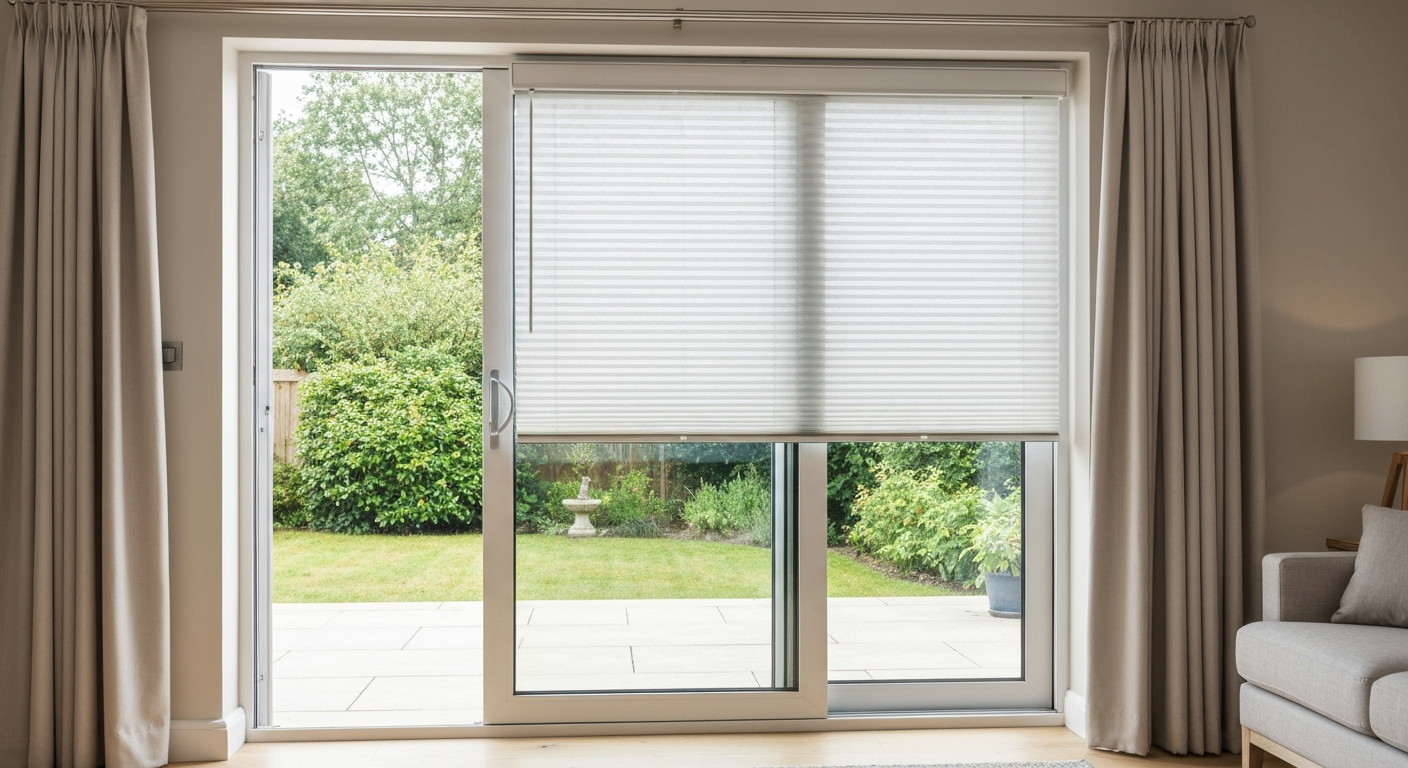
Perfect Fit is a framed blind system, most associated with the Louvolite Perfect Fit Next Generation range, that clips directly into the rubber beading of a uPVC or aluminium window or door frame. Louvolite describes the Perfect Fit® Next Generation as a UK-designed, clip-in framed blind system that fits inside uPVC window and door beads without drilling and is offered for roller, pleated, cellular and Venetian styles Perfect Fit® Blinds | Louvolite. There are no screws, no brackets drilled into the wall, and no adhesive. Instead, a slim engineering-grade polymer and aluminium frame slides under the existing window bead using spring-loaded clips, and the blind fabric sits within that frame. Because the whole unit is self-contained, it can be removed in seconds for cleaning or if you move house.
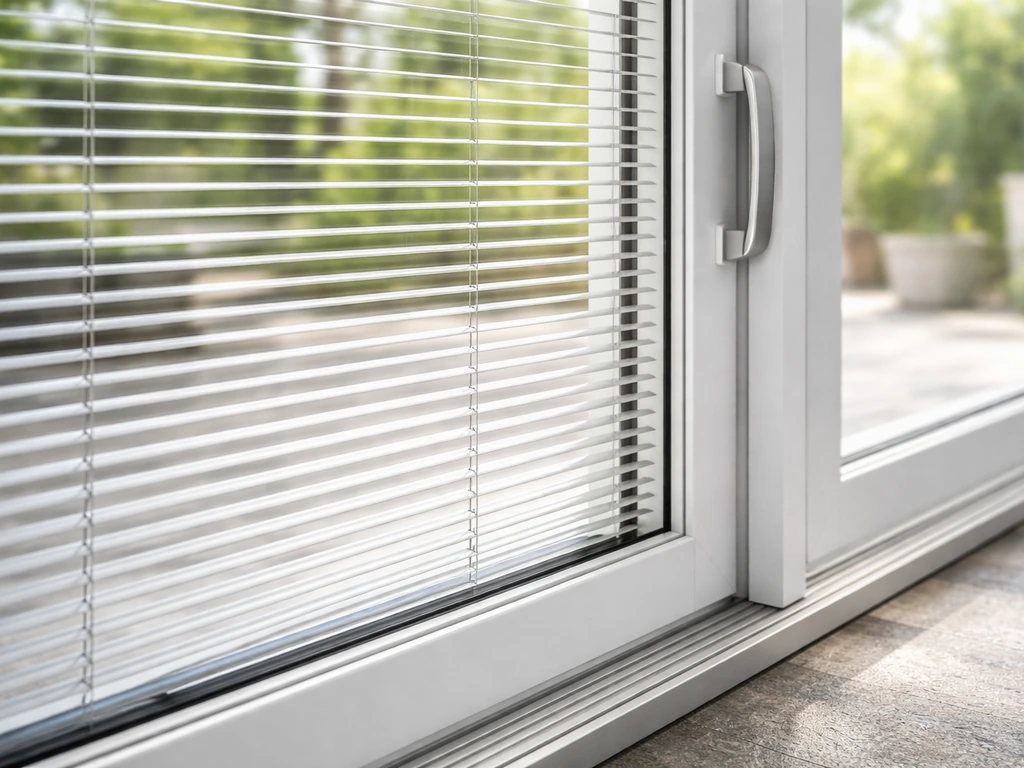
It is worth separating Perfect Fit from two things it is often confused with. First, add-on blinds: things like vertical louvres or panel tracks that hang from a separate track fitted to the wall or ceiling above the door. Perfect Fit is fitted to the door panel itself, not to the surrounding wall. Second, in-glass or integral blinds: these are factory-sealed blinds fitted between the double-glazed panes during manufacture. Perfect Fit sits in front of the glass on the room-facing side of the frame, so it can be retrofitted to any compatible existing door without replacing the glazing unit.
How it works on sliding and top-hung patio doors
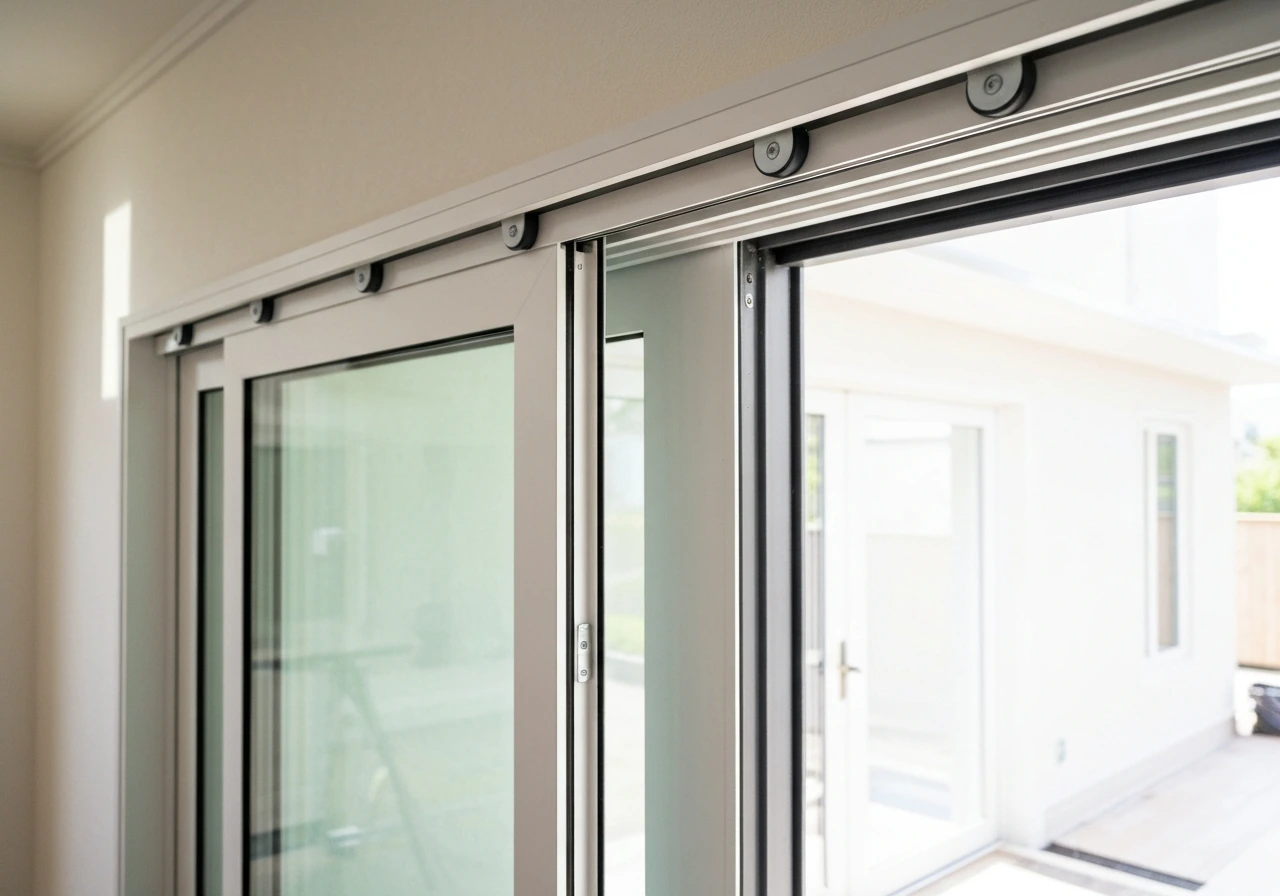
For a top-hung sliding patio door (where the sash hangs from an overhead track and slides parallel to a fixed panel), each sash has its own separate frame rebate and bead channel. In theory, a Perfect Fit blind clips into each individual sash independently, moves with the sash when you slide it, and never needs repositioning. That is the best-case scenario for this door type and genuinely works well when the bead depth and clearances are adequate. See our guide to top hung sliding patio doors for detailed compatibility and clearance considerations.
For a bottom-rolling sliding door, the sash slides on a floor track. The principle is the same: the blind fits to the sash rather than to the wall. However, the frame depth tolerance is tighter on many bottom-rolling designs because the rebate is shallower. The Louvolite Next Generation system uses bracket options sized to suit different bead depths, and their measuring guides will tell you which bracket you need once you have recorded your bead depth measurement.
In terms of operation, Perfect Fit blinds come in three forms. Cordless manual systems (the blind raises and lowers by gripping the bottom rail and pulling or pushing) are the standard and most popular option. Cord-operated systems exist for some Venetian styles. Motorised options use Louvolite's One Touch rechargeable DC motor, which charges via USB-C, runs at roughly 30 dB (quiet enough not to notice from across the room), and supports Louvolite's Smart Hub, remote control, and voice assistant integration. The motorised system has a weight capacity of 1 kg, which limits the fabric size and weight you can use.
Pros and cons for sliding and top-hung patio doors
I want to be specific here because Perfect Fit's strengths and weaknesses look quite different depending on which door type you have.
Top-hung sliding doors
- The blind travels with the sash, so you never have to adjust it when opening the door. This is a genuine quality-of-life improvement over verticals or panel tracks.
- No exposed cords on cordless models means the system is child-safe by design, which satisfies UK child-safety guidance from RoSPA and the BBSA 'Make it Safe' campaign, as well as the EN 13120 and EN 16433 standards.
- Light sealing at the edges is better than with vertical louvres because the frame sits in the bead, but it is not draught-proof. If you are expecting the blind to contribute meaningfully to heat retention in winter, cellular/honeycomb fabric helps but the perimeter gaps in the bead channel will still allow some cold air movement.
- Sightlines are clean: the frame is narrow and sits flush with the bead, so when the blind is raised you barely notice it.
- Wear point: the clip-in brackets and spring clips experience repeated stress each time the sash is slid. On a door used many times a day, inspect the clips annually and replace before they fatigue.
Standard sliding (bypass) patio doors
- Compatibility is the primary risk. The Perfect Fit frame protrudes slightly beyond the face of the sash, and on a bypass door where one sash overlaps the other in the track, that protrusion can physically stop the door from closing or catch on the adjacent panel. Many UK retailers, including Dunelm, explicitly warn that Perfect Fit is 'often not suitable for sliding doors'.
- If your sliding door has sufficient rebate depth and the panels do not overlap (for example, a wide four-panel sliding door where each panel runs in a dedicated lane with no overlap), compatibility improves significantly. Always check your specific door manufacturer's frame dimensions before ordering.
- Draft sealing on bypass doors is limited for the same reason as top-hung doors. The blind does not create an airtight seal.
- Access: because the blind is fixed to the sash, sliding the door open takes the blind with it, keeping the opening clear. That is an advantage in summer when you want light control and ventilation at the same time.
- Cord-free pleated and roller styles are the least problematic on sliding doors because there is nothing external to snag or tangle as the sash moves.
Types, materials, and UK availability
Louvolite and the main UK retailers (Hillarys, Dunelm, Blinds2Go, and independent fitters) offer Perfect Fit in four core fabric types. Each has a distinct performance profile, and the right choice depends on whether your priority is blackout, insulation, diffused light, or easy cleaning.
| Type | Light control | Insulation | Best for | Typical UK price range (per sash, made to measure) |
|---|---|---|---|---|
| Roller | Good (up to blackout depending on fabric) | Low | Clean modern look, easy to wipe down | £40–£120 |
| Pleated | Moderate to good (depending on fabric opacity) | Low to moderate | Conservatories, budget buyers | £30–£100 |
| Cellular / Honeycomb | Moderate to good | Best of the four types (trapped air cells) | Energy efficiency, noise reduction | £60–£150 |
| Venetian (aluminium slats) | Excellent, adjustable | Low | Adjustable privacy and light | £50–£130 |
All four types are available made to measure across the UK through multiple channels. Louvolite supplies trade retailers and independent fitters; Dunelm sells its own branded made-to-measure Perfect Fit pleated and cellular ranges online; Hillarys offers home consultation and supply-fit service; and Blinds2Go is a popular DIY-order online retailer. Colour choices are broad: roller fabrics run from plain whites and neutrals through to printed and textured weaves. Venetian slats typically come in a range of 20-30 standard finishes. Cellular fabrics in the UK market skew toward neutral tones. Lead times for made-to-measure orders are typically 7–14 working days from most UK retailers.
One technical limit worth knowing: some Perfect Fit Next Generation pleated and cellular variants are specified for blinds up to 1.4 m wide. A standard UK two-panel sliding patio door is typically 1800 mm or 2100 mm wide overall, meaning each sash is approximately 900–1050 mm wide. That falls within the 1.4 m limit comfortably. Larger format doors with wider individual sashes may push against that limit, so confirm the maximum width specification with the retailer before ordering.
How to measure your sliding patio door for Perfect Fit blinds
The single biggest mistake people make is measuring the overall door frame width and ordering one blind to cover it. Perfect Fit blinds are made to fit each individual sash panel, not the full door opening. Measure each sash separately, even if they look identical.
What you are measuring and why
Perfect Fit blinds are ordered to the glass dimensions, not the full frame. You measure the visible glass width and the visible glass drop (height). The frame and bead are not included in the order dimensions because the blind bracket hooks under the bead, not over the frame.
- Measure the glass width: using a steel tape, measure the width of the glass pane only, from inner edge of rubber seal to inner edge of rubber seal on the opposite side. Record in millimetres. Do this at the top, middle, and bottom of the pane and use the smallest measurement if they differ.
- Measure the glass drop: measure the height of the glass pane from inner seal edge at the top to inner seal edge at the bottom. Again, take three measurements (left, centre, right) and use the smallest.
- Check the bead depth: this is the depth of the frame channel that the rubber seal sits in. Dunelm's guidance suggests a credit-card test: if a credit card (roughly 0.76 mm thick) cannot slide behind the rubber seal, the bead is too shallow. Most retailers provide a minimum bead depth requirement, typically around 14–22 mm depending on the bracket size used.
- Check the rubber seal height: the rubber seal over the glass should not exceed approximately 5 mm. If it is larger, the bracket cannot seat correctly.
- Check handle and hardware clearance: there must be at least approximately 25 mm of clear space between the glass surface and any handles, tilt mechanisms, or locking points. The Perfect Fit frame will occupy this space and must not contact the hardware.
- Note the door operation direction: for a sliding sash, confirm whether it slides left or right. This affects which side of each sash has the handle and where the bracket clips may need to accommodate hardware.
- Check for overlap zones: on a bypass sliding door, identify exactly where the fixed and moving panels overlap when the door is partially open. The Perfect Fit frame protrusion in this zone is where compatibility problems occur.
Common measuring mistakes to avoid
- Measuring the full door frame width instead of individual sash glass widths.
- Measuring in centimetres and rounding: always work in millimetres and do not round up.
- Ignoring the bead depth check and discovering post-delivery that the bracket does not fit.
- Forgetting to account for trickle vents or night-latch hardware that protrudes into the clearance zone.
- Assuming all sashes on a multi-panel door are the same size: measure each one individually.
Step-by-step installation guide
Louvolite publishes dedicated how-to videos and measuring cards for the Next Generation system, and they are worth watching before you start. The installation sequence below covers the main steps for a cordless roller or pleated Perfect Fit blind on a sliding patio door sash.
Tools you will need
- Steel tape measure
- Soft cloth or cleaning spray (to degrease the bead channel)
- Plastic pry tool or credit card (to check bead gap and help seat brackets)
- The Perfect Fit blind unit (frame pre-assembled by the manufacturer to your glass measurements)
No drill, no screwdriver, and no adhesive are needed for a standard Perfect Fit installation. That is genuinely the case, not marketing speak.
Installation sequence
- Clean the bead channel: wipe out any dust, condensation residue, or grease from the rubber seal and the bead channel around the full perimeter of the glass. The spring clips grip best on a clean surface.
- Lay the blind flat and identify top and bottom: the headrail (where the fabric rolls up or pleats compress) always goes at the top. The bottom rail has the cord-free pull handle or cord exit.
- Start at one top corner: hold the frame section at a 30-45 degree angle and slide the top-corner bracket under the rubber seal at the top corner of the glass. Apply gentle pressure until the spring clip clicks audibly into the bead channel.
- Work along the top rail: press the remaining top-rail brackets into the bead channel from the centre outward, clicking each one in. You should hear a distinct click for each bracket.
- Fit the side channels: once the top rail is seated, press the side-channel sections into the bead down each vertical edge. These typically snap into the corner joints of the top rail and then press into the side beads.
- Fit the bottom rail: the bottom rail sits in the bottom bead channel last. Press it into place working from one corner to the other.
- Test the operation: raise and lower the blind several times. The fabric should travel smoothly without catching on the frame. If there is any resistance, check that all bracket clips are fully seated.
- Check clearance with door operation: slide the door sash slowly through its full travel range. Watch and feel for any contact between the Perfect Fit frame and the adjacent panel, the door frame surround, or the track housing. If you feel resistance or hear scraping, the door is not compatible and the blind must be removed.
Adjusting panels and sealing
Perfect Fit does not create a draught seal. If you want to improve the edge seal for thermal performance, cellular fabric helps because it traps air within the blind itself, but do not expect the clip-in frame to seal the perimeter of the glass. For a proper thermal or acoustic seal on a patio door, that job needs to be done at the door frame and weatherstripping level, not by the blind.
DIY vs professional installation
Perfect Fit is one of the genuinely DIY-friendly blind systems on the market. The clip-in design requires no power tools, no fixings, and minimal time: an experienced fitter can install a single sash blind in under 10 minutes, and a first-timer with the measuring done correctly should manage it in 20–30 minutes per panel. The main DIY risk is not the installation itself but the measuring. If the glass dimensions are wrong or the bead depth is not checked, the blind simply will not fit and you will be paying for a remake.
| Scenario | Recommended approach | Approximate UK cost | Key consideration |
|---|---|---|---|
| Single sash, straightforward uPVC door, confident measurer | DIY supply and fit | £30–£150 per sash (blind cost only) | Measure three times, check bead depth carefully |
| Two-panel sliding door, moderate confidence | DIY with retailer measuring guide | £60–£300 total blind cost | Check bypass track clearance before ordering |
| Large multi-panel door or non-standard frame | Professional fitter (measure and supply) | From ~£120 per panel fitted (trade estimate) | Fitter takes responsibility for measurement accuracy |
| Motorised system with smart home integration | Professional or experienced DIY | £150–£350+ per sash including motor | USB-C charging, 1 kg weight limit, check fabric weight |
| Rental property or warranty-critical install | Professional, request written guarantee | From ~£120 per panel fitted | Some fitters offer a fitting guarantee; retailers like Hillarys include fitting in their service |
In the UK, Hillarys offers a home consultation, measure, supply, and fit service with a guarantee on fitting. Independent local fitters typically charge by the job and may not offer a formal guarantee, so ask explicitly. If you are buying through Dunelm's online made-to-measure range and fitting yourself, Dunelm's customer service team can help if the blind does not fit due to a manufacturing error, but measurement mistakes are the customer's responsibility. That is standard across the industry.
If you are outside the UK, for example in Australia, the USA, or continental Europe, the Perfect Fit system is available through local distributors but the fitting trade is less standardised. In those markets, DIY is more common simply because finding a specialist fitter is harder. The installation process is identical, but warranty support for manufacturing defects varies by region and retailer.
Price ranges and brand comparison
Louvolite is the originator of the Perfect Fit Next Generation system and the product most fitters and retailers refer to when they say 'Perfect Fit'. The Louvolite system has a documented 10-year life-cycle test and is the benchmark against which other framed clip-in systems should be compared. Other brands produce similar no-drill clip-in blind systems but may not use the same bracket engineering or fabric quality.
| Brand / Retailer | System | Price range (per sash, UK made to measure) | Fitting service | Warranty |
|---|---|---|---|---|
| Louvolite (via trade fitter) | Perfect Fit Next Generation (roller, pleated, cellular, Venetian) | £60–£180+ depending on fabric and size | Via approved trade installers | 10-year life-cycle tested; installer warranty varies |
| Hillarys | Perfect Fit (Louvolite-based range) | £80–£200+ including consultation | Yes, included in price | Hillarys fitting guarantee |
| Dunelm (online made to measure) | Own-brand Perfect Fit pleated and cellular | £22–£100+ depending on size | No (DIY fit) | Standard retailer returns/manufacturing defect policy |
| Blinds2Go (online made to measure) | Perfect Fit roller and pleated | £30–£130+ | No (DIY fit) | Manufacturing defect remakes standard |
For budget buyers: Dunelm and Blinds2Go are the cheapest entry points in the UK. A small sash pleated Perfect Fit can start from around £30, though patio door sashes are larger than most windows and realistic prices for a standard sash (say 900 mm wide by 2000 mm drop) will sit in the £80–£150 range for a decent fabric. For energy-efficiency priority: go cellular/honeycomb fabric through any of the above retailers. For child-safe priority: any cordless Perfect Fit (roller, pleated, or cellular) meets the cordless requirement. The motorised Louvolite One Touch system also includes mid-point limit setting, which is a useful child-safety and convenience feature. For the most integrated look: Perfect Fit gives a cleaner result than add-on verticals, but if you want the truly seamless appearance of no visible blind hardware at all, look at doors with built-in blinds between the glazing panes, which eliminate the frame entirely.
Perfect Fit vs the alternatives
This is where I want to be honest about the trade-offs, because depending on your door and priorities, Perfect Fit may not be the best answer.
| Solution | Best for | Weakness | Approximate cost (UK, per door) |
|---|---|---|---|
| Perfect Fit (clip-in frame blind) | uPVC/aluminium top-hung patio doors, no-drill requirement, clean look | May not work on bypass sliding doors; no draught seal | £60–£350 DIY; £120–£400+ fitted |
| Vertical louvres (wall-mounted track) | Wide sliding doors, full coverage, budget installs | Cords (unless motorised), less sleek, louvres can snag | £50–£200 DIY; £150–£400 fitted |
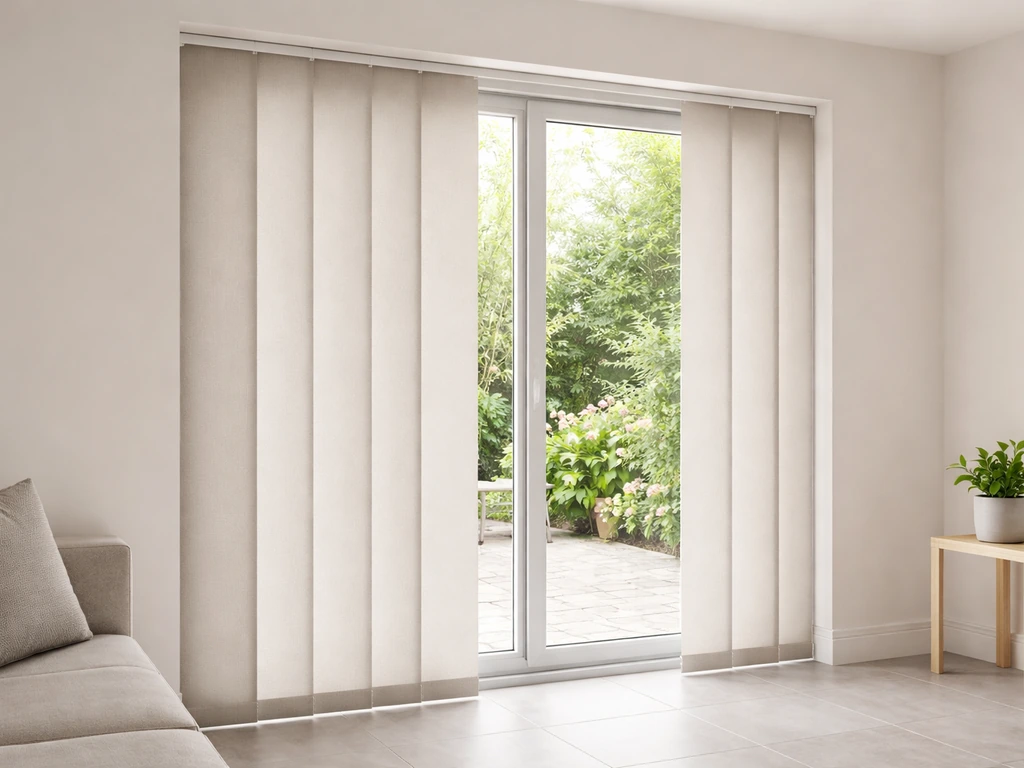
| Panel track blind | Wide sliding or bifold doors, contemporary look | Requires ceiling or wall mounting above door, stacks outside glass area | £80–£300 DIY; £200–£500 fitted |
| In-glass / integral blinds (factory fitted between panes) | New door replacement, zero maintenance blind, fully integrated | Only available on new door purchase, higher upfront door cost | £300–£800+ additional cost on door purchase |
| Replacement door with built-in blinds | Full renovation, maximum convenience, long-term durability | Highest cost, requires installation of new door | £1,500–£5,000+ installed |
If your sliding door is incompatible with Perfect Fit due to bypass track interference, a panel track blind mounted above the door is the closest aesthetic equivalent. It gives a clean, modern look, covers the full door width, and does not require any modification to the door itself. Vertical louvres are cheaper and more widely available from stock but look noticeably more dated in most modern homes. If you are already considering replacing your sliding door, it is worth looking at whether a new door with integral in-glass blinds makes more sense for your long-term budget. If you're considering replacing your sliding door, see our guide to the best sliding patio doors for the money for options that include integral blinds and long-term value. If you want to compare models, see our guide to the best sliding patio doors with built in blinds. If you're considering a replacement, see our guide to the best sliding glass patio door for models that pair well with integral blinds.
Maintenance, warranty, and troubleshooting
One of the genuine practical advantages of Perfect Fit over integral/in-glass blinds is that the blind can be removed in seconds for cleaning. The Louvolite frame clicks out of the bead channel without tools. Wipe the fabric with a damp cloth for roller and cellular types; pleated fabrics are more delicate and should be dusted rather than wiped. Aluminium Venetian slats can be wiped down with a damp cloth once removed. Reinstallation is the same clip-in process described above.
The most common problems people report are: brackets not seating fully (usually caused by debris in the bead channel or a bead depth that is marginal for the bracket size used); fabric catching on the frame (usually because the blind is slightly over-width due to measurement error); and spring clip fatigue on high-use sliding door sashes. Replacement brackets and clips are available through Louvolite's trade network and some retailers. If a clip fails within the warranty period, contact the retailer; if you installed it yourself through Dunelm or Blinds2Go, the warranty covers manufacturing defects but not clips broken by force or incorrect installation.
For motorised systems: the One Touch motor charges via USB-C and should be recharged every few months depending on use frequency. The motor is rated at 1 kg, so if you are having the motorised system made up for a tall patio door sash with a heavy fabric, check the finished blind weight with the retailer before ordering.
Child safety: what you need to know
UK child-safety standards under EN 13120 and EN 16433 require that internal blinds either eliminate cord hazards by design or include approved safety devices. Cordless Perfect Fit blinds (roller, pleated, and cellular operated by pulling the bottom rail) have no exposed loop cords and are considered child-safe by design, which is the position supported by RoSPA and the BBSA 'Make it Safe' campaign. If you opt for a cord-operated Perfect Fit Venetian, make sure it comes with a compliant cord-safety device such as a tensioner or cord cleat, and that the cord is positioned out of reach. The Louvolite motorised One Touch system includes a mid-point limit setting, which is useful both for safety and for setting a daytime privacy position without fully closing the blind.
Best-pick recommendations by use case
- Best for budget: Dunelm or Blinds2Go made-to-measure Perfect Fit pleated, DIY installation. Expect to pay £30–£80 per sash for a standard patio door panel. Check bead depth carefully before ordering.
- Best for energy efficiency: cellular/honeycomb fabric from Louvolite's Next Generation range (via trade fitter or Hillarys). The trapped-air cells provide the best thermal performance of the four fabric types.
- Best for child-safe households: any cordless Perfect Fit roller or pleated blind. Louvolite One Touch motorised is the premium option with mid-point limit setting.
- Best for the most integrated look: Perfect Fit roller in a neutral tone that matches your door frame colour. For an even more seamless result, consider a replacement door with integral in-glass blinds if you are already planning a door upgrade.
- Best for top-hung patio doors: Perfect Fit is particularly well-suited here because the blind travels with the sash. Any of the four fabric types works; choose based on your light and privacy priorities.
- Best for bypass sliding doors: verify track clearance first. If compatible, cordless pleated or roller Perfect Fit. If not compatible, consider a ceiling-mounted panel track blind instead.
Quick buyer checklist before you order
- Confirm your door type: top-hung or bottom-rolling bypass? Bypass doors need the track clearance check.
- Measure each sash individually: glass width and drop in millimetres, three measurements each.
- Check bead depth: use the retailer's bracket size guide to confirm compatibility.
- Check rubber seal height: should be no more than approximately 5 mm.
- Check hardware clearance: at least approximately 25 mm from glass surface to handles/vents.
- Choose fabric type based on priority: cellular for insulation, roller for easy cleaning, Venetian for maximum light control, pleated for budget.
- Decide: cordless (standard, child-safe by design), cord-operated Venetian (fit a safety device), or motorised (USB-C charged, 1 kg weight limit).
- Choose supply route: Dunelm/Blinds2Go for DIY budget, Hillarys for supply-and-fit, trade fitter for Louvolite Next Generation with full warranty coverage.
- Order and allow 7–14 working days for made-to-measure production.
If after going through this checklist you find your sliding door is not compatible with Perfect Fit, do not write off the whole project. For a quick comparison of options and retailers, see our guide to the best blinds for sliding patio doors UK. Panel tracks, vertical louvres, and doors with factory-fitted integral blinds are all worth exploring depending on whether you are covering an existing door or planning a replacement. If you're also shopping for an affordable replacement, see our guide to the best sliding patio doors under $1000. The right solution depends on your door geometry, budget, and how long you plan to stay in the property.
FAQ
What core product specifications should I collect for each Perfect Fit model reviewed?
Collect product name and manufacturer, compatible blind styles (roller, pleated, cellular/duette, Venetian), mounting system details (bracket types, frame/profile codes), materials (polymer, aluminium, fabric composition), maximum/minimum width and drop limits, weight limits (motorised and manual), operation types (cordless, handle, side‑pull, motorised with motor model and battery/charging method), acoustic/light reduction/R‑value data if provided, ingress/UV/temperature limits, removable/cleanable notes, and declared life/cycle testing (e.g., Louvolite 10‑year cycle test). Include links to manufacturer spec sheets and PDFs.
Which technical installation and measuring details are essential to verify?
Record exact measuring rules manufacturers require (glass width × drop only vs finished frame), required bead/frame depth ranges and how to measure bead depth (credit‑card test), maximum rubber‑seal protrusion allowed, clearance needed for handles/vents, whether the system is compatible with sliding/bypass sashes or top‑hung doors, bracket part numbers, headrail/channel dimensions, and any limitations for sash movement. Capture manufacturer step‑by‑step fitting guides or videos and note whether drilling is required or if clips slide under the bead.
What compatibility and practical limits should I check for sliding patio doors specifically?
Confirm whether the Perfect Fit frame interferes with door bypass/track movement (many suppliers warn sliding doors are often unsuitable), required clearance for sash overlap, how the frame sits relative to the sash stop, compatibility with sliding patio door handles and multi‑panel configurations, and any recommended workarounds (e.g., partial fitting to fixed panel only). Collect installer notes and real‑world reports showing success/failure rates on sliding systems.
What UK pricing data and ranges must I gather for accuracy?
Gather retail list prices for small, medium and large made‑to‑measure units across multiple retailers (Dunelm, Hillarys, Blinds2Go, eBay) and local trade fitting estimates. Record typical starting prices for pleated/roller Perfect Fit (~£30 for very small DIY units at discount retailers), average fitted prices from trade (examples from ~£120 per window fitted for small installs), and upper ranges for large motorised bespoke systems (several hundred pounds to £1k+ depending on fabric and motorisation). Note regional variation and additional costs for measuring/installation, call‑outs, VAT and delivery. Provide price examples for comparable alternatives (panel tracks, in‑glass blinds, replacement patio doors).
Which brands and models should be compared and what brand data is needed?
Include Louvolite (Perfect Fit Next Generation — manual and One Touch® motorised), major retailers' branded ranges (Hillarys, Dunelm, Blinds2Go), and specialist installers. For each brand gather spec sheets, available styles/fabrics, motor options, warranty terms, measured size limits, and claims (e.g., Louvolite’s 10‑year life‑cycle test, ~30 dB motor noise). List representative model recommendations for use cases (budget, energy‑efficiency, child‑safe, integrated look) with links to product pages and price examples.
What safety and standards information must be cited for a UK audience?
Cite EN 13120 (internal blinds performance and safety) and related EN 16433 test methods, UK safety guidance from RoSPA and BBSA/Make It Safe on cord hazards, and manufacturer compliance statements. Note industry emphasis on cordless or motorised solutions for child safety and any motor limits or safety features (e.g., motor weight capacity, mid‑point limits). Include summary of legal/standard obligations for retailers and installers where applicable.