Patio screen doors are not universal. There is no single screen door that fits every patio opening, and the word 'universal' on a retail box almost always means 'adjustable within a narrow range,' not compatible with every door on the market. To get a screen that actually works, you need to measure your specific opening, identify your door style and frame profile, and match hardware details like track width, roller size, and threshold height before you buy anything.
Are Patio Screen Doors Universal? Sizing, Kits, Costs

Owen Delaney
22 Jul 2026
Why most patio screen doors are not interchangeable
The core problem is that major manufacturers, Pella, Andersen, Milgard, and others, each publish their own series-specific size charts with different nominal dimensions, frame profiles, and hardware specs. Pella's standard sliding door heights run at 6'8" (80"), 6'10" (82"), 8' (96"), 9' (108"), and 10' (120"), while Andersen lists nominal 2-panel gliding door widths at 5'-0", 5'-11 1/4", 6'-0 3/4", and 8'-0 3/4", and Milgard publishes separate min/max charts for each of its series like the V400 and V450. None of those charts agree on a single shared standard. A screen panel built for a Pella 6'8" door will likely have a different track profile, roller housing, and frame thickness than what an Andersen or Milgard door of the same nominal height requires. That dimensional mismatch is why swapping a screen door from one brand to another almost never works without modification.
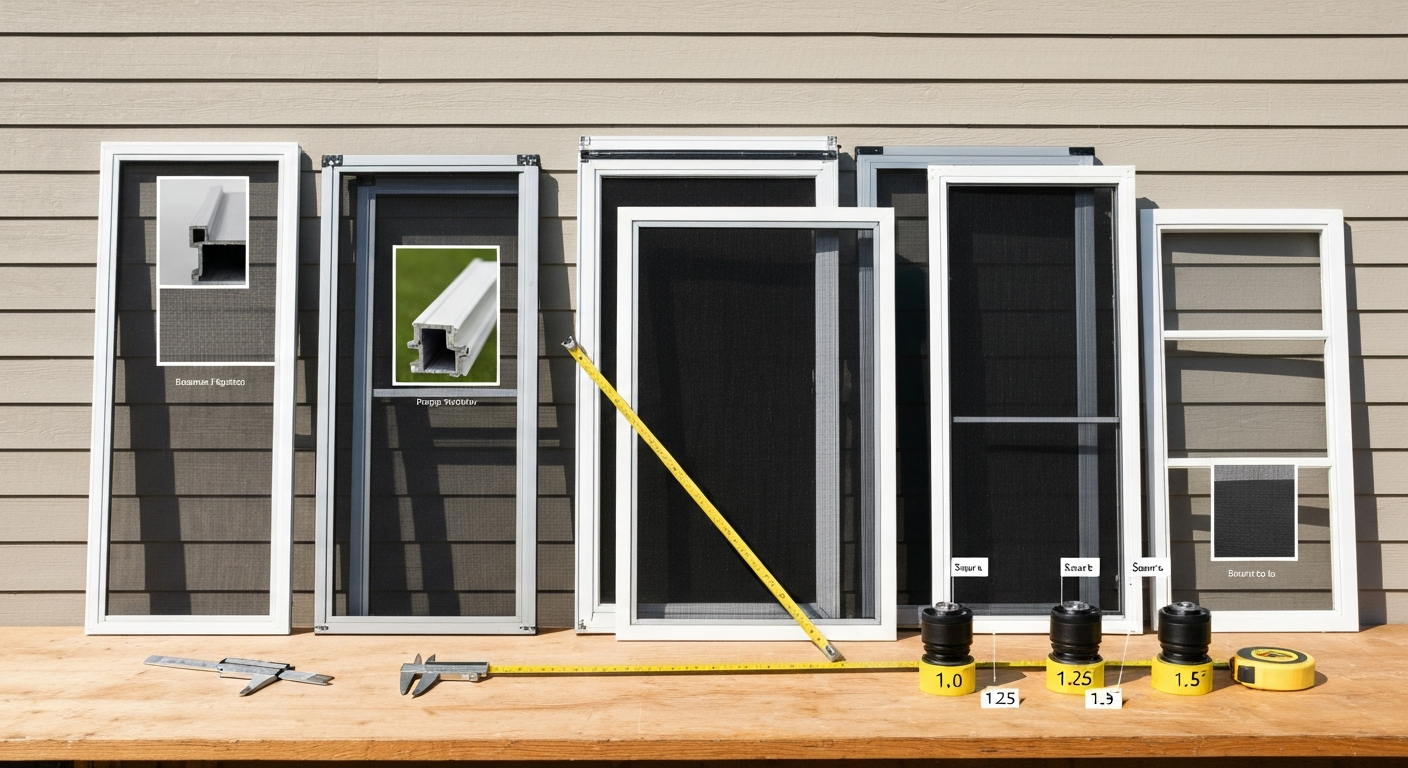
Beyond width and height, the internal geometry of a door frame varies by manufacturer and product line. Track cross-sections come in single and double configurations with asymmetric profiles. Roller wheel diameters range from 1.0" to 1.25" to 1.5" assemblies with different housing styles. Latch strike locations and header reveal depths are unique to each series. Those details are usually invisible until you try to slide a new screen panel into an old track and it either jams, wobbles, or falls off entirely. I've seen homeowners buy three different 'fits most doors' screen panels before finally measuring the track width and realizing none of them matched.
Standard sizing practices and common measurement terms
Before you measure anything, it helps to know the vocabulary installers and manufacturers use, because the same door can have three different measurements depending on what you're describing.
- Rough opening (RO): the framed opening in the wall before any door frame is installed. This is the largest measurement.
- Nominal size: the labeled or marketed size of a door unit, usually close to but not exactly the rough opening.
- Unit/masonry opening: the actual clear dimension inside the installed door frame, measured jamb to jamb and sill to header.
- Clear opening: the usable pass-through dimension after the door panels and frame are in place.
- Shim/clearance allowance: the gap left between the door frame and rough opening for leveling and shimming, typically 1/4" to 3/4" per side and 1/4" to 1" at the head depending on the product spec sheet.
- Insert vs. surface mount: insert fits inside the existing frame recess; surface mount attaches to the face of the frame and requires less precise clearance but more visible hardware.
Manufacturers consistently instruct measuring width and height at multiple points (at least two to three locations across the opening) and using the smallest measurement to order by. See LARSON, Wall Screen Owner’s Guide & Installation Instructions (measuring/installation procedure) for step‑by‑step measuring that directs measuring the height from the top of the bottom track to the bottom of the top track in multiple places and recording the smallest measurement (and for guidance on checking for uneven floors/frames and specifying inside‑mount vs outside‑mount installation) LARSON — Wall Screen Owner’s Guide & Installation Instructions (measuring/installation procedure). That practice avoids a screen panel that binds at a narrow spot even if the opening is wider elsewhere. Uneven floors, settling frames, and out-of-square openings are common in homes more than 10 to 15 years old, and a quarter-inch difference in measurement height can mean the difference between a smooth-rolling screen and one that drags on every use.
Common dimensional variations that prevent a one-size-fits-all fit
Width and height get most of the attention, but four specific dimensions are where compatibility actually breaks down in practice.
| Dimension | What to measure | Why it matters | Common variation |
|---|---|---|---|
| Opening width | Jamb face to jamb face at top, middle, and bottom; use smallest | Determines panel width; too wide means binding, too narrow means gaps | Common slab widths: 28", 32", 36" for single doors; 60", 72", 80", 96" for sliders |
| Opening height | Top of bottom track to bottom of top track at 2-3 points; use smallest | Determines panel height and roller engagement | Pella standards: 80", 82", 96", 108", 120"; older homes often non-standard |
| Track depth/width | Inside channel width of top and bottom track with calipers | Screen frame must fit track profile; mismatched profiles cause binding or falling out | Ranges roughly 3/16" to 5/8" depending on brand and series |
| Sill clearance/threshold height | From finished floor to bottom of screen frame travel zone | Affects roller height adjustment and whether the door clears rugs or transitions | Varies from flush to 1" raised depending on door series and age |
Track depth deserves special attention because it is the most overlooked measurement. A screen panel with a frame that is even 1/8" too wide for the track channel will not seat properly, and no amount of force will fix it. Bring calipers when you go to a hardware store to match replacement parts, or photograph the track cross-section clearly before ordering online.
Hardware and frame differences that affect compatibility
Even when the opening dimensions line up, hardware mismatches can make a screen panel incompatible with an existing door system. Here are the four hardware factors that cause the most problems.
Rollers
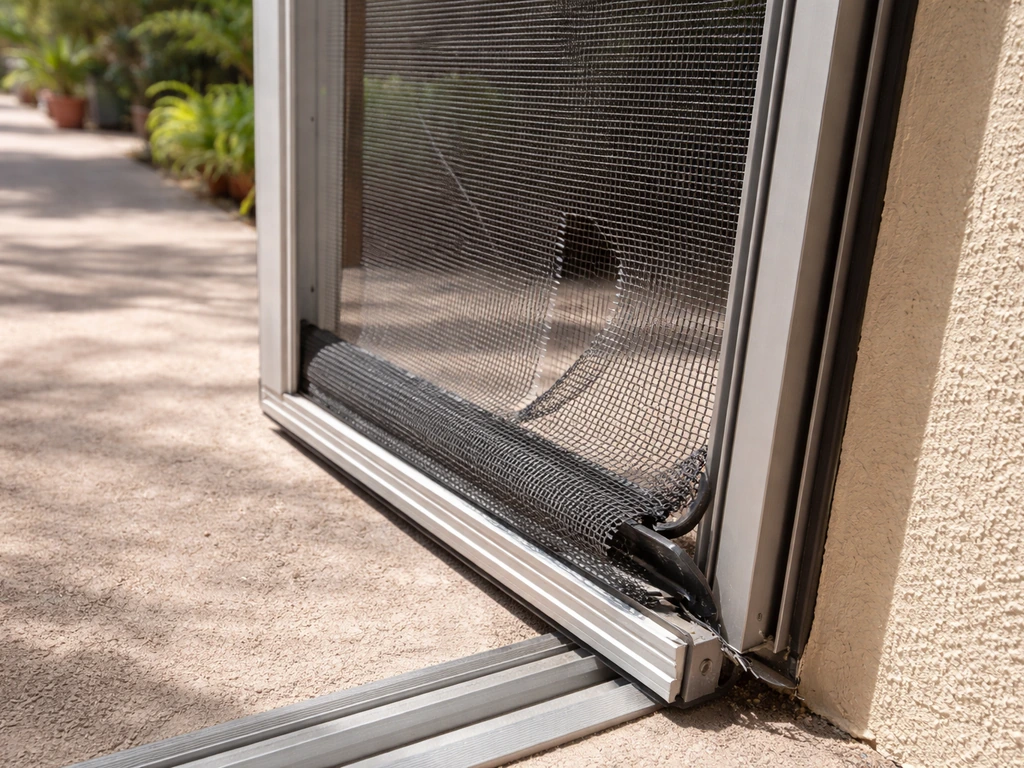
Roller wheel diameters and housing heights vary across manufacturers, with common sizes at 1.0", 1.25", and 1.5" wheel assemblies. Adjustable roller housings are sold specifically because worn or incompatible rollers are one of the most frequent retrofit obstacles. Replacement rollers and adjustable roller housings are sold as common repair/retrofit items (manufacturers and hardware suppliers offer 1"–1.5" wheel diameters and adjustable heights) Replacement rollers and adjustable roller housings are sold as common repair/retrofit items (manufacturers and hardware suppliers offer 1"–1.5" wheel diameters and adjustable heights).. If you are replacing just the screen panel and not the track, confirm the roller size matches the track channel depth or you will get wobble and poor travel.
Latch types and strike locations
Latch hardware and strike plate locations are brand-specific. A hook latch that works on a Larson screen will not line up with the strike on an Andersen door frame, even if the panel dimensions are identical. When ordering a replacement screen, confirm whether the latch mechanism needs to match the existing strike plate or if you are replacing both.
Header and threshold profiles
The header (top track channel) and threshold (bottom sill) profiles are proprietary on many manufacturer door systems. A replacement screen panel that drops into the top track but will not seat into the threshold, or vice versa, is a common failure mode when buying generic or big-box replacement panels without confirming the profile shape.
Mounting flange and reveal depth
Surface-mount screen systems use a mounting flange that attaches to the face of the door frame. The depth of the frame reveal (how much flat surface is available to mount to) determines whether a surface-mount cassette will sit flush or protrude awkwardly. Retractable screen systems like those from Phantom Screens publish detailed cassette dimensions (for example, a motorized 5.5" housing) and require installers to confirm reveal and cassette depth conditions before ordering, precisely because there is no universal cassette that fits every frame.
Door-style compatibility at a glance
| Door style | Screen type that typically fits | Key compatibility concern | Universal kit available? |
|---|---|---|---|
| Sliding/gliding patio door | Sliding screen panel in matching track | Track profile, roller size, panel width | Limited; adjustable panels fit narrow size ranges |
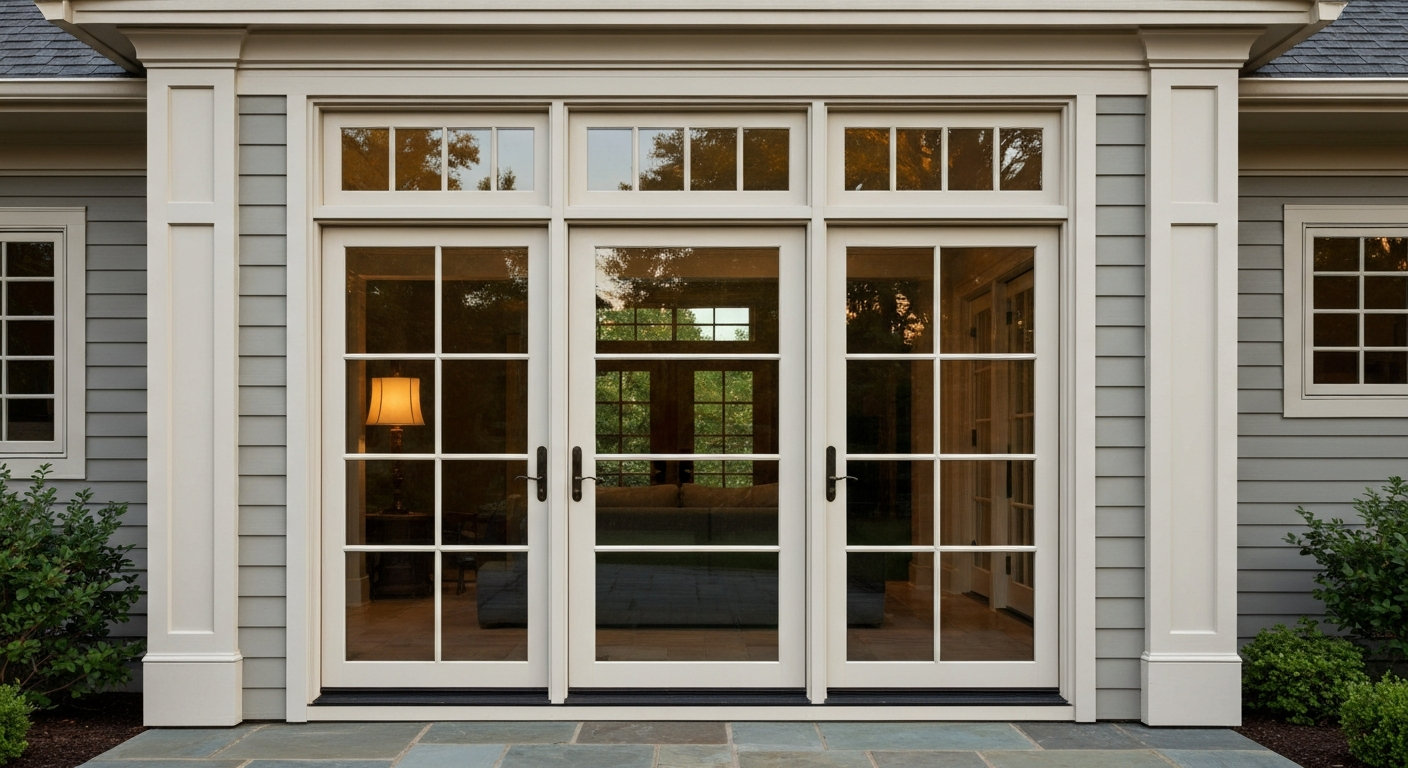
| Hinged/French door (single or double) | Hinged/swing screen door or retractable screen | Swing direction, hinge placement, threshold clearance | Some universal hinged kits for standard 32" and 36" widths |
| Bifold patio door | Retractable screen or magnetic screen | Wide opening span, no standard track for sliding panels | Retractable custom-built; magnetic kits for narrower openings |
| Retractable/large-span door | Retractable screen (custom-built) | Cassette depth, mounting reveal, span limits (up to ~15' wide x 12' high for some systems) | No; custom measurement and installation required |
How to measure your patio opening before buying anything
Grab a steel tape measure, a notepad, and ideally a pair of calipers for track measurements. Work through these steps in order and write every number down before you shop.
- Measure the opening width: Measure the inside dimension from jamb face to jamb face at three heights: near the top, in the middle, and near the bottom. Record all three. Use the smallest number as your working width.
- Measure the opening height: Measure from the top surface of the bottom track (or sill) to the bottom surface of the top track (or header) at two or three points across the width. Use the smallest number.
- Measure the track width (depth): Use calipers to measure the inside channel width of both the top and bottom tracks. Note whether the channels are equal in depth or asymmetric.
- Check the threshold style: Note whether the bottom sill is flush with the floor, raised, or has a step-down profile. Measure the height from the floor to the top of the sill.
- Identify the mount type: Determine whether the existing screen sits inside the door frame recess (insert mount) or attaches to the face of the frame (surface mount). This affects which replacement types will work.
- Confirm swing direction or panel travel direction: For hinged screens, note which side the hinge is on (left-hand or right-hand). For sliding panels, note which side the screen opens toward.
- Photograph the track cross-sections and hardware: Clear photos of the top track profile, bottom track profile, roller housing, and latch strike help when matching parts online or at a hardware store.
- Note the door brand and series if visible: Check the frame edge or threshold for a manufacturer label. Brand and series information lets you search for manufacturer-specific replacement parts, which will fit better than generic alternatives.
Compatibility checklist before you buy
Run through this list for any screen door product you are considering, whether it is a replacement panel, a retrofit kit, or a new screen door system.
- Track width confirmed: panel frame width matches existing top and bottom track channel dimensions
- Jamb-to-jamb measurement matches: panel width is at or below the smallest measured opening width
- Frame type compatible: insert-mount product for recessed frames, surface-mount for flat reveals
- Swing direction or travel direction specified and matches your door
- Panel thickness within track tolerance: frame thickness fits the channel without binding
- Threshold clearance adequate: roller height adjustment range covers your sill height
- Latch type and strike location compatible with your existing door frame
- Header reveal depth sufficient for cassette or frame mounting (retractable systems especially)
- Panel height at or below smallest measured height with roller height adjustment factored in
- Pet resistance or security mesh specified if needed (standard mesh will not hold up to dogs or cats)
Compatible screen types and when to use each
Sliding screen panels
The most common option for sliding/gliding patio doors. The panel travels in the same track as the door. It is the lowest-cost replacement option when the track is in good condition and you can find a panel that matches the track profile. Use this when your existing track is intact, rollers are worn, and the opening is a standard width.
Retractable screens
Retractable screens (also called retractors) coil into a cassette housing mounted to the door frame and pull across the opening when needed. They work well for hinged doors, French doors, bifold doors, and large openings where a sliding panel track does not exist. Phantom Screens, for example, builds these custom to measured dimensions with a motorized option spanning up to approximately 15 feet wide by 12 feet high for door systems. Because they are custom-built, retractable screens require a site measurement and are installed by authorized installers, not off-the-shelf at a hardware store.
Hinged and swing screens
Hinged screens work like a traditional storm door and suit single hinged patio doors and French doors. They are available in standard widths (most commonly 32" and 36") and some adjustable sizes. The hinge side, swing direction, and threshold clearance all need to match your door exactly. Outswing and inswing versions are not interchangeable.
Security and pet screens
Security screens use heavier mesh (typically 17 to 20 gauge stainless steel or aluminum) that resists tearing and forced entry. Pet screens use reinforced polyester or vinyl-coated mesh to resist claw damage. Both are available as drop-in replacement mesh for existing frames or as complete door units. If pets or security are your primary concern, confirm the mesh specification before buying; standard fiberglass mesh is not adequate for either purpose.
Retrofit and universal-kit options
If your door does not have a screen track at all, or if the existing track is too damaged to use, a few retrofit options can add screening without a full door replacement. For a side-by-side look at retrofit kits, hinged screens, retractable systems, and other patio screen door alternatives, see our comparison guide.
- Magnetic screen curtains: Two mesh panels held together by magnets along the center seam, attached by hook-and-loop tape around the door frame. No tools required. Works on any door opening but has no frame, gaps at the edges in wind, and will not hold up to heavy use. Best as a temporary solution.
- Spring-tension and tension-rod systems: A rod-mounted mesh panel held in place by spring tension between door jambs. Similar to a window tension rod. Fits a modest range of widths and heights. Not suitable for openings wider than about 40 inches.
- Telescoping frame kits: Adjustable aluminum frames that expand to fit a range of opening sizes, then accept a replacement mesh panel. Sold at big-box retailers in common size ranges. The LARSON Brisa retractable screen, for example, is marketed as 'universal/reversible' but its product page lists a specific fit range (a 36" model fits door widths roughly 32" to 36") rather than every door.
- Adjustable track adapters: Add-on track pieces that attach to an existing door frame to accept a screen panel where no screen track exists. Compatibility depends heavily on frame material and reveal dimensions; aluminum frames adapt more easily than vinyl or wood.
The honest reality about universal kits is that 'universal' means 'adjustable within a published range.' Every product has a maximum and minimum width and height, and most have frame-profile requirements. Read the fit range on the packaging as a hard specification, not a guideline.
Fit kit, universal kit, custom replacement, or full door replacement: how to decide
Most homeowners can follow a straightforward decision path based on what is actually broken or missing and what measurements reveal.
- If the existing screen track is intact and the frame is in good shape, start with a manufacturer-matched replacement panel or a roller/hardware repair. This is the lowest-cost path and usually the best fit.
- If the track is intact but the panel size is non-standard or the brand is unknown, measure the track and opening precisely, then try a telescoping adjustable frame kit sized to your smallest measurement. Confirm the fit range on the label before purchasing.
- If there is no screen track and the door is a standard hinged, French, or sliding door, a retrofit hinged screen door (for hinged/French) or a surface-mount retractable screen kit (for sliding or bifold) is usually the right move.
- If the opening is unusually large, non-rectangular, or if the door is bifold or multi-panel, a custom-built retractable screen measured and installed by an authorized installer is the practical solution. Off-the-shelf kits will not cover the span reliably.
- If the door frame itself is damaged, rotted, or severely out of square (more than 1/2" deviation across the opening), no screen panel or kit will perform well. A full door replacement makes more sense than repeatedly fighting a bad frame.
Recommended solutions by door style and common problem
| Door style / problem | Recommended solution | Notes |
|---|---|---|
| Sliding door: screen drags or sticks | Replace rollers (1.0"–1.5" wheel assemblies, adjustable housing) | Clean track first; rollers are the most common cause of drag on older sliding screens |
| Sliding door: screen falls out of track | Check track width with calipers; replace panel with correct frame width or add track filler strip | Worn tracks can sometimes be shimmed; severely bent tracks need replacement |
| Sliding door: sill gap at bottom | Adjust roller height to raise panel; add bottom pile weatherstrip to panel frame | Pile weatherstrip is sold by the foot at hardware stores and cuts to length |
| Hinged/French door: gap at threshold | Add door sweep to screen panel bottom; confirm threshold height and adjust hinge placement | Threshold ramps can help with uneven floors |
| Hinged/French door: no screen at all | Install hinged swing screen door (standard 32" or 36") or surface-mount retractable screen | Confirm swing direction (inswing vs. outswing) before ordering |
| Bifold or large-span opening | Custom retractable screen measured on site | Systems like Phantom cover spans up to ~15' wide x 12' high |
| Pet damage to existing screen mesh | Re-screen frame with pet-resistant mesh (reinforced polyester) or replace with pet screen panel | Re-screening a frame costs significantly less than a new panel |
| Security concern | Replace mesh with 17–20 gauge stainless or aluminum security mesh, or install a security screen door unit | Security screen doors are heavier and may require stronger hinges |
Typical cost ranges and installation guidance
Costs vary based on door style, screen type, and whether you install yourself or hire a pro. The ranges below are conservative estimates for materials and typical labor in the United States as of mid-2026. Local labor rates and material costs will shift these numbers.
| Screen type / solution | DIY material cost | Installed (pro) cost | Notes |
|---|---|---|---|
| Replacement sliding screen panel (standard size) | $40–$120 | $100–$250 installed | Big-box retailers stock common sizes; custom panels cost more |
| Roller replacement (parts only) | $10–$30 per pair | $75–$150 with labor | Easy DIY if you are comfortable removing the panel |
| Magnetic screen curtain | $20–$60 | DIY only (self-install) | Not suitable as a permanent solution |
| Telescoping/adjustable frame kit | $50–$150 | $100–$200 installed | Confirm fit range before purchasing |
| Hinged swing screen door (standard) | $60–$200 | $150–$350 installed | Includes hardware; labor varies by market |
| Retractable screen (single door, custom) | $300–$700 | $500–$1,200 installed | Custom-measured and installed; motorized versions higher |
| Retractable screen (wide/bifold opening) | $600–$1,500+ | $1,000–$3,000+ installed | Span and housing type drive cost significantly |
| Re-screening existing frame (fiberglass mesh) | $10–$25 DIY | $50–$100 with labor | Pet or security mesh costs more per linear foot |
| Full patio door replacement with screen | $500–$2,500+ (door unit) | $1,500–$5,000+ installed | Reserved for structural or severely damaged frame situations |
DIY installation is reasonable for replacement sliding screen panels, roller swaps, hinged screen doors, and re-screening. Retractable screen systems, especially motorized or wide-span versions, benefit from professional installation because cassette alignment and track tensioning are exacting and mistakes are expensive to undo. If you are unsure about any measurement or mounting condition, getting a pro measurement quote usually costs nothing and can save you from buying the wrong product. For local professional help, search patio screen repair Lake Worth to find measured-site installers and service providers in the Lake Worth area.
Maintenance, simple repairs, and when small fixes will restore function
Most sliding screen door problems are maintenance issues, not replacement issues. Before you spend money on a new panel, work through this short checklist. A screen that drags, sticks, or falls off the track can often be fixed in under an hour with cleaning supplies and a few hardware-store parts.
- Clean the track: Vacuum out debris, then wipe the track channel with a damp cloth. Grit in the track is the single most common cause of a dragging screen.
- Lubricate the track and rollers: Apply a dry silicone spray or a small amount of PTFE lubricant to the track channel and roller housing. Avoid WD-40, which attracts dirt.
- Adjust roller height: Most sliding screen panels have an adjustment screw on each bottom corner that raises or lowers the roller. Raising the roller slightly lifts the panel and reduces bottom-track drag.
- Re-screen torn mesh: A screen frame re-screening kit costs $10 to $25 and the job takes about 30 minutes with a spline roller tool. This is always worth trying before replacing the whole panel.
- Replace worn pile weatherstrip: The fuzzy pile strip along the panel edges that seals against the frame compresses over time. It is sold by the foot and is easy to peel-and-stick into the existing channel.
- Tighten or adjust the latch: A latch that does not engage is usually misaligned by 1/8" to 1/4". Loosen the latch mounting screws, shift the latch body until it lines up with the strike plate, and retighten.
If cleaning, lubrication, and adjustment do not resolve the problem, replacing rollers is the next step before buying a new panel. Replacement roller sets cost $10 to $30 and require only a screwdriver and a few minutes to swap. A new panel is warranted only when the frame itself is bent, the track is damaged beyond shimming, or the mesh is beyond re-screening.
When to choose a custom replacement
Custom replacement makes sense when none of the standard or adjustable options cover your opening, when the aesthetics of a retrofit kit would look out of place on your home, or when structural issues make a full door system replacement the smarter long-term investment. Specifically, consider custom when: your opening height falls outside the standard ranges (outside of 80", 82", 96", 108", or 120" for most brands), your opening width exceeds what adjustable kits cover (generally beyond 96" for most retail options), your door frame is non-rectangular or the opening has unusual trim conditions, or you want a retractable screen that is color-matched to a specific door system. Custom retractable screens are built to the measured opening by authorized installers and are the default solution for bifold patio doors and multi-panel glass wall systems where no off-the-shelf product exists. The higher upfront cost is offset by a proper fit, better long-term function, and typically a manufacturer warranty.
Your buying and decision checklist
Before you purchase any screen door product, confirm you have covered every item on this list. Skipping even one step is how most people end up returning a product or calling a pro to fix a botched install.
- Measure width at three heights, height at two or three points, and use the smallest number for each.
- Measure track channel width and depth with calipers, not a tape measure.
- Identify your door style (sliding, hinged, French, bifold, retractable) and confirm which screen type is compatible.
- Confirm mount type: insert mount or surface mount based on your frame reveal depth.
- Specify swing direction or travel direction for the replacement product.
- Check panel thickness against track tolerance.
- Confirm roller height adjustment range covers your threshold height.
- Verify latch type compatibility with your existing door frame strike.
- Specify mesh type: standard, pet-resistant, or security based on your household needs.
- Compare the product's listed fit range against your measurements. If your measurements are at the edge of the range, size down or go custom.
- For wide or non-standard openings, contact an authorized retractable screen installer for a site measurement quote.
- If you are unsure whether your door frame is square and sound, have a pro assess it before ordering any screen product.
- Consider patio screening alternatives like retractable awnings or louvered patio covers if a screen door is not practical for your configuration.
- Check manufacturer-specific sizing tables and installation guides before ordering replacement parts to confirm part numbers and roller specs.
Next steps: measure, match, and move forward
Start by doing the measurements outlined above before you look at any product. Write down every number including the track width, because that single measurement eliminates more wrong products than anything else. Once you have your dimensions, use them to filter options by size range: replacement sliding panel if the track is intact and a matching panel exists, an adjustable retrofit kit if you are within a standard size range, or a custom retractable screen for anything non-standard or wide-span. If you need help finding the right door sizing reference for your specific brand or want to compare screen costs against other patio protection options like retractable awnings or louvered covers, the rest of this site has detailed guides for each. And if measurements reveal that your door frame itself is the real problem, exploring a full patio door replacement with built-in screening may be more economical over a five- to ten-year horizon than fighting a damaged frame with retrofit solutions. For shade and weather-control alternatives, consider manual louvered patio covers as a durable, adjustable option.
FAQ
Short answer — are patio screen doors universal?
No. Patio screen doors are not universally interchangeable. ‘Universal’ products exist but usually fit only a limited range of sizes and profiles; most manufacturers use different door dimensions, track profiles, thresholds, and hardware that prevent a one‑size‑fits‑all replacement.
Why aren’t patio screen doors universal?
Variations in opening width/height, track/profile cross‑section, threshold/head reveal, jamb/throat depth, roller/wheel dimensions, latch/strike locations and door style (sliding, hinged, bifold, retractable) create many incompatibilities. Manufacturers publish series‑specific size limits and installation details, so replacements must match those variables.
What standard sizing practices exist?
Manufacturers offer nominal standard heights and widths (examples: common heights include 80", 82", 96", 108", 120") but series and panel counts change exact sizes. Standardization is limited to common nominal ranges; exact frame/trim dimensions and required clearances vary by product.
Which dimensional and hardware differences most often block interchangeability?
Key incompatibilities: track cross‑section (single/double or asymmetric), track width and spacing, roller wheel diameter/assembly height, bottom guide geometry, threshold/sill profile and height, head/spacing for retractable cassette, jamb depth and frame thickness, and latch/strike location.
How do I measure my opening for a replacement screen door?
Actionable measuring steps: 1) Decide mount type: inside‑mount (in the frame) or surface/outside‑mount. 2) Measure width at 3 places (top, middle, bottom) from inside face to inside face for inside‑mount — record the smallest. 3) Measure height at 3–5 places from top of bottom track (or finished floor) to underside of top track/head — record the smallest. 4) Measure jamb/throat depth, track width/profile depth, and threshold height. 5) Note door style (sliding/hung/bifold/retractable), panel count, direction of slide, and any obstructions. 6) Photograph tracks, roller housings, and head reveal for hardware matching.
What are the common screen types and compatibility notes?
- Sliding screen panels: must match track width, roller assembly height and bottom/guide geometry. - Retractable/retractor screens: typically custom to opening and mounting (cassette size and mounting reveal matter). - Hinged/swing screens: need correct hinge screw pattern and jamb depth; some retrofit frames are adjustable. - Security/pet screens: usually custom or mounted to surface with specific frame attachments; heavier frames may need new jamb reinforcement.