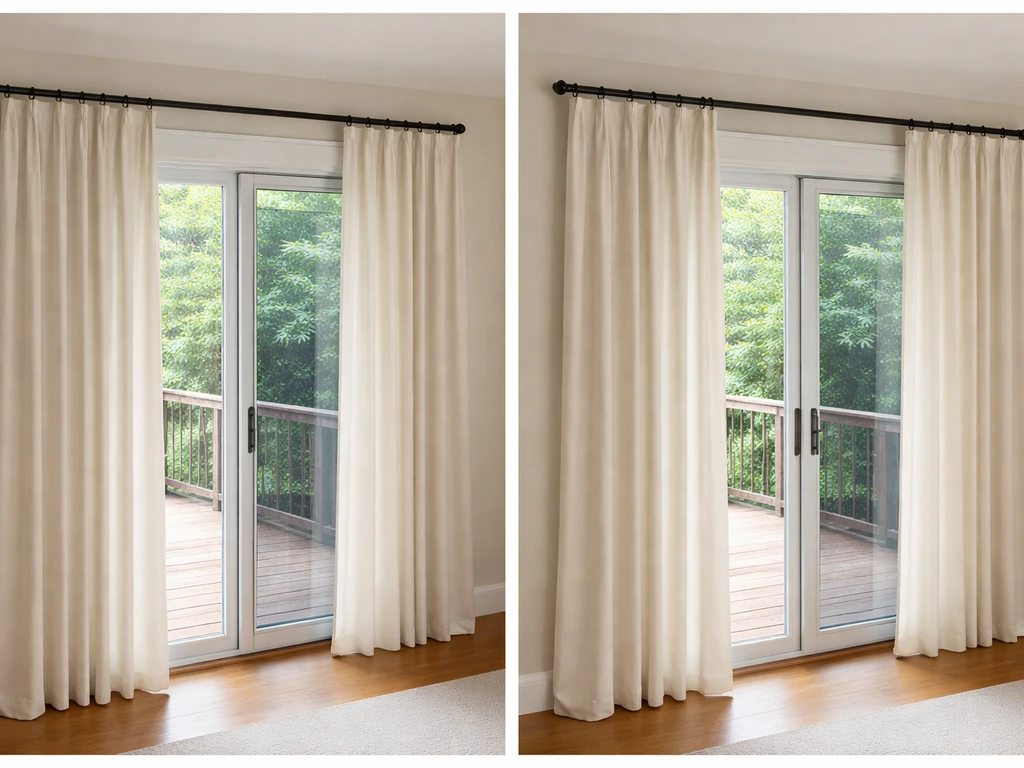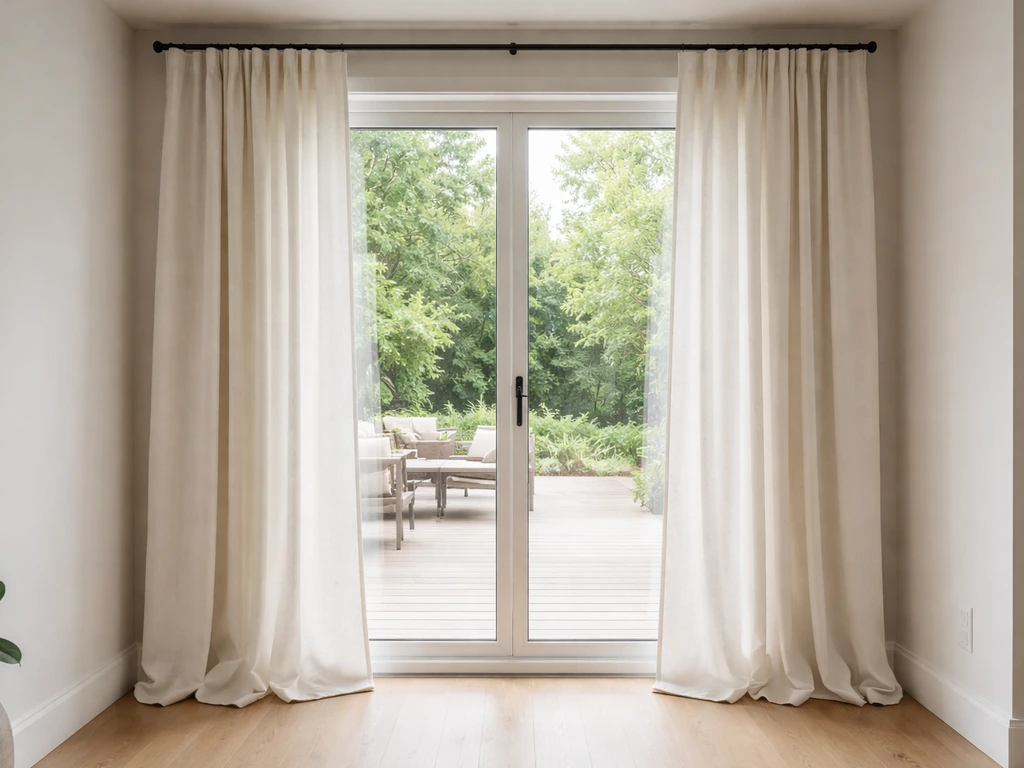
For most patio doors, you'll need either 2 or 4 curtain panels. A standard 72-inch sliding door covered by a rod spanning about 100–110 inches takes 2 panels for a basic look or 4 panels for a fuller, more layered appearance. French doors almost always call for 2 panels (one per door) or 4 panels if you want a dramatic, gathered look. The exact number depends on your rod width, your target fullness (how gathered you want the fabric to look), and whether you need curtains that actually move to operate the door or just frame it. If you are wondering what length curtains you need for a patio door, panel width and rod span are only part of the story what length curtains for patio doors.
How Many Curtain Panels for Patio Door: Sizing Guide
Owen Delaney
24 May 2026
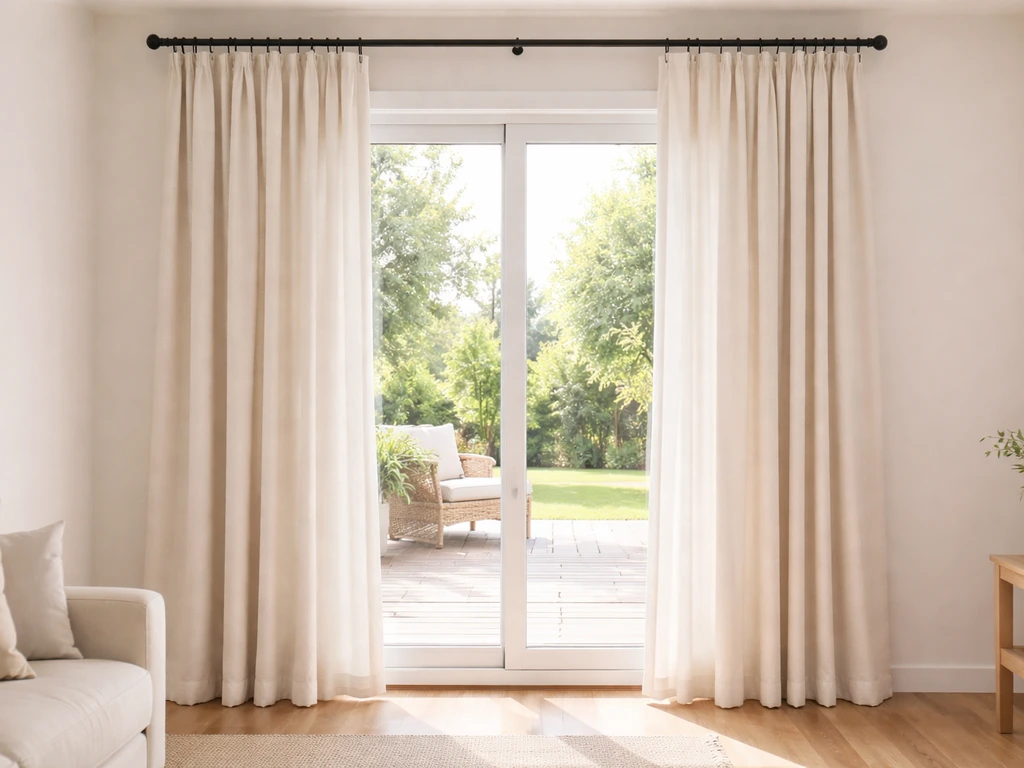
Panel count depends on rod span, not just door width
Here's the thing most people get wrong: they measure the door and stop there. But your curtain math should start with your rod or track width, not the door itself. The rod almost always extends past the door frame, so if you're sizing panels off the door width alone, you'll end up short. Once you have your rod width, you multiply it by your desired fullness ratio to get the total fabric width you need, then divide that by the width of each individual panel to get your count.
The formula looks like this: Number of panels = (Rod width × Fullness ratio) ÷ Panel width. Standard ready-made curtain panels in the U.S. are almost universally 50–54 inches wide. So if your rod spans 110 inches and you want 1.5x fullness, you need 165 inches of total fabric, which means you'd buy 3 panels at 54 inches each (162 inches), or round up to 4 if you want more gather. That rounding-up rule is important: always go to the next whole panel rather than ending up half a panel short.
Measure your patio door first, and decide inside vs. outside mount
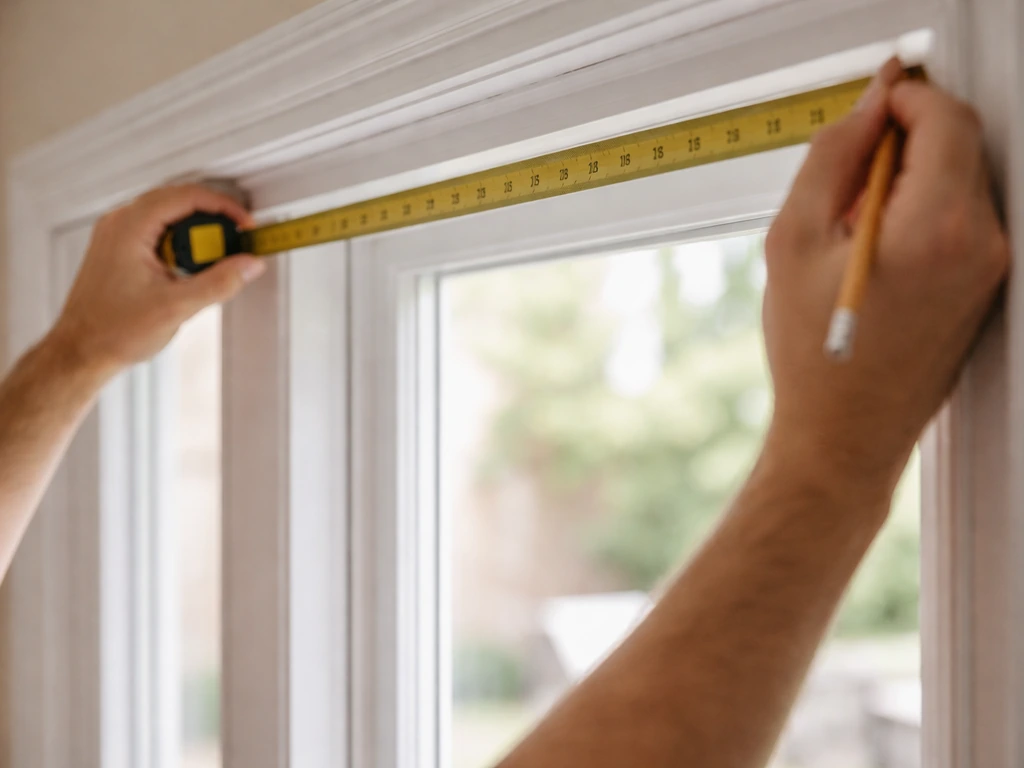
Before you touch the formula, grab a tape measure and settle the mounting question. Inside mount means the rod fits inside the door frame, and you measure from trim to trim. Outside mount means the rod goes above and outside the frame, which is far more common for patio doors because it makes the opening look larger and gives the panels somewhere to stack when the door is open.
For an outside mount, add 4–6 inches on each side of the frame just for coverage and light blocking, then add another 6–15 inches per side for stack-back clearance (so the open panels don't block the door). One measurement guide for outside-mount curtains suggests adding 4 to 6 inches to each side for coverage and light blocking add 4–6 inches to each side. For a sliding patio door especially, I'd lean toward 10–12 inches per side for stack-back since you're literally opening and closing the door every day. That can push your rod well past 100 inches on a standard 72-inch door, which is exactly why panel count climbs quickly.
| Mount Type | Starting Measurement | Add Each Side | Typical Rod Span (72" door) |
|---|---|---|---|
| Inside mount | Inside trim to inside trim | None (rod fits inside) | 68–70 inches |
| Outside mount (standard) | Outer frame width | 4–6 inches coverage | 80–85 inches |
| Outside mount (with stack-back) | Outer frame width | 10–15 inches per side | 95–115 inches |
Sliding patio door panel math
A sliding patio door is essentially one large glass opening, so you're treating the whole span as a single window for curtain purposes. The two most common approaches are: a single rod running the full width of the opening with two panels that draw to the sides, or one panel stacked on a single side to leave the active slide path clear.
Full two-way draw (most popular)

This is the setup most people picture: two panels meet in the center and draw open to opposite sides. For an 80-inch sliding door with a rod spanning about 104 inches (adding 12 inches per side for stack-back), you need 104 × 1.5 = 156 inches of fabric minimum. At 52 inches per panel, that's exactly 3 panels, but since you need an even number for a two-way draw, you'd buy 4. Four panels gives you 208 inches, which is closer to 2x fullness and looks genuinely luxurious. Two panels technically works for light coverage but can look flat and won't give much center overlap.
One-way draw (single side stack)
Some sliding doors are positioned so you only ever open one side, or you want all the fabric stacking to one side for a design reason. In that case you only need coverage for half the rod span once panels are open, and you can sometimes get away with 2 panels instead of 4. Just make sure those 2 panels combined cover the full rod span when closed, use the same fullness math, just know all the fabric will stack to one side when open.
French patio door panel math
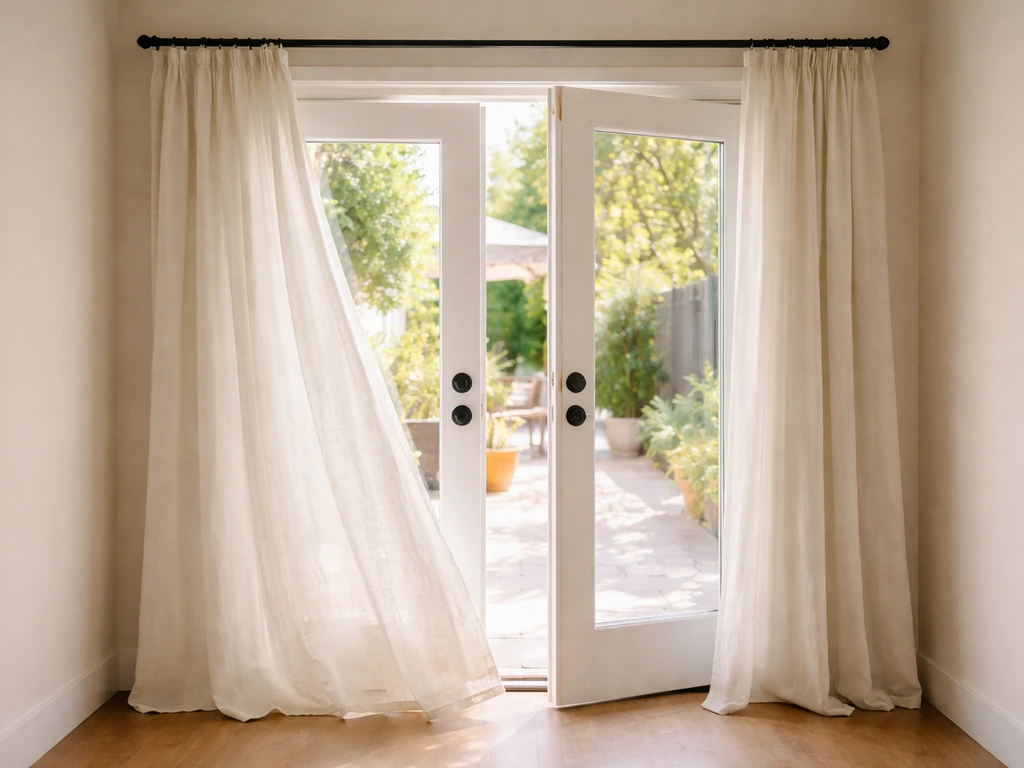
French doors are a different animal. Each door is its own swinging panel, usually 24–36 inches wide, and they swing open into the room (or outward). You have two main options: hang one rod across the full door opening and treat it like a wide window, or mount individual rods or hardware directly on each door so the curtain swings with it.
One rod across both doors
If you mount a single rod above the entire French door opening, the panel math is the same as any wide window. A standard French door pair spans about 60–72 inches. Add 12 inches per side for stack-back and coverage, and you're at an 84–96 inch rod. At 1.5x fullness, you need 126–144 inches of fabric, which typically means 3 panels, but again, round up to 4 for a centered, symmetrical look. Two panels per side keeps things balanced when they're open. For a formal, layered look with sheers underneath (at 2–2.5x fullness), 6 panels total isn't overkill.
Panels mounted on each door (door-mounted rods)
If you attach rods directly to the doors themselves, each door gets its own curtain that swings with it. This is a clean look but you need to keep the panels short enough not to drag. Here, you measure each individual door leaf width (typically 24–30 inches) and apply your fullness ratio to get fabric per door. At 1.5x fullness on a 30-inch door leaf, you need 45 inches of fabric, which is basically one 50-inch panel per door, so 2 panels total. For fuller coverage on both doors, 2 panels per door (4 total) gives a more traditional French door aesthetic. Make sure panels are evenly matched for symmetry; mismatched fullness between the two doors looks off.
How fullness rules translate into panel count
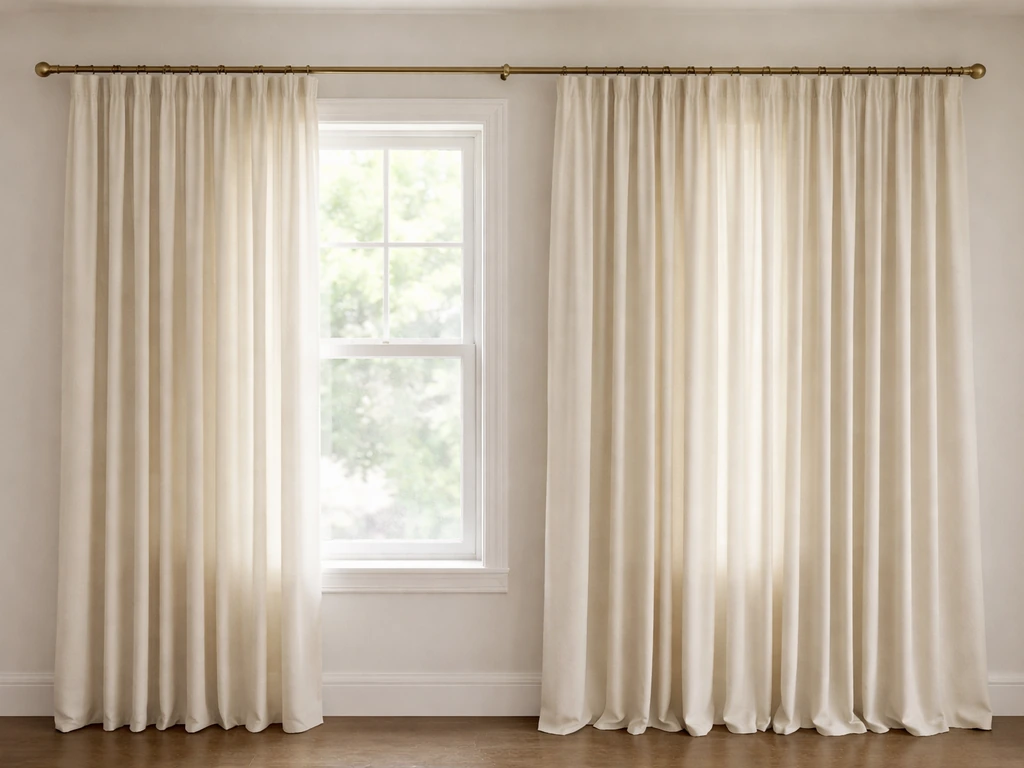
Fullness is the multiplier that separates a skimpy flat curtain from a rich, layered drape. The industry standard range is 1.5x to 2.5x the rod width, depending on fabric weight. Simply Windows also advises measuring from the rod (not just the window) and using a fullness ratio commonly around 1.5x, 2x or higher for sheers before dividing by the number of panels you plan to buy How Wide Should Drapery Panels Be for Perfect Coverage.
| Fabric Type | Recommended Fullness | Look/Feel |
|---|---|---|
| Sheer or lightweight | 2.0x–2.5x | Airy, flowing, romantic |
| Medium weight (unlined) | 1.75x–2.0x | Soft folds, relaxed look |
| Heavier/lined or blackout | 1.5x–2.0x | Structured, formal, better insulation |
| Thermal or interlined | 1.5x | Dense, energy-blocking, minimal gather |
Blackout and thermal drapes in particular need enough width to ensure the center seam overlaps generously. A skimpy 1.5x fullness with blackout fabric can leave a light-leaking gap right down the middle, which defeats the whole purpose. I'd go 2x minimum for blackout panels on a patio door, especially since the door glass is so large. For the best thermal drapes for patio doors, focus on blackout coverage that also helps cut drafts and heat loss blackout panels on a patio door.
Here's the practical panel count math at a glance for a rod spanning 100 inches and panels that are 52 inches wide: Once you know your rod span and chosen fullness ratio, you can determine the right curtain rod size for your patio door and how many panels you need to match it.
| Fullness Target | Total Fabric Needed | Panels Required (at 52" each) | Buy This Many |
|---|---|---|---|
| 1.5x | 150 inches | 2.88 | 4 panels |
| 2.0x | 200 inches | 3.85 | 4 panels |
| 2.5x (sheers) | 250 inches | 4.81 | 6 panels |
Overlap, center meeting, and whether panels actually need to move
If your curtains need to draw open and closed on a traverse rod, you need to account for center overlap. The standard allowance is about 5 inches total (2.5 inches per panel) so the panels genuinely overlap at the center rather than just barely touching. Without this, even a slight movement leaves a gap. Add those 5 inches to your rod measurement before doing your fullness math.
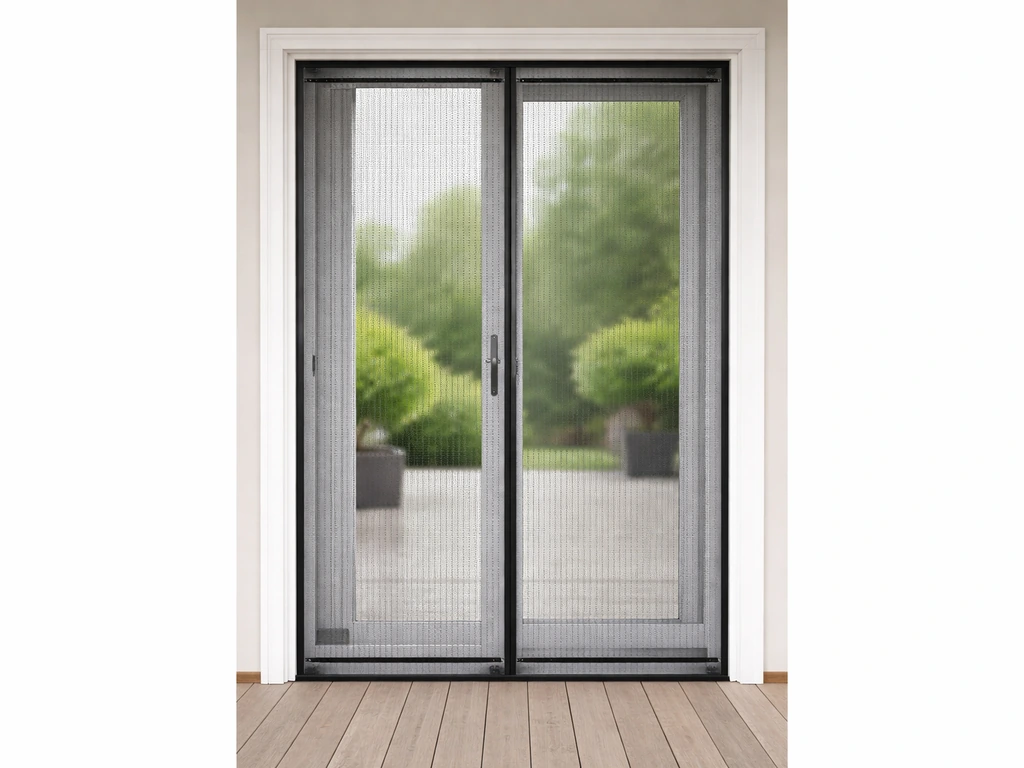
If you're using a stationary rod and the curtains are purely decorative or stay pushed to the sides, overlap allowance isn't a concern. But you still need enough total width to cover the glass completely when closed. Many patio door curtain setups fall into this category: panels stay parted 90% of the time and are only pulled closed for privacy at night, so they live permanently stacked at the sides. If you're shopping specifically for bug curtains for patio doors, the same rod span and panel-count math applies so the fabric covers properly while still working with how you open the door. In that case, prioritize stack-back clearance in your rod extension over center overlap math.
For sheers, which are often layered behind heavier drapes, a two-way draw with center overlap matters most since sheers typically cover the door full-time. If you're layering (sheers plus drapes), count panel quantities separately for each layer and add them together for your total purchase.
Real examples and a before-you-buy checklist
Example 1: Standard 72-inch sliding patio door, outside mount
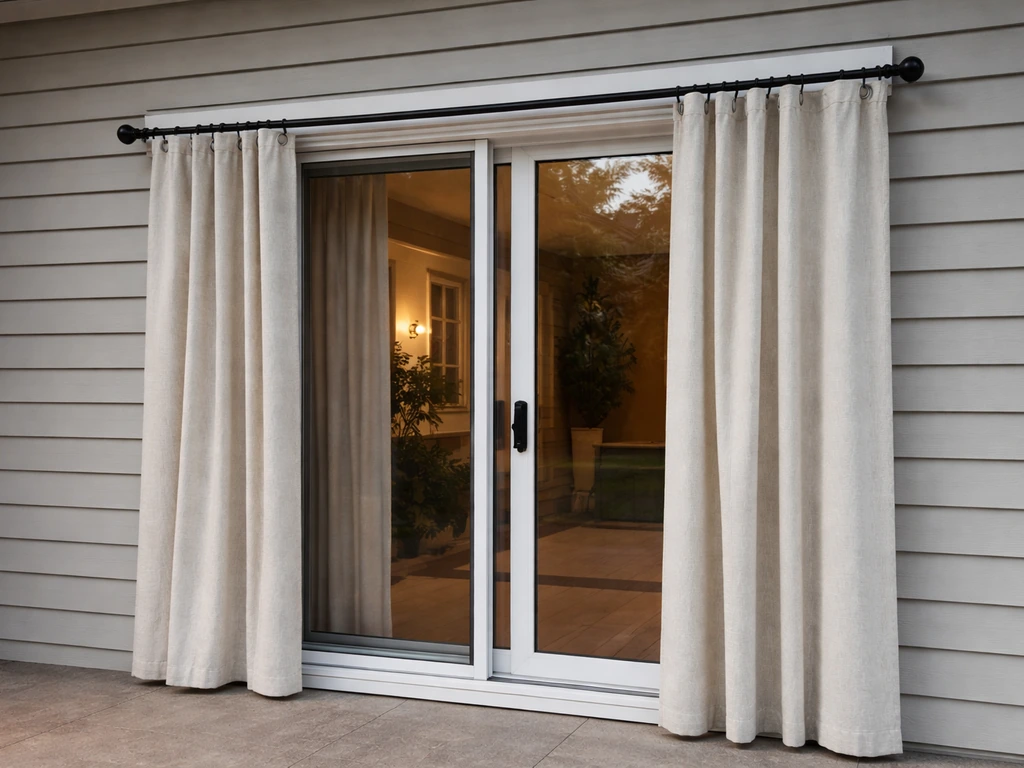
Door width: 72 inches. Rod placement: 12 inches per side for stack-back plus 4 inches per side for coverage. Rod span: 72 + 32 = 104 inches. Add 5 inches for center overlap: 109 inches. Target fullness for medium-weight lined panels: 1.75x. Total fabric needed: 109 × 1.75 = 191 inches. Panels at 52 inches wide: 191 ÷ 52 = 3.67. Buy 4 panels. Two panels draw to each side.
Example 2: French door pair (60-inch opening), single overhead rod, sheers
Door pair width: 60 inches. Rod extended 10 inches each side for clearance: 80 inches. Fullness for sheers: 2.5x. Total fabric needed: 80 × 2.5 = 200 inches. Panels at 54 inches wide: 200 ÷ 54 = 3.7. Buy 4 panels. Two sheers per side, symmetrical.
Example 3: French doors with door-mounted rods, blackout panels
Each door leaf is 30 inches wide. Fullness for blackout fabric: 2x for center overlap protection. Fabric per door: 30 × 2 = 60 inches. Panels at 52 inches: 60 ÷ 52 = 1.15. Buy 2 panels per door, 4 panels total. This gives each door 104 inches of fabric across 30 inches of glass, plenty of overlap and no light bleed.
Before you order: confirm these things
- What is your actual rod span in inches (measured after deciding on mount type and stack-back extensions)?
- Are you doing inside mount or outside mount? Outside mount almost always results in a longer rod and more panels.
- What is the stated panel width on the packaging? Don't assume 52 inches — check the label.
- What fullness do you want? Sheers need 2–2.5x. Heavy blackout drapes work at 1.5–2x.
- Does the rod draw open (traverse rod) or are panels stationary? Add 5 inches to rod span for center overlap if drawing.
- Do you need an even number of panels for symmetry? Almost always yes for patio doors.
- Are you layering sheers and drapes? Count each layer separately.
- For French doors: are panels mounted on the door or above it? Door-mounted means one or two panels per leaf; overhead rod means treat it like a wide window.
- Are you between panel counts? Always round up to the next even number — never try to stretch fewer panels.
Getting the panel count right before you buy saves a real headache. Curtains are often sold in pairs, so accidentally ordering 3 panels when you need 4 means a second trip or an unmatched dye lot. Run through the checklist above, confirm your rod length, pick your fullness ratio, and the math will give you a confident number every time. If you're shopping for privacy and bug-free airflow, look for the best fly curtains for patio doors that match your mounting style and panel count. You can use these same steps to narrow down the best curtains for a patio door, whether you’re buying for a sliding setup or French doors best curtains for patio door.
FAQ
Do I need an even number of curtain panels for a patio door?
Often yes for a two-way draw where panels meet at the center, most commonly 2 or 4 panels. If your setup is one-side stacking (everything gathers to one side), you can use an odd total if it covers the full rod span when closed, but make sure you still have enough fabric width for your chosen fullness.
What if my ready-made panels are not 50–54 inches wide?
Use your actual panel width, not the standard. In the formula, replace the assumed 52 or 54 inches with your panel’s stated width, then round up to the next whole panel to avoid ending short.
How do I calculate panel count if I’m using track-mounted curtains instead of a rod?
Measure the usable track span for where the curtain can travel, then apply the same fullness math to that span. If the track causes curtains to bunch differently than a rod (common with traverse systems), keep your overlap allowance in place so the center seals when closed.
Do I need extra fabric width for blackout vs sheer when counting panels?
Yes. Blackout typically needs fuller center overlap to prevent light gaps, so a higher fullness target (commonly around 2x) is safer. Sheers can sometimes use slightly lower fullness if the sheers are layered behind drapes, but count each layer separately.
How much should I add to my measurement when I mount outside the frame?
A common approach is 4–6 inches per side for coverage and light blocking, plus extra stack-back room (often 10–12 inches per side for frequently used sliding doors). If you have wide trim or a wall obstruction, measure the actual space your stacked fabric will occupy and adjust accordingly.
Can I buy fewer panels if I’m only closing them for privacy at night?
Yes, sometimes. If curtains mostly stay stacked to the sides and only close fully when needed, you still need enough total width to cover the glass completely when closed, but you may not need the same luxurious center overlap you would for all-day fully drawn coverage.
What happens if I end up with slightly too few panels?
The most visible problem is reduced fullness, which can look flat and can expose gaps at the center seam, especially with blackout. If you’re between two counts, rounding up is usually the better visual and functional choice.
How do I handle a sliding door where the panels interfere with the opening route?
If the door handle or leading edge requires a clear path, prioritize stack-back clearance on the working side. Use the rod extension guideline as a starting point, then verify with a test placement or by checking how much curtain fabric will sit where the door travels.
Should I count panels differently for layered looks (sheers plus drapes)?
Yes. Treat each layer as its own purchase quantity, calculate panel count for the rod span for sheers and separately for the drapes, then add totals. Don’t assume you can share panel counts across layers, because each layer needs its own fullness and coverage.